1.1 Nature of Economics
 Call Kai
 Learn
 Practice Test
 Spaced Repetition
 Match
 Flashcards
 Knowt Play
1/31

Earn XP
Description and Tags
Follows the edexcel a level economics a specification
32 Terms
the 4 factors of production
land, labour, capital, enterprise
the 3 economic agents
consumers, producers, government
ceteris paribus
all other things being equal
positive statement
objective statements that can be tested and evaluated based on empirical evidence
normative statement
subjective statements that carry one or more value judgements about what ought to be
the economic problem (scarcity)
matching limited resources to unlimited wants and needs
renewable resources
commodities which are inexhaustible or replaceable over time
non-renewable resources
commodities which cannot be renewed or replenished
opportunity cost
the value of the next best alternative forgone
capital goods
goods used to make consumer goods and services
example: machines and equipment
consumer goods
goods used to satisfy our needs and wants directly
(these goods are used for final consumption)
example: food, clothing, electronics
production possibility frontier (PPF)
shows the maximum combinations of output that an economy can produce when its resources are fully and efficiently employed

points on, inside and outside a PPF curve

opportunity cost on a PPF
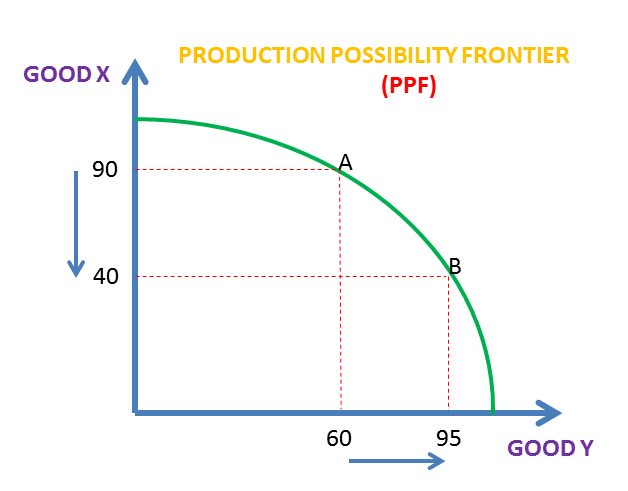
Opportunity Cost of Moving from Point A to Point B:
To produce more of Good Y we have to forgo (90-40=50) of Good X, gaining us (95-60=35) of Good Y.
Opportunity Cost is forgoing 50 units of Good X to gain 35 of Good Y.
explaining an outward shift of a PPF (economic growth)
Increase in natural resources
Technological advancements
Human capital development
Investment in capital

explaining an outward shift of a PPF for one good
If the technology only improves for good Y then there will only be a shift outwards along good Y’s axis

specialisation
the process where individuals, firms or regions concentrate on producing a narrow range of goods in which they have a comparative advantage
advantages of specialisation
more productivity leads to higher profits
surplus output to be traded
lower prices cause higher real incomes for consumers
disadvantages of specialisation
higher trading costs lead to lower profits
over-reliance on specialists
depletion of resources
division of labour
a form of specialisation where the production process is broken down into separate, distinct tasks, with each worker assigned to a specific task (Adam Smith)
therefore workers achieve ‘learning by doing’
advantages of division of labour
raises output per person as people become more proficient or specialised
increases productivity as time is not wasted switching between tasks
lowers unit costs
disadvantages of division of labour
repetitive strain injury
reduced job satisfaction and boredom
lower quality products
high worker turnover
the barter system
a system of trade where goods and services are directly exchanged for other goods and services without the use of money
problems with the barter system
lack of a double coincidence of wants
lack of a common measure of value
difficulty in making deferred payments
lack of division of goods
difficulty in storing value
money
anything that is generally acceptable as a method of payment when trading goods and services
money is legal tender, so only the central bank of a country has authority to print notes and coins,
types of money: notes, coins, credit/debit cards, cheques
the 4 functions of money
A medium of exchange
A measure of value
A store of value
A standard for deferred payment
free market economies
the majority of resources are owned and controlled by private individuals and firms rather than the state (Adam Smith)
Examples: United States, Singapore
advantages and disadvantages of free market economies
Lower prices as consumers have the priority
Increased competition, innovation and quality
Efficient use of scarce resources
Reduction in quality to increase profits
Monopoly power
Worker and consumer exploitation
command economies
the majority of resources are owned or allocated by the state and the market mechanism only plays a small part (Karl Marx)
Example: North Korea
advantages and disadvantages of command economies
Greater equality
Less unemployment
Resources can be directed quickly towards urgent priorities
Inefficient use of scarce resources
Less innovation
Lower living standards
Black markets
mixed economies
both private individuals and firms as well as the state control the economy (Friedrich Hayek)
Most commonly 40% of resources are owned by the state and 60% by the free market
Example: United Kingdom
advantages and disadvantages of mixed economies
Shares the advantages and disadvantages of both
Increased competition
Resources can be allocated quickly
Increased innovation and quality
Inefficient use of scarce resources
Clashing priorities
Worker and consumer exploitation