neutering and ligating
 Call Kai
 Learn
Learn Practice Test
 Spaced Repetition
 Match
Match Flashcards
 Knowt Play
1/13

There's no tags or description
Looks like no tags are added yet.
Name | Mastery | Learn | Test | Matching | Spaced | Call with Kai | Chat |
|---|
No analytics yet
Send a link to your students to track their progress
14 Terms
castration
neutering of male
orchidectomy
spaying
neutering of femal
ovarioectomy = just overies
ovariohysterctomy = removal of uterus and ovaries
reasons for neutering
health
behaviour
contraception
what are the 2 method of a cat spay
flank
ventral midline
flank cat spay
pros
fast
short convalescence
cons
if something goes worng you cant sort it out so must convert to midline
ventral midline cat spay
pros
full access to abdomen so can deal with any complications
cons
slower
longer convalescence
types of ligations of blood vessels
circumferential/ encircling ligature
halstead transfixed
modified ligature

Circumferential / encircling ligature
1 or 2 ligatures tied around a vessel
need sufficient pedicle to prevent ligature rolling off end
can be made more secure by ligating in a groove created by aretery forcep = 3 clamp technique

Halstead transfixed ligature
more secure than circumferential
can only be used with fine suture material/ smaller vessels

Modified transfixed ligature
enables use of thicker suture material/ larger vessels

friction knot ligation
In some situations the tissue to be ligated is under too much tension for the double throw of a surgeon’s knot to hold
This is particularly common when ligating the ovarian ligament in a
bitch spay
Consequently we need a knot with more ‘friction’. In surgery these
are referred to as friction knots (or colloquially as binding knots)
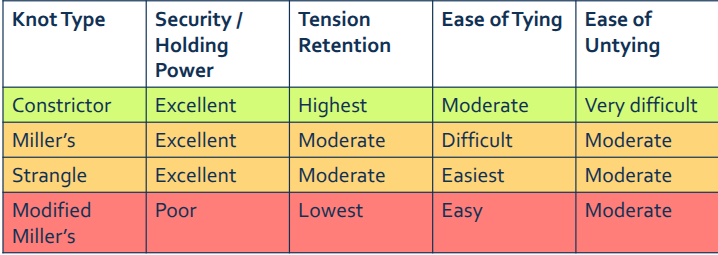
Miller’s knot
Strangle knot - This is sometimes INCORRECTLY referred to as a Modified Miller’s knot, but it’s not! There is another knot called the Modified Miller’s knot which we do not recommend using for ligation.
Constrictor knot

properties of friction knots
how to check tightness of ligature
There should be ‘blanching’ either side of the ligature
There should be a waist
You should be able to see the knot, but not be able to follow the strands as they should be embedded in the tissue