Chapter 8: Alkenes & Alkynes
 Call Kai
 Learn
 Practice Test
 Spaced Repetition
 Match
 Flashcards
 Knowt Play
1/67

There's no tags or description
Looks like no tags are added yet.
68 Terms
Addition Reactions:
usually exothermic
Binary acids =
HCl, HBr, HI
Addition of H-X to alkenes:
Binary acids like HCl, HBr, & HI can add across alkenes
Markovnikov’s rule
Markovnikov’s rule =
the hydrogen adds to the carbon that already has the most hydrogens → “the rich get richer”

Regioselective Reactions:
A reaction that can yield two or more constitutional isomers (generally one is preferred) — will have major and minor products
Exception to Markovnikov’s Rule:
When the reaction of an alkene with HBr is carried out in the presence of peroxide, the Anti-Markovnikov product dominates
Peroxide =
ROOR
Anti-Markovnikov =
poor guy gets rich
3 Types of steps in Radical Reactions:
Initiation
Propogation
Termination
Initiation =
radical created
Propogation =
radical moves
Termination =
radical dies —> sometimes, you don’t see this step
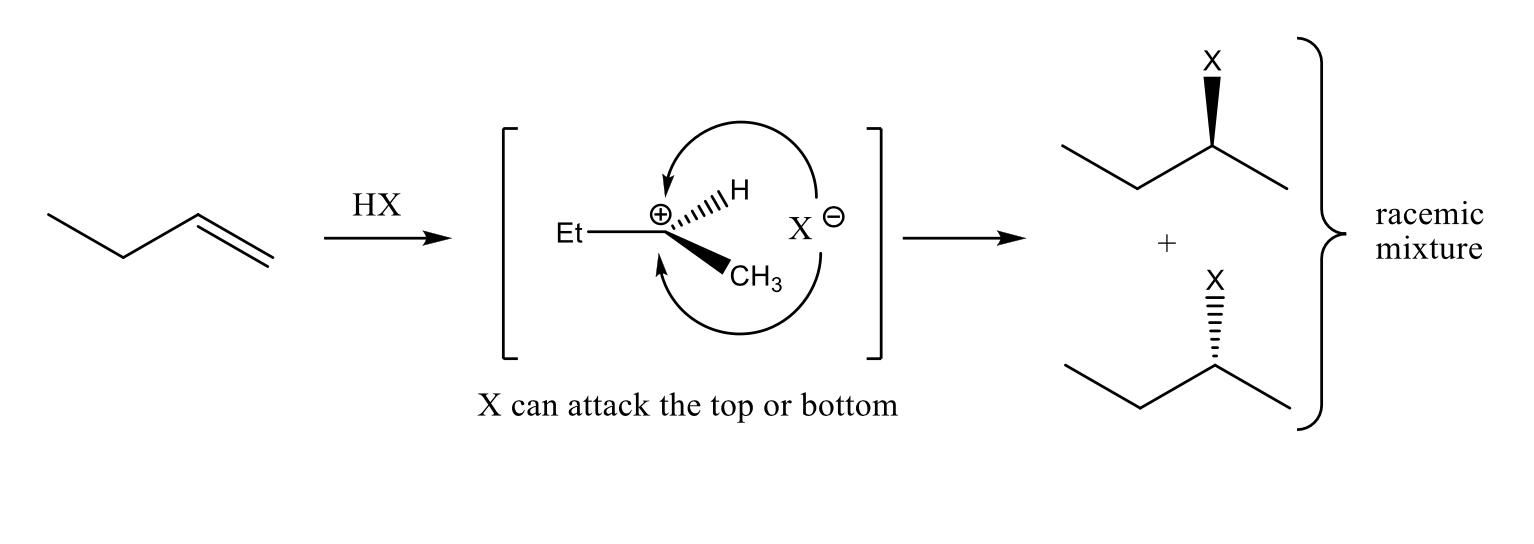
Stereochemistry of Addition to an Alkene:
Carbocation intermediate is susceptible to attack from either side → leads to enantiomers

Hydration of an alkene:
adding H2O to give an alcohol
uses a strong catalyst like H3O+ (H3PO4) or cat.H2SO4
Markovnikov product
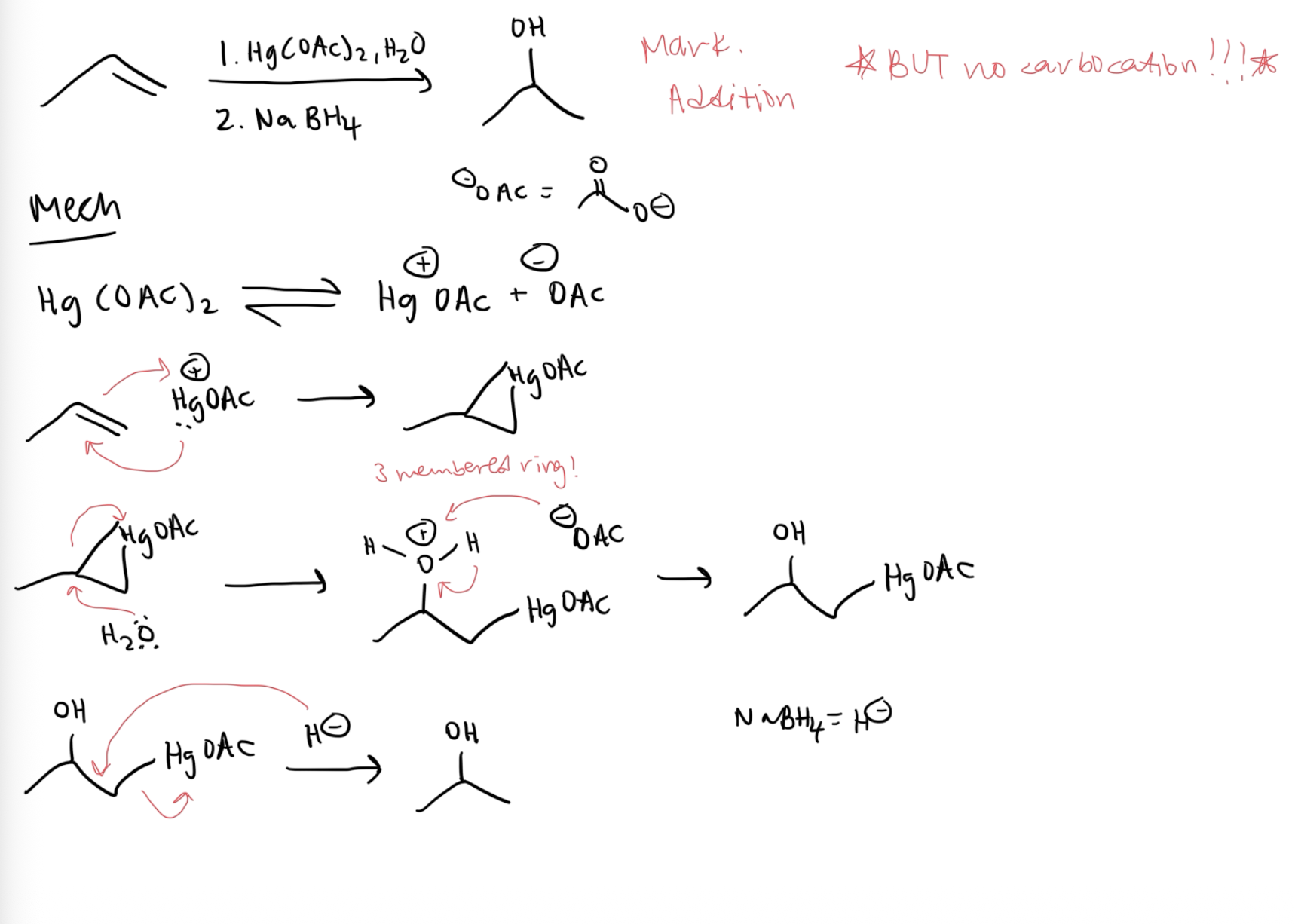
Oxymercuration-Demercuration:
Reaction is initiated by electrophilic addition of Hg2+ ion to the alkene
Gives an intermediate mercurinium ion
Regiochemistry of the reaction corresponds to Markovnikov addition of H2O
No carbocation
Forms 3 membered ring intermediate & water is added to it
Final product will have OH
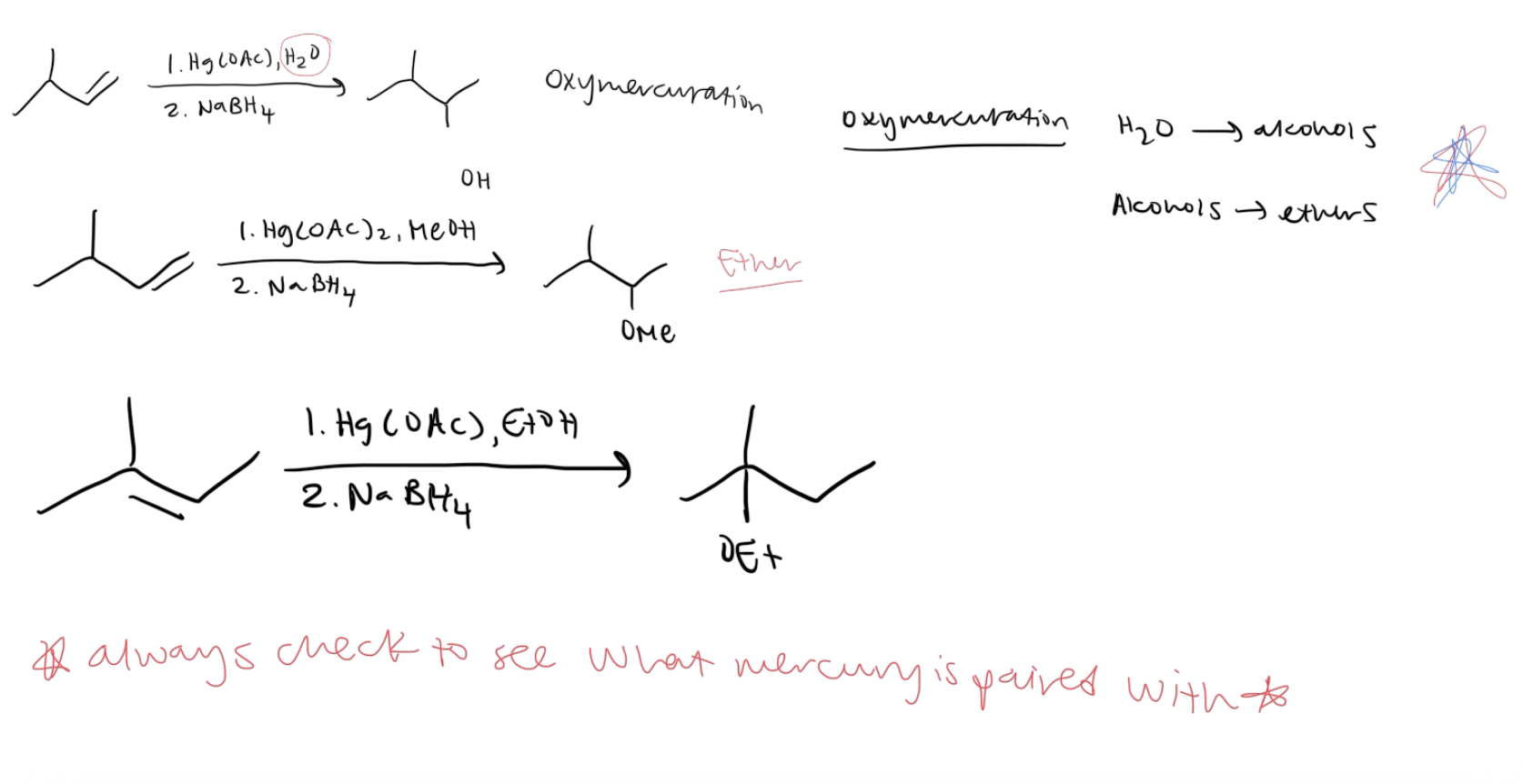
Adding H2O gives:
alcohols

Adding alcohols gives:
ethers

Formation of an alcohol through Markovnikov addition:
image
What is the Markovnikov site?
the sit where the OH attaches — the more substituted C
Hydroboration:
Process involving addition of a B–H bond of borane, BH3, to an alkene to yield an organoborane intermediate, RBH2
Hydroboration-Oxidation:
anti-Markovnikov
Alkene reacts with BH3 in THF solution, rapid addition to the double bond occurs three times and a trialkylborane is formed
syn addition
Regioselective
Non-Markovnikov regiochemistry

What is Deuterium?
a stable, naturally occurring isotope of hydrogen — represented by the symbol ²H or D
Hydroboration-Oxidation: Regioselective
boron and hydrogen add to the alkene from the same face of the double bond with syn stereochemistry
Addition of Halogens to Alkenes:
Halogens (X2) add across the double bond
Halogens will add to the alkene via anti addition
Regioselective & Stereospecific (you’ll only ever get anti addition)

When will enantiomers be present?
when the molecule is chiral
Addition of Halogens to Alkenes: Halogens typically used are
Br & Cl

Halogenation:
Anti stereochemistry: forms the trans stereoisomer
The reaction intermediate is bromonium ion, not a carbocation
Stereospecific reaction =
a particular stereoisomeric reactant reacts by a mechanism that gives a specific stereoisomeric form of the product
In halogenation, what is added?
only a halogen
Id the alkene the halogen is being added to is not chiral:
ex.Cl2 added — each Cl does not have to be on opposite sides
Halohydrin Formation =
both Halogen & H2O added
Water is the solvent & reacts because it is in high concentration
The halogen adds to the carbon with the most hydrogens
anti addition
only ever seen with Cl and Br

Reaction of alkenes with a halogen and water yields a 1,2-halo alcohol, called a:
halohydrin
Carbene =
R2C: Neutral molecule containing a divalent carbon with only six electrons in its valence shell
is sp2 like carbocation and has an empty p orbital
can act as both Nu and Eu
Forming double or triple bonds is done through:
Beta elimination
Ways to make carbenes:
Simmons-Smith Cyclopropane Synthesis
Alpha (α) elimination

When carbenes are generated, something needs to be lost:
from the carbon containing compound over the arrow
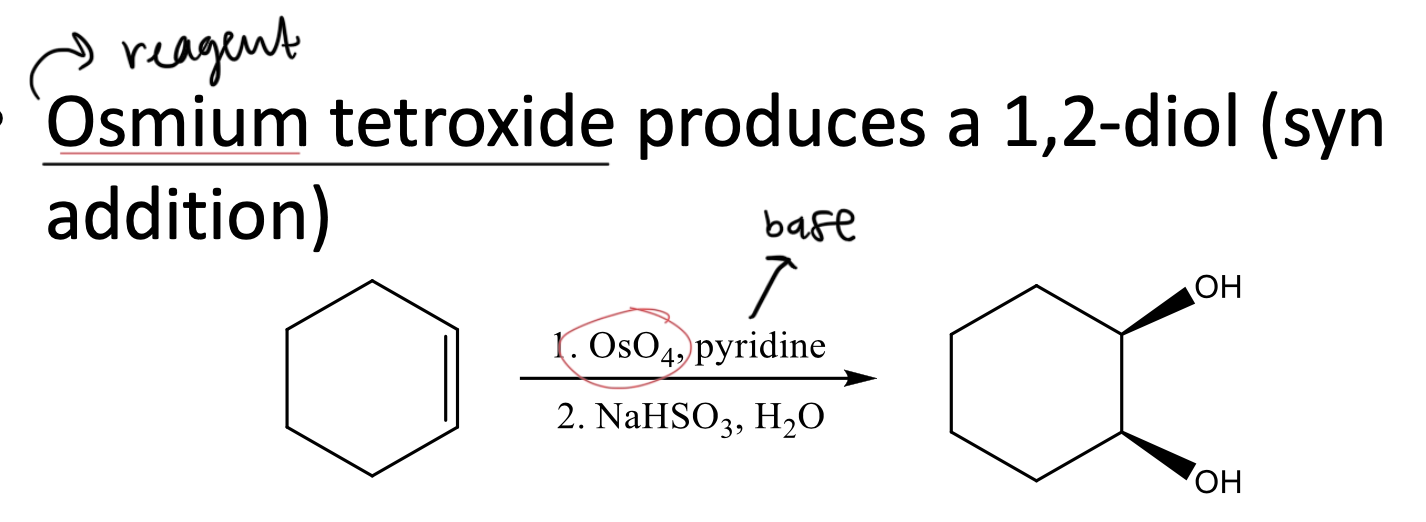
Oxidation of Alkenes: Osmium tetroxide
produces a 1,2-diol (syn addition)
Reduction =
adding H or losing O
Oxidation =
losing H or gaining O

Oxidation of Alkenes: KMnO4 (potassium permanganate)
Cold conditions produces 1,2-diols (syn addition)
Hot conditions cleave the double bond
Cold Basic KMnO4:
acts same as OsO4 & makes a syn diol
Hot acidic KMnO4:
cleaves double bonds
Hot acidic KMnO4 # of Hydrogens on Alkene: 0H
Ketone
Hot acidic KMnO4 # of Hydrogens on Alkene: 1H
carboxylic acid
Hot acidic KMnO4 # of Hydrogens on Alkene: 2H
CO2 gas
Oxidation of Alkenes: Ozonolysis
Double bond cleaved and replaced by C=O

Ozonolysis # of H on C of alkene: 0H
ketone
Ozonolysis # of H on C of alkene: 1H
aldehyde
Ozonolysis # of H on C of alkene: 2H
formaldehyde

Periodic (Per-iodic) Acid:
HIO4 (periodic acid)
1,2-diol is converted to C=O
Cleavage is very molecule specific
Better definition – cleavage occurs between carbons if both bare an oxygen (-OH or C=O)
Periodic Acid cut between:
2 carbonyls, 2 alcohols, carbonyl next to alcohol

For periodic, you can only laso water from:
OH
For periodic, if you take an Oxygen’s hydrogen, it becomes:
a carbonyl
Epoxides are a:
new functional group
a subclass of ether
Epoxidation =
formation of a 3-membered ring that contains oxygen

Epoxides can be formed by:
peroxy acids (RCO3H); peroxy acids do syn addition
What is a simplest epoxide?
an oxirane

In the making of epoxides, where does the oxygen come from?
from the one on the OH
Stereochemistry with epoxidations?
cis alkene = cis
trans alkene = trans

What are the 2 types of ring openings of epoxides?
Basic & Acidic

Epoxide Ring Opening: Basic
SN2 attack — stereochemistry flips
will attack the least hindered site
Epoxide Ring Opening: Acidic
SN2 attack — stereochemistry flips
if tertiary site, attack there
is no tertiary site, attack the least hindered site
Epoxide basic Common Bases:
NaOH, NaOMe, NaOEt

Epoxide acidic Acidic list:
H3O+, cat.H2SO4/MeOH, cat.H2SO4/EtOH, HCl, HBr, HI

Addition of H-X to Alkynes:
Remember: Markovnikov’s rule

Addition of X2 to Alkynes:
Remember: anti addition

Alkynes: Reaction of HBr & peroxide
Anti-Markovnikov addition of HBr

Alkynes: Oxidative Cleavage
usually get carboxylic acids for this
