4 - brain cells + pain
 Call Kai
 Learn
 Practice Test
 Spaced Repetition
 Match
 Flashcards
 Knowt Play
1/48

There's no tags or description
Looks like no tags are added yet.
49 Terms
LOS:
istinguish nociceptive input from pain + identify sensory, integrative + protective responses
describe peripheral nociceptor transduction + afferent fibre types
explain spinal integration + modulation: WDR responses, population coding, sensitisation, inhibition + gating
outline ascending pathways + distributed brain processing + evaluate supporting experimental evidence
revision
Revision:
nociceptor transduction + afferent fibre classes
local/ projecting interneurons + WDR coding
spinal summation, sensitisation, inhibition + gating
ascending pathways + distributed brain processing
good answer - explains how mechanisms work + use research evidence to evaluate claims
Types of neurons (morphology),eg:
1) Unipolar
2) Bipolar
3) Multipolar - short axons
4) Multipolar - long axons
Direction + function eg:
1) Efferent neuron
2) Afferent neuron
3) Inhibitory interneuron
4) Projection neuron (ascending)
5) Projection neuron (descending)
Location + anatomy:
1) Peripheral nerve
2) Spinal cord: relevant circuits
3) Brain – cerebral cortex
4) Brain: relevant distributed regions
5) Brain – brainstem
Neurotransmitters eg:
1) GABA/glycine
2) Glutamate
3) Opioids/Serotonin (5-HT)
4) Noradrenaline
1: neurons - types + functions (recap)
what are the three major purposes of neurons?
1) sensation - afferent neurons: to gather + send information from the senses such as touch, smell, sight etc
2) integration - interneurons: to process all information gathered, thus allowing us to take action
3) action - motor neurons: to send appropriate signals to effectors
→ muscles (cardiac, smooth + skeletal
→ glands
how are neurons classified according to morphology?
according to the number + arrangement of neuronal processes (extensions) emerging from the cell body
what are golgi I + golgi II neurons?
golgi I: multipolar (multiple extensions/ processes) neurons with long axons
golgi II: multipolar neurons with shorter axons that project locally
how are neurons classified according to function?
function classification based on whether conveying messages towards, within or away from the central nervous system
towards: afferent (sensory) neurons (bipolar, unipolar)
within: interneurons, integrate + relay info within CNS (multipolar; short or long
away: motor (efferent) neurons (multipolar; long)
what is the difference between an afferent + efferent neuron?
afferent: carries sensory information towards the CNS
efferent: carries motor information away from the CNS
afferent = arrives at the CNS; efferent = exits the CNS
2) pain – definition + dimensions
how does the International Association for the Study of Pain (2020) define pain?
an unpleasant sensory and emotional experience associated with, or resembling that associated with, actual or potential tissue damage
what are the three dimensions of pain?
sensory: type of stimulus, intensity + location
affective: unpleasantness + emotions
cognitive: attention, memory, expectation + imagination
what are the three main functions of neurons in relation to pain?
1) sensation - detecting + signalling potentially damaging stimuli through sensory neurons eg signalling danger through pain
'nociceptors' - noci → potentially damaging stimulus, ceptor → receiver of sensory info, sensory receptors that detect noxious (potentially damaging) stimuli
1) integration - sensory, emotional + cognitive
3) action - producing responses to potentially damaging stimuli eg withdrawal reflex
what is the withdrawal reflex + how does it requie conscious pain?
an automatic protective response to a harmful stimulus
can occur without conscious pain perception
what pathway is shown in the sensory/ integrative diagram?
nociceptive info travels from peripheral receptors → spinal cord → brain where it is processed
what is the role of the spinal cord in processing pain?
integrates incoming sensory info
contributes to protective reflexes
relays info towards brain
3: peripheral sensory neurons - pain sensing
what are the three main functions of peripheral sensory neurons?
contain receptors (either cellular, eg vision; or molecular, eg pain nociceptors)
translate receptor codes to neural codes
transmit information to CNS
what do they do?
pain-sensing free nerve endings
detect noxious stimuli + inflammation
transmit nociceptive information into spinal circuits
found in the dermis and can extend into the epidermis
contain molecular receptors that detect potentially damaging stimuli
their cell bodies are located in dorsal root ganglia
what types of stimuli can activate peripheral nociceptors?
thermal stimuli (temperature)
mechanical stimuli (pressure)
chemical stimuli
different molecular receptors respond to different types of stimuli
how does nociceptive transduction occur?
1) a noxious stimulus activates molecular channels on free nerve endings
2) channels open, allowing ions to enter the neuron
3) this produces a local generator potential (depolarisation)
4) if threshold is reached, voltage-gated sodium channels generate action potentials
5) action potentials propagate along the afferent axon towards the CNS
what would be included for an essay on peripheral sensory neurons?
(1) explain what nociceptors respond to
(2) how free nerve endings transduce stimulation + conduct action potentials
(3) why fibre properties + central processing matter for pain, molecular channels differ in the stimulus modalities to which they respond; not every receptor detects everything
what are other skin receptors?
merkel: sustained pressure
meissner: dynamic touch/flutter
pacinian: high-frequency vibration
ruffini: skin stretch
what is TRPV1 + what activates it?
transduction channel found in some peripheral sensory nerve endings
activated by capsaicin, noxious heat (above 43°C) + acidic condition
inflammation can sensitise TRPV1
when TRPV1 opens, Na⁺ + Ca²⁺ enter, causing a local depolarisation called a generator potential
if threshold is reached, voltage-gated Na⁺ channels generate action potentials that travel along the axon
this explains why chilli causes a burning sensation without necessarily damaging tissue.
stimulus → TRPV1 opens → Na⁺/Ca²⁺ enter → generator potential → threshold reached → action potential
what is the labelled line theory (specificity theory) of pain?
posits that specific neurons, or "lines," are dedicated to transmitting specific types of sensory information (eg temperature, pressure, or a specific type of pain)
in a simplified labelled-line account, specialised pathways favour particular sensory qualities; conscious pain depends on central processing too
what are the limitations of the labelled line theory?
many neurons are polymodal (respond to more than one stimulus modality)
does not adequately account for neuronal integration + cross-talk in the spinal cord + brain
does not fully explain the complex nature of pain
what evidence supports different peripheral sensory fibre types
peripheral afferent fibres differ in:
diameter
myelination
conduction velocity
these differences influence how quickly sensory information reaches the CNS
what are the four types of peripheral nerve fibres?
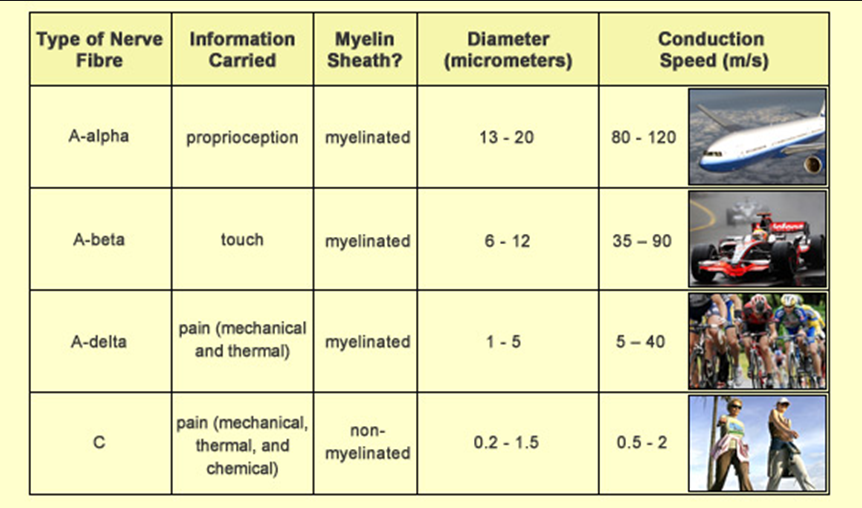
what is the first pain(a-delta)?
earlier, sharper + more localised sensation after a brief noxious skin stimulus
myelinated, for faster signal transmission
eg first pain following brief noxious heat stimulation
what is the second pain (c-fibres)
later, more diffuse burning or aching sensation after the same brief stimulus
unmyelinated, resulting in slower signal transmission
eg second pain following brief noxious heat stimulation
4: spinal neurons
what are the main functions of spinal interneurons?
1) integration of sensory information from the periphery
2) modulation of pain sensitivity
3) initiate automatic motor withdrawal reflexes
4) pass (modulated) information to the brain
what are the main features of spinal interneurons?
can be excitatory or inhibitory neurons (can facilitate or inhibit nociception
include “wide dynamic range (WDR)” neurons, which respond to both pain + non-painful (e.g. touch) sensations
what are the three theories of spinal pain coding?
1) labelled line theory
2) population coding theory
3) combinatorial coding theory
what is the population coding theory of pain?
proposes that co-activation of a number of unspecialised neurons (eg WDR neurons) contributes to the experience + coding of pain
patterns of activity across neuronal populations help encode stimulus strength + spatial extent
how can population coding explain pain intensity?
increasing noxious stimulus intensity can:
recruit more spinal neurons
increase the firing frequency of active neurons
together, these changes contribute to coding the strength of a painful stimulus
how do large, overlapping receptive fields (region of the body from which stimulation changes the activity of a particular neuron) contribute to spatial summation?
same neuron can respond to stimulation at two different locations
stimulation across multiple locations can increase neuronal activity
this increases the likelihood of WDR neurons reaching the threshold for generating action potentials
what is spatial summation?
n increase in pain associated with stimulation across multiple locations or a greater spatial extent
can occur because large, overlapping receptive fields allow the same neuron to respond to stimulation at different locations
what is combinatorial coding theory of spinal interneurons?
proposes that cross-talk between different neurons can modulate pain by increasing or decreasing nociceptive transmission
includes:
central sensitisation - an increase in the responsiveness of spinal neurons to sensory input, can cause normally non-painful stimulation, such as Aβ touch input, to produce pain
gate control
lateral inhibition
what is hyperalgesia?
an increased sensitivity to painful stimulation, where a normally painful stimulus produces an exaggerated pain response
what is the difference between primary + secondary hyperalgesia?
primary hyperalgesia: increased sensitivity to painful stimulation at the site of injury or capsaicin application, peripheral nociceptor sensitisation contributes
secondary hyperalgesia: increased sensitivity to painful stimulation beyond the treated or injured area, associated with central sensitisation
what happens when capsaicin is injected into the skin?
can produce two zones of increased sensitivity:
primary zone: increased sensitivity at the application site, involving peripheral nociceptor sensitisation
secondary zone: increased sensitivity beyond the application site, involving central sensitisation
what is gate control theory of pain?
proposes that non-noxious touch inputs can reduce the transmission of nociceptive information through inhibitory circuits in the spinal dorsal horn
this helps explain why rubbing an injured area can reduce pain
substantia gelatinosa - contains excitatory + inhibitory interneurons involved in modulating nociceptive transmission
what is the proposed role of lateral inhibition in pain?
may sharpen the spatial representation of pain, helping people discriminate the location of a painful stimulus
what is the difference between central sensitisation, gate control + lateral inhibition?
central sensitisation: increases neuronal responsiveness, potentially causing normally non-painful stimulation to produce pain
gate control: touch input recruits inhibitory circuits that can reduce nociceptive transmission
lateral inhibition: inhibitory interactions can sharpen the spatial localisation of pain.
5: brain neurons
what do they do?
receive ascending input (from the spine)
integrate spinal input with existing sensory, affective + cognitive information in the brain – important for the multidimensional perception of pain
initiate motor responses/behaviours
modulate spinal nociception (including the extent of the spinal reflex) depending on cognitive/emotional context
what are their main features?
different anatomical regions contribute to different functions, including sensory, affective + cognitive processing
can have short axons for local processing
can have long axons for communication with other regions, including descending modulation
use neurotransmitters + modulators including glutamate, GABA, endogenous opioids + serotonin
what are the three neurons involved in the simplified spinothalamic pathway?
1) first-order neuron: primary sensory neuron with its cell body in the spinal ganglion; carries information into the spinal cod
2) second-order neuron: spinal projection neuron; crosses via the anterior white commissure + ascends towards the thalamus
3) third-order neuron: thalamic neuron; transmits information towards the cerebral cortex
what is the pain neuromatrix theory:
proposes distributed processing across interacting brain regions
neuromatrix integrates sensory, emotional = cognitive inputs/processes
accounts for the multidimensional experience of pain