ch. 6 mechanical properties

0.0(0)
Studied by 0 people
call kaiCall Kai
learnLearn
examPractice Test
spaced repetitionSpaced Repetition
heart puzzleMatch
flashcardsFlashcards
GameKnowt Play
Card Sorting

1/44

encourage image

There's no tags or description

Looks like no tags are added yet.

Last updated 11:31 PM on 10/1/26
Name
Mastery
Learn
Test
Matching
Spaced
Call with Kai
Chat

No analytics yet

Send a link to your students to track their progress

45 Terms

1
New cards

hooke’s law for stress-strain


<p></p>
2
New cards

tensile stress

tensile force/applied area

<p>tensile force/applied area</p>
3
New cards

shear stress

shear force/applied area

<p>shear force/applied area</p>
4
New cards

torsion

torque/polar moment of inertia

5
New cards

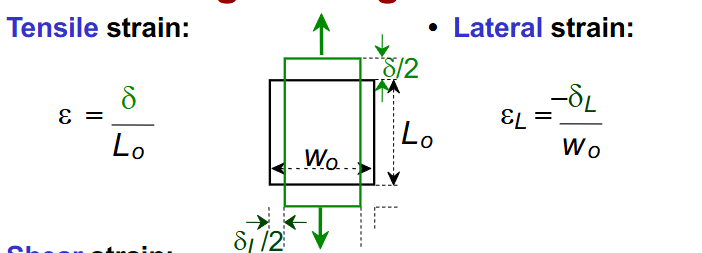
strain

change in length/original length (no units)
<p>change in length/original length (no units)</p>
6
New cards

shear strain

∆x/y=tanθ

<p>∆x/y=tanθ</p>
7
New cards

poisson’s ratio

dimensionless

<p>dimensionless</p>
8
New cards

nature of elastic forces

knowt flashcard image
9
New cards

shear modulus


<p></p>
10
New cards

bulk modulus (K)

knowt flashcard image
11
New cards

relationships between moduli for isotropic materials

knowt flashcard image
12
New cards

stress-strain diagram for tensile testing

knowt flashcard image
13
New cards

yield strength

stress at which a noticeable plastic deformation has occurred

0.2% method

<p>stress at which a noticeable plastic deformation has occurred</p><p>0.2% method</p>
14
New cards

tensile strength

maximum stress on engineering stress-strain curve

15
New cards

fracturing for metal

fracture occurs when noticeable necking starts

16
New cards

fracturing for polymers

fracture occurs when polymer backbone chains are aligned and about to break

17
New cards

percent elongation

knowt flashcard image
18
New cards

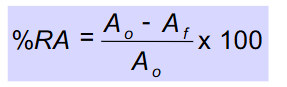
percent reduction of area

at necking point
<p>at necking point</p>
19
New cards

toughness

energy to break a unit volume of material

approximated by the area under stress-strain curve

<p>energy to break a unit volume of material</p><p>approximated by the area under stress-strain curve</p>
20
New cards

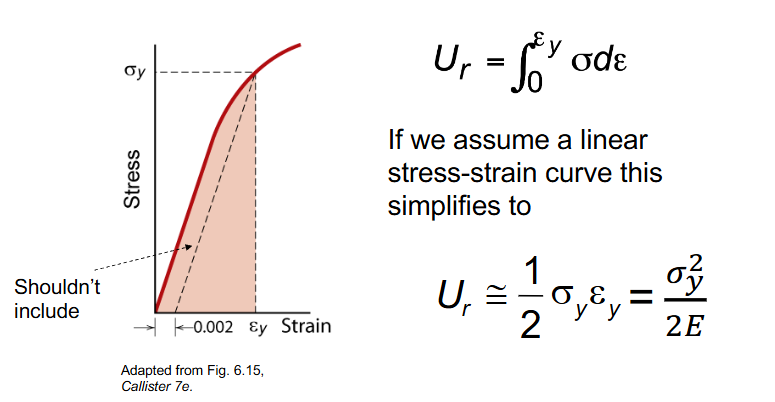
resilience

ability of material to store energy (best stored in elastic region)
<p>ability of material to store energy (best stored in elastic region)</p>
21
New cards

elastic strain recovery

knowt flashcard image
22
New cards

true stress

knowt flashcard image
23
New cards

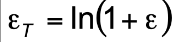
true strain

knowt flashcard image
24
New cards

trues stress-true strain curve

stops at yield point

<p>stops at yield point</p>
25
New cards

strain hardening

as plastic defromation increases, metal becomes stronger

<p>as plastic defromation increases, metal becomes stronger</p>
26
New cards

strain hardening curve fit equation

knowt flashcard image
27
New cards

compression test

necking replaced by barreling due to friction between specimen and the platen

28
New cards

three point bending test

bending stress is higher, but shows greater scatter

<p>bending stress is higher, but shows greater scatter</p>
29
New cards

four point bending test

bending stress is lower, but shows more consistent results

<p>bending stress is lower, but shows more consistent results</p>
30
New cards

hardness

resistance to permanently indenting the surface

large hardness means resistance to plastic deformation in compression, and better wear properties

31
New cards
What are the standard test parameters and units for the Brinell Hardness (HB) test?
Uses a 10 mm diameter steel/tungsten carbide sphere under a 3000 kg load for 10-15 seconds; output units are BHN or kg/mm^2.
32
New cards
What are the major load options and indenter types used in the Rockwell Hardness test?
Major loads are 60 kg (Scale A), 100 kg (Scale B), and 150 kg (Scale C); indenters are diamond cones (A, C) or a 1/16 inch steel ball (B).
33
New cards
What is the general empirical relationship between hardness and yield strength (sigma_y) for metals?
Hardness is approximately equal to 2.5 to 3.0 times the yield strength (sigma_y).
34
New cards
What is microhardness testing, and what maximum load is typically used?
Hardness testing where indentation dimensions are comparable to microstructural features (e.g., individual grains/phases); uses loads of 200 g or less on polished surfaces.
35
New cards
What type of indenter and geometry are used in the Vickers Hardness test?
A square-base pyramidal diamond indenter with an angle of 136 degrees between opposite faces.
36
New cards
What is the formula for Vickers Hardness (HV)?
HV = (2 * P * sin(alpha / 2)) / d^2 = (1.8544 * P) / d^2, where P is load in kg and d is average diagonal length in mm.
37
New cards
What geometry characterizes the Knoop Hardness indenter, and why is it useful?
An elongated diamond pyramid indenter with a 7.11 to 1 major-to-minor diagonal ratio; its shallow impression makes it ideal for testing thin components.
38
New cards
What is the formula for Knoop Hardness (HK)?
HK = (14.228 * P) / L^2, where P is load in kg and L is the long diagonal length in mm.
39
New cards
What are the hardest and softest minerals on the Mohs Hardness Scale?
Softest is Talc (Mohs 1) and hardest is Diamond (Mohs 10).
40
New cards
Why is there notable statistical variability in measured mechanical properties like tensile strength?
Critical failure properties depend heavily on microscopic sample flaws and defects, leading to sample-to-sample scatter.
41
New cards
How are the sample mean (x-bar) and standard deviation (s) calculated for mechanical property data?
Mean is the sum of all x_i divided by n; standard deviation is the square root of [sum(x_i - x-bar)^2 / (n - 1)].
42
New cards
What is the formula for working stress (sigma_working) using a factor of safety (N)?
sigma_working = sigma_y / N, where sigma_y is yield strength and N is the safety factor (typically between 1.2 and 4).
43
New cards
How do you select a material to minimize elastic deformation in a load-bearing application?
Select a material with a high elastic modulus (E or G).
44
New cards
What defines the onset of plastic behavior in a material during a tensile or compressive test?
Plastic (permanent) deformation occurs when the uniaxial stress reaches the yield strength (sigma_y).
45
New cards
What is the definition of toughness in material mechanical behavior?
The total energy required to break a unit volume of material, represented by the area under the stress-strain curve up to fracture.