Lecture 11 - AFO Biomechanics
 Call Kai
 Learn
 Practice Test
 Spaced Repetition
 Match
 Flashcards
 Knowt Play
1/12

There's no tags or description
Looks like no tags are added yet.
13 Terms
How the solid ankle AFO affects gait at the ankle during initial contact
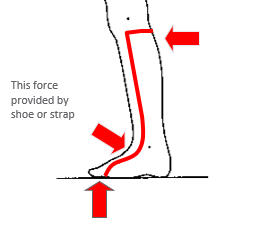
Substitutes for dorsiflexors
The AFO holds ankle in neutral position both in the sagittal and frontal planes to prepare for loading, prepositions the foot/ankle
How the solid ankle AFO affects gait at the ankle during loading response
The AFO substitutes for eccentric contraction of dorsiflexion that occurs due to the plantar flexion moment that is created when the weight line is posterior to the anatomical ankle joint
prevents foot slap at loading or foot flat position at loading
The weight line moves anterior to the pivot point (where heel contacts ground – not anatomical ankle)
causes the tibia to be pushed forward; the plantar surface is drawn to the floor, which results in a knee flexion moment.
Note: The magnitude of this floor reaction force can be controlled by the design of the trim lines at the ankle.
How the solid ankle AFO affects gait at the ankle during midstance
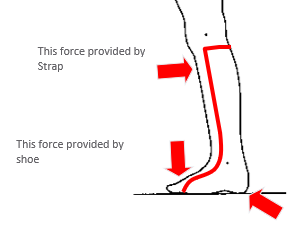
The AFO aids in stance limb progression (forward progression of the tibia) by holding the ankle in neutral or dorsiflexion
Throughout Midstance with the weight line now being anterior to the anatomical ankle joint the AFO substitutes for Plantarflexor muscles and stabilizes the tibia.
controls tibial progression and reduces vertical drop (changes in the center of gravity), which ultimately results in reducing energy expenditure.
How the solid ankle AFO affects gait at the ankle during Terminal stance:
AFO continues to substitute for plantarflexors and limits excessive dorsiflexion (slows/controls tibial progression).
How the solid ankle AFO affects gait at the ankle during Preswing
AFO continues to substitute for the plantarflexors and stops dorsiflexion and creates heel rise.
How the solid ankle AFO affects gait at the ankle during Swing
The AFO substitutes for dorsiflexor muscles and assists to clear the foot
How the solid ankle AFO affects gait at the ankle during Terminal Swing
Pre-position foot for Initial Contact
Stance Phase: Preventing Dorsiflexion (substituting for Plantarflexors)
Swing Phase: Preventing Plantarflexion (substituting for Dorsiflexors)
Varus / Valgus control

Effects at the knee
Increases the knee flexion moment at loading response because the GRF is moved posterior to the knee
Increasing dorsiflexion decreases knee stability

Effects at the knee - Genurecurvatum
If genurecurvatum is a result of the patient attempting to increase knee stability due to weak quads (eg. Polio), then SA AFO is contraindicated. This would add to their instability.
Genurecurvatum may be a compensatory mechanism when a patient has weak plantarflexors. The patient is unable to control tibial progression during mid to late stance, and hyperextends the knee for added stability.
Tight plantarflexors may increase the tendency to hyperextend. Plantarflexors may be tight due to muscle imbalance when dorsiflexors are weak. The AFO could hold the foot in neutral and therfore reduce the knee hyperextension. A heel lift could also be built into the AFO to reduce the hyperextension.
Genurecurvatum may be a result of upper motor neuron problems (CP, CVA, TBI, MS) = spasticity, this is an indication for creating knee flexion moment with SA AFO because quad strength is usually good
At midstance the GRF moves anterior to the knee, therefore we lose the mechanical advantage of the AFO to control knee hyperextension.
A tall trimline is critical to producing a knee flexion moment at loading response.

Effects at the knee - Excessive Knee Flexion
If a patient is able to ambulate with knees flexed, this indicates that they have strong Quads. (ie. Weak knee extensors do no result in ambulating with flexed knees)
Weak plantarflexors may result in a crouch gait (knee flexion) because they are unable to restrain forward tibial progression and the ankle remains excessively dorsiflexed
A Dorsiflexion Stop is indicated to prevent tibial progression
Solid Ankle AFOs provide a dorsiflexion stop
