Game Theory Midterm 1 Prep
 Call Kai
 Learn
Learn Practice Test
 Spaced Repetition
 Match
Match Flashcards
 Knowt Play
1/48

There's no tags or description
Looks like no tags are added yet.
Name | Mastery | Learn | Test | Matching | Spaced | Call with Kai | Chat |
|---|
No analytics yet
Send a link to your students to track their progress
49 Terms
Strictly dominates
strategy α strictly dominates strategy 𝛽 if my payoff from my playing α is strictly larger than that from my playing 𝛽, regardless of what others do
Do not play a dominated strategy.
Prisoners’ dilemma
choosing undominated strategies can lead to sub-optimal outcomes
common resources (overabuse)
price competitions (undercut)
joint project (incentive to shirk)
Remedies of PD
credible communication, e.g. contracts → (coordination problem for evil git → indignant angle)
repetition
weakly dominated strategy
gives a player a payoff that is never higher and sometimes lower than another strategy, regardless of what the other player does
Explain the logic behind the outcome of the 2/3 Average Game.
Iterative deletion: repeatedly eliminate guesses that cannot be optimal. Common knowledge of rationality: everyone is rational, everyone knows this, and so on. Since everyone knows guesses above 100 are irrational, they eliminate them, then keep reasoning downward toward 0.
Invasion through the mountain passes (Hannibal and his elephants)
invader doesn’t play weakly dominated strategy
A strategy can be weakly dominated even if the opponent’s best response is uncertain, allowing the invader to eliminate the inferior route without knowing the defender’s choice.
Median-Voter model (chose location on a line)
think: “does my choosing 2 do better than my choosing 1 regardless of what the other candidate chooses?”
iterative deletion of dominated strategies on the “end” of the spectrum
result:
the only strategies that survive are 5 and 6 (all 4 strategy profile combinations, all have payoff of 50)
had there been an odd # of strategies, only the “middle” would have survived

The Median Voter Theorem
Candidates choose the position of the median voter to max votes
What is missing from the median voter model? How is it “too simple”?
• unable to choose (and commit to) positions
• more candidates
• not voting (turnout)
• uniform distribution of voters
• more “dimensions” (e.g., David Leonhardt)
• primaries
• shifting the debate (the “Overton window”)
Best Response
For any belief 𝑝 that you could hold about others’ choices, the best response is the strategy that maximizes your expected payoff given that belief.
• beliefs “rationalize” choices
• beliefs are probabilities over the actions of others.

The Penalty-Shot Game
• with these numbers, no matter what you believe, shooting to the middle is never a best response.
Do not choose a strategy that is not a best response to any belief.
(in reality more variables, e.g. right-footed)

Partnership effort game
given a formula for payoffs in a game, to find the BR function use calculus of one variable.

Partnership game (for b = 1/4)
[the best responses if 𝑏 = 1⁄4]
BR1(s2) = 1 + ¼ s2
BR2(s1) = 1 + ¼ s1
due to iterative deletion of non best-response strategies, both players converge where the best response lines cross: at the “crossing point” each player is playing a BR to the other (i.e. Nash Equilibrium)
At any other point (besides (4/3, 4/3), at least one player could change their effort to improve their payoff in response to the others’ strategy)
if s1* = 1 + bs1* and b = ¼ then s1* = s2* = 4/3
![<p>[the best responses if 𝑏 = 1⁄4]</p><p>BR1(s2) = 1 + ¼ s2</p><p>BR2(s1) = 1 + ¼ s1</p><p></p><p>due to iterative deletion of non best-response strategies, both players converge where the best response lines cross: at the “crossing point” each player is playing a BR to the other (i.e. Nash Equilibrium)</p><ul><li><p>At any other point (besides (4/3, 4/3), at least one player could change their effort to improve their payoff in response to the others’ strategy)</p></li></ul><p></p><p>if s1* = 1 + bs1* and b = ¼ then s1* = s2* = 4/3 </p>](https://assets.knowt.com/user-attachments/3eaf0c06-cb5c-4efd-9dfa-f8adc9a36de0.png)
Nash Equilibrium
A Nash Equilibrium of a game is a set of strategies when no player (firm) has an incentive to unilaterally deviate from the strategy they are playing
each player’s strategy is a best response to the strategies of all other players
can improve their payoff by unilaterally deviating
no one “regrets” their choices

Investor Co-ordination game (more investors, more returns)
• There are multiple equilibria in this game. (Invest,Invest) and ($0,$0)
• The equilibria are “Pareto ranked”
• one is better for everyone than the other
• all could do better if everyone deviated to the “all invest” equilibrium, but no individual can do better by a “unilateral deviation.”
• gains to coördination
Q: is this a prisoners’ dilemma? A: no. It’s a coordination problem

Coordination Problem
a situation where players achieve their highest payoffs by selecting the same or compatible strategies, and mutual success depends on everyone aligning their choices
examples:
primaries help 1 party coordinate on 1 candidate
same meeting places
driving on same side of road
bank runs
solutions (unlike PD):
leadership
contracts
“Battle of the Sexes” (choosing movies to watch on the airplane)
coordination problem with conflicting preferences
scope for leadership and communicaiton but harder when interests are not perfectly aligned
Two “workhouse models” Cournot vs. Bertrand
• Cournot: firms compete by setting quantities (impacting market price)
• Bertrand: firms compete by setting prices(impacting sales for each firm)
Cournot and Bertrand models both assume imperfect competition, but firms compete differently: Cournot firms choose quantities, while Bertrand firms choose prices. Under standard assumptions, Cournot firms charge above marginal cost, while Bertrand competition drives prices down to marginal cost.
Cournot Model
firms compete by setting quantities (impacting market price)
Example: Two oil companies decide how many barrels of oil to produce.
Key idea: Each firm’s production decision affects the market price, so firms account for each other’s output.
illustrates imperfect competition by modeling firms that compete on quantity, each accounting for how its output affects market price and profits, unlike a monopoly where one firm controls total output; each firm has an incentive to produce more to increase its own sales and profits, but not so much that the resulting fall in market price reduces its profits.
makes sense when a small number of firms sell similar or identical goods and compete by choosing how much to produce, such as oil producers or mining companies.
Bertrand Model
firms compete by settingprices (impacting sales for each firm)
Example: Two gas stations sell identical gasoline.
Key idea: Each firm has an incentive to undercut its competitor’s price to attract customers.
Bertrand is not perfect competition because it assumes only a few firms (often two), whereas perfect competition assumes many firms. However, same outcome because each firm has an incentive to slightly undercut its competitor to attract customers.
Cournot Duopoly
two firms produce an identical product
firms compete by setting quantities
how much to sell to keep p high but making max profit?
what is the q of the how is the other firm, and what is the best response to their q? (because goods are “strategic substitutes” - the more I produce the less you want to produce)
Perfect Competition
demand: P = a - bQ
P = MR = MC at the profit-maximizing output, because the firm’s marginal revenue equals the market price.

Monopoly
MR = a -2bQ
The monopolist produces where MR=MC, then charges the price on the demand curve at that quantity.
Unlike perfect competition, P>MR for a monopolist (with a downward-sloping demand curve).

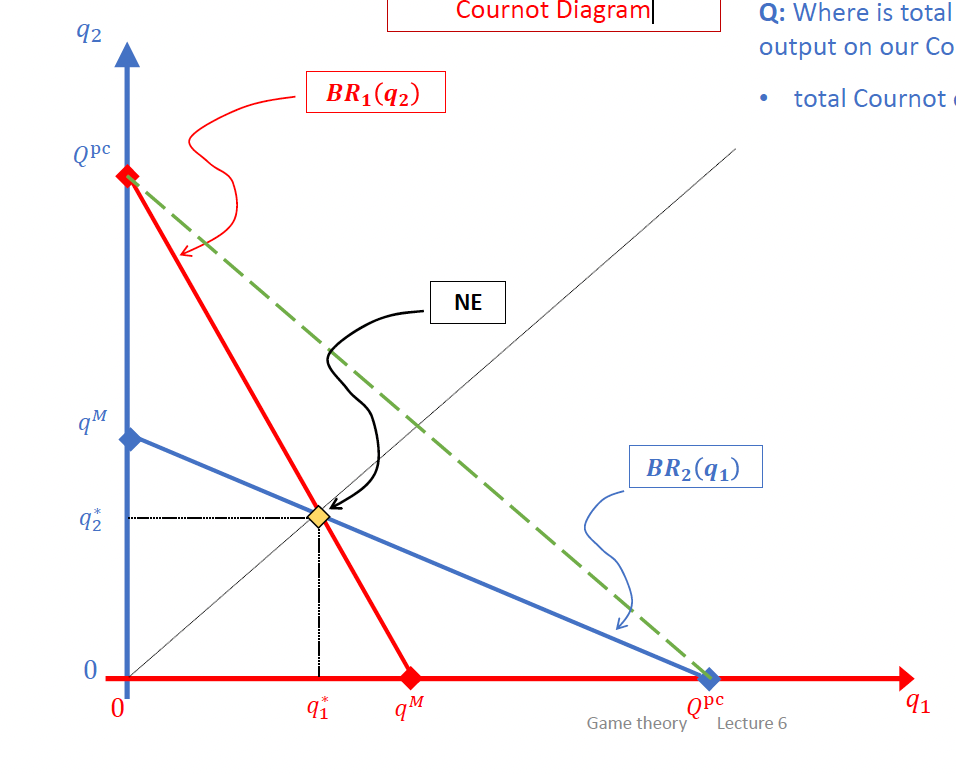
Best Response Diagram: Cournot

Perfect Competition Output on Cournot Diagram
Monopoly Output on Cournot Diagram
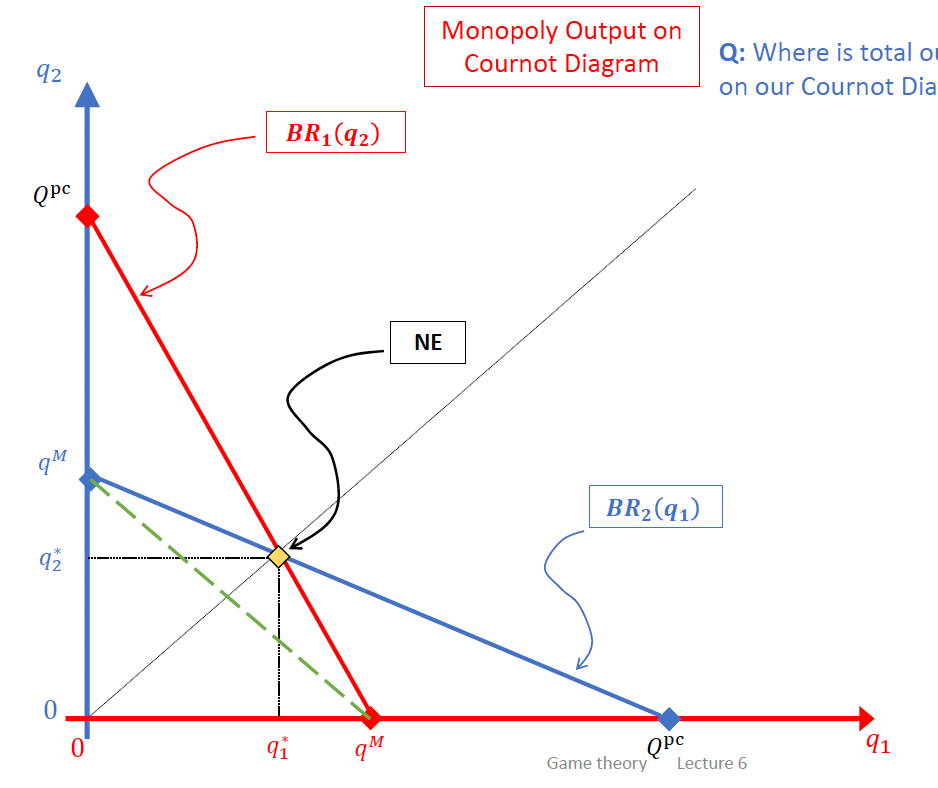
Could two firms agree to split monopoly output in a Cournot Duopoly?
No, because w/o negotiation both firms have a unilateral incentive to deviate to their best response given the other firm’s q. Firms will anticipate this and play their best responses to other firms’ best responses, eventually converging at the N.E.

Bertrand Competition
assume constant marginal costs, same for both firms
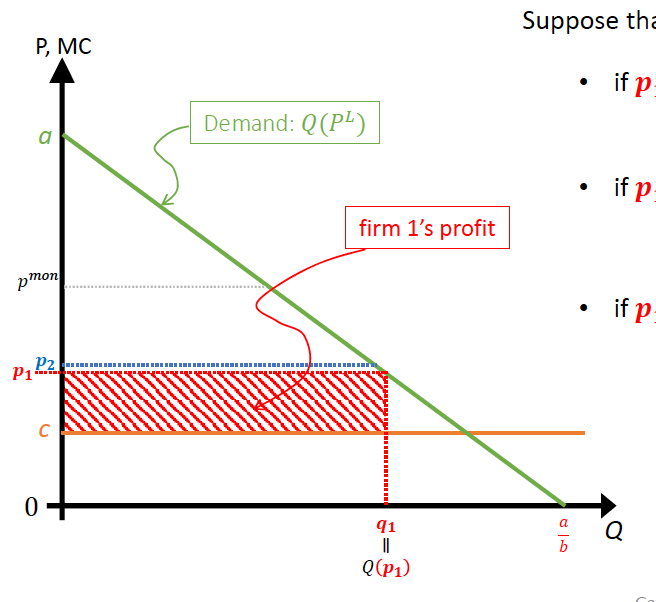
Undercutting: if mc < p2 ≤ p(mon)
• then firm 1’s best response is to set 𝒑𝟏 slightly under 𝒑𝟐 and hence capture the entire market.
N.E. thus at at P = MC, because competition between the firms drive prices all the way down to marginal cost, eliminating all profits
good for consumers, hgih consumer surplus (same as perfect competition)
Linear city price competition with differentiated goods (3)
similar to Bertrand (set price) but products differentiated by location
each firm aims to maximize its profit.
Customers buy from the “cheapest firm” including the transport cost.
think of 𝑡𝑦 and 𝑡1 𝑦 as “transport costs” to “travel” to each firm, in distance
• Key ideas:
• if I undercut your price by a little, I increase my sales but (unlike in the Bertrand model) I do not capture the entire market because my good is not identical to your good.
• the ‘degree’ to which customers switch to my good depends on how ‘close’ together are the goods, and on how much customers care about the differences.
• In Nash Equilibrium, prices will be higher when goods are more differentiated and when customers care more about differentiation (e.g., higher transport costs).

Voter-Candidate Model (chose to enter the election or not)
like median-voter model except
the number of candidates is not fixed (“endogenous”)
candidates choose whether to enter or not
but they cannot choose their positions
• Candidates are voters (“citizens”), and so they care about the position of the winner (Players: every voter is a potential candidate)
Payoffs:
• prize if win = 𝐵
• cost of running = 𝑐 where 𝐵 ≥ 2𝑐 [For today, let us just assume 𝐵 = 2 and 𝑐 = 1]
• if you are at 𝑥 and the winner is at 𝑦, you get -|𝑥-𝑦| disutility (a voter experiences more dissatisfaction the farther the winning candidate’s political position is from their own) -c if candidate x also enters race
By sitting instead of running, a losing candidate, say 𝑦, can benefit in two ways:
• Save the cost of running
• Lower disutility since the winner will be closer to 𝑦
N.E.
Q: is there any equilibrium with exactly one candidate?
A: Yes, if the candidate is exactly at ½.
Q: is there an equilibrium with exactly two candidates?
A: Yes, if both candidates are equally far from the center (but not so far a middle candidate could enter), so each has a 50% chance of winning; running costs money, while dropping out saves money but guarantees the other candidate wins, so neither candidate can improve their payoff by changing their decision. (and no third candidate wants to join because it would cause the less-preferred candidate to win, entering on inside will lose)
Q: Can there be an equilibrium with three candidates 1/6, 1/2, 5/6 ?
A: No, becuase the outside candidate’s expected payoff from running is (-1+2/3=-1/3), equal to their payoff from exiting, so they are indifferent rather than strictly better off staying in the race
• But we can see that if 𝐵 > 𝑐 then this can be an equilibrium.
There are equilibria with more candidates as the expected benefit from winning increases and thecost of running decreases.
![<p><span style="font-family: "Times New Roman", serif;">like median-voter model except </span></p><ul><li><p>the number of candidates is not fixed (“endogenous”)</p></li></ul><ul><li><p>candidates choose whether to enter or not</p></li><li><p>but they cannot choose their positions</p></li><li><p>• Candidates are voters (“citizens”), and so they care about the position of the winner (Players: every voter is a potential candidate)</p></li></ul><p></p><p>Payoffs:</p><p class="p1">• prize if win = 𝐵</p><p class="p2">• cost of running = 𝑐 where 𝐵 ≥ 2𝑐 [For today, let us just assume 𝐵 = 2 and 𝑐 = 1]</p><p class="p3">• if you are at 𝑥 and the winner is at 𝑦, you get -|𝑥-𝑦| disutility (a voter experiences more dissatisfaction the farther the winning candidate’s political position is from their own) -c if candidate x also enters race</p><p class="p3"></p><p class="p3">By sitting instead of running, a losing candidate, say 𝑦, can benefit in two ways:</p><p class="p1">• Save the cost of running</p><p class="p1">• Lower disutility since the winner will be closer to 𝑦</p><p class="p1"></p><p class="p3">N.E. </p><p class="p1">Q: is there any equilibrium with exactly one candidate?</p><p class="p2">A: Yes, if the candidate is exactly at ½.</p><p class="p2">Q: is there an equilibrium with exactly two candidates?</p><p class="p2">A: Yes, if both candidates are equally far from the center (but not so far a middle candidate could enter), so each has a 50% chance of winning; running costs money, while dropping out saves money but guarantees the other candidate wins, so neither candidate can improve their payoff by changing their decision. (and no third candidate wants to join because it would cause the less-preferred candidate to win, entering on inside will lose)</p><p class="p2">Q: Can there be an equilibrium with three candidates 1/6, 1/2, 5/6 ?</p><p class="p2">A: No, becuase the outside candidate’s expected payoff from running is (-1+2/3=-1/3), equal to their payoff from exiting, so they are indifferent rather than strictly better off staying in the race</p><p class="p2">• But we can see that if 𝐵 > 𝑐 then this can be an equilibrium.</p><p></p><p>There are equilibria with more candidates as the expected benefit from winning increases and thecost of running decreases.</p>](https://assets.knowt.com/user-attachments/581346c4-20b7-453f-a172-b9d8149ad7ac.png)
Schelling Location Model
everyone
• likes equally mixed towns the most
• but they prefer being in a majority to being in a minority
There are two Nash equilibria (NE):
Segregated: Each type lives entirely in a separate town (100% of their own type).
Integrated: Half of each type lives in each town (50% of their own type).
In both cases, no individual wants to move unilaterally.
Even mild preferences for living near similar people can lead to segregated communities that are Nash equilibria but not socially efficient, i.e. “segregated”
If the towns start slightly off 50/50, some people may move toward the town with more people like themselves, causing the towns to become increasingly segregated rather than return to 50/50.
It’s a coordination problem because everyone’s outcome depends on where others choose to live, and without coordinating, individual moves can lead to segregation even when integration is possible. (segregation could occur even when no-one wants it)
poilcy: centralized randomization means a central authority randomly assigns people to towns to maintain a balanced mix, preventing individual choices from creating segregation.

mixed strategies
when a player randomly chooses between different pure strategies with specific probabilities
Rock-Paper-Scissors.
can be a NE in mixed strategies but not pure
If you play (⅓, ⅓, ⅓), your opponent earns an expected payoff of 0 from R, P, and S alike, so they are indifferent and have no incentive to deviate from their own mix. If you instead play (½, ½, 0), their payoffs become R: −½, P: +½, S: 0, so Paper is strictly best and they would abandon randomizing.
The indifference principle: in a mixed-strategy Nash equilibrium, each player randomizes in a way that makes the opponent indifferent among the pure strategies they mix over, so no one can gain by deviating.

What is necessary for a mixed strategy profile to be at a Nash equilibrium?
1) Each player must be indifferent among all pure strategies they play with positive probability, and none of the pure strategies they play with zero probability may give a strictly higher payoff. (each strategy in the mix is a best response)
2) one player’s mix must make the opponent indifferent among the pure strategies the opponent plays with positive probability: it must be chosen so that these strategies yield the opponent equal expected payoffs, leaving them no incentive to deviate from their own mix.
Player 1’s equilibrium mix is determined by player 2’s payoffs because player 1 must happen to choose probabilities that leave player 2 indifferent, so player 2 has no strictly preferred strategy and is willing to keep mixing.
player 1’s payoffs (and the fact she must be indifferent) determine player 2’s equilibrium mix
(for NE must be true for both strategies)
(make sure in mix no pure-strategy strictly profitable deviations)
Payoff from a mixed strategy
The expected payoff from the mixed strategy 𝑝𝑖 (probability assigned to si) is the weighted average of the expected payoffs of the pure strategies in the mix, where 𝑝𝑖𝑠 is the weight on 𝑠𝑖.
Venus and Serena tennis game
no pure strategy NE
Venus coach: play to your strengths or their weaknesses?
• The NE is: (0.7, 0.3) , (0.6, 0.4)
Serena is not “trying to make Venus indifferent” per se. But if Serena chose any other mix, then Venus would always choose the same passing shot, which cannot be an equilibrium.
In a game where any predictable choice can be exploited, each player must randomize in exactly the proportions that make the opponent indifferent, so Serena’s 60/40 mix is set by Venus’s payoffs and Venus’s 70/30 mix is set by Serena’s.

Audit Game
no pure strategy NE
• audit rate: genuine randomized strategy
• compliance rate: a population mix of taxpayers, each playing a pure strategy
problem in this game is that auditors cannot commit to audit. therefore, in equilibrium, there needs to be:
• enough cheating to maintain the incentive to audit
• and enough auditing to maintain the incentive to pay tax
Suppose we increase the punishment if caught cheating from -10 to -20.
Q: will this increase the equilibrium compliance rate?
A: No, the equilibrium proportion in compliance is determined by the auditor’s payoffs, which did not change!
rather, the audit rate of the auditor changes and the auditor audits less because the audit rate is “endogenous”, and auditing decreased.
Could we fix auditing rates exogenously (e.g. setting govt quota) but unpopular and takes resources. then circular, “why audit so much if fewer people are cheating?”
Lesson: when NE are mixed, changing payoffs only on one side, only changes equilibrium behavior on the other side.
the rich are audited more often to offset their greater incentive to cheat, keeping them indifferent between cheating and complying

Bystander Effects
1 if the crime is reported but not by her
0 if the crime is reported by her (regardless of whether others report)
-1 if no-one reports the crime
one witness, 100% chance the crime is reported because 0>-1.
(symmetric NE)
probability each individual does not call rises from 0% and approaches 100%
probability that no-one calls rises rises from 25% to and approaches 50%
As the number of witnesses 𝑛 increases, there are two effects:
1. (Good) there are more witnesses who could make a call.
2. (Bad) the free-rider effect gets worse: each individual is less likely to call. The bad effect dominates
Lesson: It can be that the more people witness a crime, the less likely it is to be reported. In equilibrium, free-rider effects can dominate just having more potential individuals.

Vaccination Game
Q: what proportion of population will not get vaccinated in equilibrium?
A: In equilibrium, each person must be just indifferent between getting vaccinated or not
-c = -pD
p* = c/D
1. the proportion of people who will choose not to get vaccine in equilibrium depends on fundamental underlying incentives (specifically 𝑝 ⁄* = c/D in the simple model)
2. this equilibrium proportion of unvaccinated is greater than would be socially optimal
(𝑝∗∗ = c/2D)
• inefficiency is because of externality: the equilibrium is bad for society because people’s choices affect others in ways they don’t account for.
• [worse if some are more likely to spread infection but have low 𝐷]
• policy: reduce 𝑐 by subsidizing vaccination
Nash equilibrium is what individuals choose, not what’s best for society. Here, equilibrium (p*) leaves more people unvaccinated than is socially optimal (p**), which is why the policy fix is to lower c with a subsidy, nudging individual incentives toward the better outcome.
![<p>Q: what proportion of population will not get vaccinated in equilibrium?</p><p>A: In equilibrium, each person must be just indifferent between getting vaccinated or not</p><p>-c = -pD</p><p><mark data-color="yellow" style="background-color: yellow; color: inherit;">p* = c/D</mark></p><p></p><p>1. the proportion of people who will choose not to get vaccine in equilibrium depends on fundamental underlying incentives (specifically 𝑝 ⁄* = c/D in the simple model)</p><p class="p1">2. this equilibrium proportion of unvaccinated is greater than would be socially optimal</p><p class="p1"><mark data-color="yellow" style="background-color: yellow; color: inherit;">(𝑝∗∗ = c/2D)</mark></p><p class="p1">• inefficiency is because of externality: the equilibrium is bad for society because people’s choices affect others in ways they don’t account for.</p><p class="p1">• [worse if some are more likely to spread infection but have low 𝐷]</p><p class="p2">• policy: reduce 𝑐 by subsidizing vaccination</p><p class="p2"></p><p class="p2"><strong><mark data-color="yellow" style="background-color: yellow; color: inherit;">Nash equilibrium is what individuals choose, not what’s best for society.</mark></strong><mark data-color="yellow" style="background-color: yellow; color: inherit;"> Here, equilibrium (p*) leaves more people unvaccinated than is socially optimal (p**), which is why the policy fix is to lower c with a subsidy, nudging individual incentives toward the better outcome.</mark></p>](https://assets.knowt.com/user-attachments/61deac2a-daad-4be3-a204-df4a477154d8.png)
strict best response
stricly hogher payoff than another strategy always
strict NE
strict NE is strategy is strict BR to others’ choices
Evolution and Game Theory
strategies are not chosen by reasoning rational agents, but rather are hard-wired
evolutionary stability
the strategy 𝑠̂ is called evolutionary stable if any small mutation playing a different strategy
will die out (and s’ mutation is es if survives)
defect is ES in prisoners’ dilemma - Nature can “suck”: evolutionary stable does not imply “good”
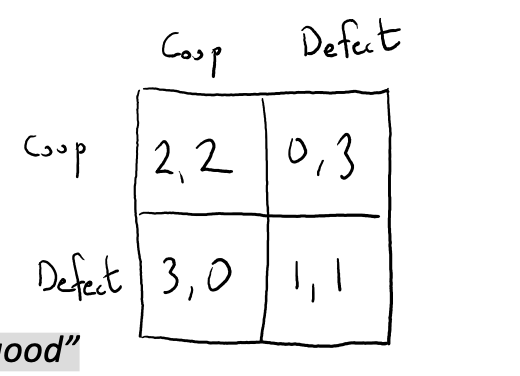
evolutionary stability conditions for incumbent 𝑠̂
ES if…
1) IS strictly dominant: The incumbent vs. incumbent > (strictly) mutant vs. incumbent.
(think: the payoff against incumbents makes up nearly all of each player’s average, and the payoff against mutants is a tiny slice)
a strategy (when incumbent symmetric) MUST be a NE to be ES.
BUT, if incumbent vs. incumbent = the mutant vs. incumbent, 𝑠̂ still ES if…
2) incumbent vs. mutant > mutant vs. mutant
(think: The only place the two groups differ is the rare meetings with other mutants)
a strategy can be a weak NE and be ES if the incumbent strictly dominates mutant against the mutant
(the incumbent’s average payoff against the mixed population is strictly higher than the mutant’s)

To check ES
1) check if nash
2) check if strict
3) if not strict, check incumbent vs mutants to mutant vs mutant
Committee Voting Game (“strength can be a weakness) (1)
Having more power (the tie-break) can be a disadvantage if it makes your best choice predictable, because others then respond to it.
Weak dominance is not strict: voter 1’s b and c are weakly dominated, not strictly, which is why deleting them is risky.
Iterated deletion of weakly dominated strategies can depend on order and can remove strategies that were once used to remove other strategies
Splitting the Dollar (2)
The rules determine the equilibrium. The same bargaining problem has a continuum of equilibria in case (a) and a unique one in case (b).
A weak NE can be strange. (10, 10) survives only because deviating ties instead of strictly improving, which connects to Problem 3(d) on weakly dominated strategies in a NE.
Many NE means you need a selection argument, such as a focal point or fairness.
Details matter. Whole-dollar rounding changes the answer in case (b).
Cournot with beat the competition payoffs (3)
u₁ = (P − c)q₁ − d(P − c)q₂, where P = a − b(q₁ + q₂)
More spite means more output and lower prices. As d rises, each firm produces more, so output goes up and price falls. At d = 1 the outcome equals perfect competition (price = c). (Because producing more hurts your rival’s profit, and a firm with d > 0 counts that as a gain)
Ordering of outcomes (by price, high to low): monopoly > standard Cournot (d = 0) > (0 < d) < 1 > perfect competition (d = 1 for both firms). Output runs in the reverse order.
Firms lose, consumers win. Profits fall toward zero as d rises, and consumer surplus rises. “Beat the competition” payoffs are good for consumers.
Prisoners’ dilemma: at d = 1, each firm’s dominant strategy is to produce the monopoly quantity no matter what, so both do, and the market floods, price falls to cost, and profits vanish, even though both would earn more by colluding.
Dominant strategy simplifies things: at d = 1, each firm’s best output is the same whatever the rival does, so you can read off the answer directly without solving where best-response lines cross.
Method: write the payoff, differentiate to get the best response, then solve where the best responses cross.
On her majesty’s secret service (4)
A strategy can be dominated by a mix. Route b looks reasonable but is strictly worse than a blend of a and d. A strategy that is never a best response, against any belief, is strictly dominated.
The indifference principle again. 002 chooses q = 1/3 so that 001 is indifferent among a, c, and d, and that indifference is what makes 001 willing to mix.
Mixing over three or more strategies can give many equilibria. 001 is indifferent among a, c, and d at q = 1/3, so many mixes work, while 002’s equilibrium strategy is unique.
Check every candidate. Neither player can be in a pure equilibrium, because 002 always wants to switch, so any equilibrium must involve mixing by both players.