Aerodynamics (copy)
0.0(0)
Studied by 2 people Call Kai
 Learn
Learn Practice Test
 Spaced Repetition
 Match
Match Flashcards
 Knowt Play
Card Sorting
1/52

Earn XP
Description and Tags
Last updated 2:23 PM on 1/8/23
Name | Mastery | Learn | Test | Matching | Spaced | Call with Kai | Chat |
|---|
No analytics yet
Send a link to your students to track their progress
53 Terms
1
New cards
Fluid particle
A relatively small mass of the fluid, containing a large number of molecules that will provide a meaningful statistical averages
2
New cards
Kutta Condition
The strength of the vortex sheet at the trailing edge must be zero
3
New cards
Streakline
a line connecting fluid particles that has passed from the same point (Eularian)
4
New cards
Streamline
imaginary lines, which are tangent to flow direction at a given instant of time
5
New cards
Pathline
a trajectory traced out by a fluid particle moving in a flow field (Lagrangian)
6
New cards
Reynolds number
a dimensionless number used in fluid mechanics to indicate whether fluid flow past a body or in a duct is steady or turbulent.
Ratio of inertial forces to viscous forces
When calculating similitudes between a model and prototype the Reynolds number for each must be the same
Ratio of inertial forces to viscous forces
When calculating similitudes between a model and prototype the Reynolds number for each must be the same

7
New cards
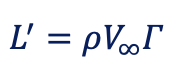
Kutta-Joukowski Theorem
the lift per unit length of a spinning cylinder is equal to the density (r) of the air times the strength of the rotation (G) times the velocity (V) of the air.
8
New cards
dynamic similarity
all forces in the model flow scale by a constant factor to corresponding forces in the prototype flow
9
New cards
Stagnation point
a point in a flow field where the local velocity of the fluid is zero
10
New cards
Boundary layer thickness
the distance normal to the wall to a point where the flow velocity has essentially reached the 'asymptotic' velocity
11
New cards
Separation
reduced lift and increased pressure drag, caused by the pressure differential between the front and rear surfaces of the object
\
A region of recirculating flow
\
A region of recirculating flow
12
New cards
Wall shear stress
expresses the force per unit area exerted by a solid boundary on a fluid in motion (and vice-versa) in a direction on the local tangent plane.
13
New cards
𝛁×𝑽
Curl
14
New cards
𝛁∙𝑽
Divergence
15
New cards
Dividing streamline
The part of the flow that separates the recirculating flow and the flow through the central region of the duct
16
New cards
Elementary flow
a collection of basic flows from which it is possible to construct more complex flows by superposition.
Laminar, Source/Sink, Vortex
Laminar, Source/Sink, Vortex
17
New cards
Buckingham Pi Theorem
Dimensional analysis is used to formulate a physical phenomenon as a relation between a set of nondimensional (unitless) groups
18
New cards
No-slip condition
assumes that at a solid boundary, the fluid will have zero velocity relative to the boundary
19
New cards
Circulation
the line integral of velocity around a closed curve in the flow
20
New cards
Vorticity
a region in a fluid in which the flow revolves around an axis line
21
New cards
Magnus effect
fluid pressure decreases at points where the speed of the fluid increases
22
New cards
d’Alembert’s Paradox
Body immersed in Fluid, There is no net drag, There is no net lift
23
New cards
Eularian
Fixed in the flow field and you observe the variation of properties at the point (spatial description)
24
New cards
Lagrangian
Identified fluid particles are followed in the course of time
25
New cards
Source/sink
fluid moves radially inward/outward towards a point known as sink, and fluid disappear at sink/source at a constant rate.
26
New cards
Doublet
a result of construction of a flow field using the superposition of a source and a sink that are placed very close to each other
27
New cards
Mean free path
The average distance a molecule travels before it collides with another molecule
28
New cards
Continuum
Fluid (gas or liquid) is continuously distributed along the region of interest.
29
New cards
Wake
the region of disturbed flow (often turbulent) downstream of a solid body moving through a fluid, caused by the flow of the fluid around the body.
30
New cards
What are the 4 thin aerofoil assumptions?
The aerofoil is thin (thickness and camber are small compared to the chord)
2\. The angle of attack is small
3\. Camberline is a streamline
4\. Aerofoil only slightly disturbs the freestream
2\. The angle of attack is small
3\. Camberline is a streamline
4\. Aerofoil only slightly disturbs the freestream
31
New cards
Ideal Fluid characteristics?
Incompressible
No internal resistance to flow (zero viscosity)
Irrotational
No internal resistance to flow (zero viscosity)
Irrotational
32
New cards
Pressure
Force per unit area acting normal to the surface
33
New cards
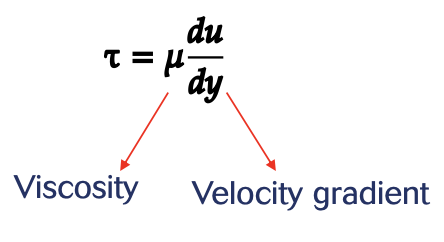
Shear Stress
Stress component acting tangential to the surface
34
New cards
Normal stress
Stress component acting normal to the surface
35
New cards
When is a fluid incompressible and when is it compressible?
Incompressible when Mach number is < 0.3
Compressible when > 0.3
Compressible when > 0.3
36
New cards
Steady Flow
Velocity and density are constant over time
37
New cards
scalar field
A scalar quantity given as a function of coordinate space and time “t“
38
New cards
dot product
Multiplying the matching components of two vectors together and adding them

39
New cards
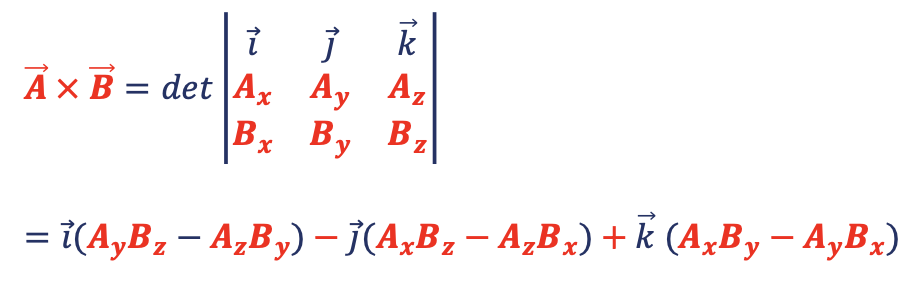
Cross product
The one where you the grid with the components and crossing out a column
40
New cards
what does ∇ 𝑓 give and what type of field can you do it on
Can only do it on a scalar field and gives the gradient (which is a vector field)
41
New cards
∇ ∙ 𝑓
Works for vector field, gives divergence (scalar field)
42
New cards
∇ × 𝑓
Works for vector field, gives curl (scalar field)
43
New cards
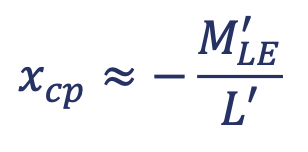
Where is the centre of pressure on a symettrical aerofoil if the angle of attack is small?
44
New cards
coefficient of pressure equation
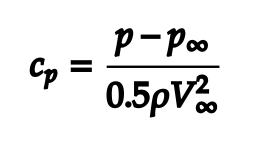
45
New cards
Kinematic Similarity
Flow fields in the prototype and the model must have the geometrically same set of streamlines
46
New cards
Fundamental units of: viscosity 𝜇, fluid density, 𝜌
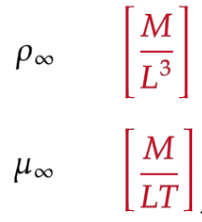
47
New cards
Fundamental units of: Drag D
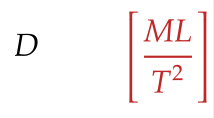
48
New cards
Displacement thickness
Imaginary increase in the thickness of the wall seen by the outer flow due to the reduced u velocity within the boundary layer
OR
the distance by which the solid boundary would have to be displaced to maintain the same mass flow rate in an imaginary frictionless flow
OR
the distance by which the solid boundary would have to be displaced to maintain the same mass flow rate in an imaginary frictionless flow
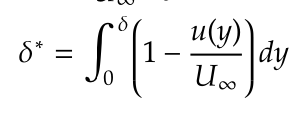
49
New cards
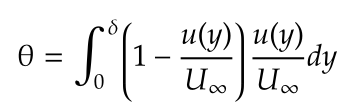
Momentum thickness
Distance by which the solid boundary would have to be displaced to maintain the same momentum transport rate at the actual mass flow rate in an imaginary frictionless flow
50
New cards
Streamlined body
A body where most of the drag is pressure drag
51
New cards
Blunt body
A body where most of the pressure is skin friction drag
52
New cards
What are Helmholtz 3 vortex theorems
The strength of vortex filament is constant along its length
A vortex filament can not enter a fluid
Vortex filament must extend up to the boundaries of the fluid/solid/infinity/form a closed path
A vortex filament can not enter a fluid
Vortex filament must extend up to the boundaries of the fluid/solid/infinity/form a closed path
53
New cards
What is kelvins circulation theorem
That there is no change in circulation around a closed curve consisting of the same fluid elements.