L3 - Stomach
 Call Kai
 Learn
 Practice Test
 Spaced Repetition
 Match
 Flashcards
 Knowt Play
1/38

There's no tags or description
Looks like no tags are added yet.
39 Terms
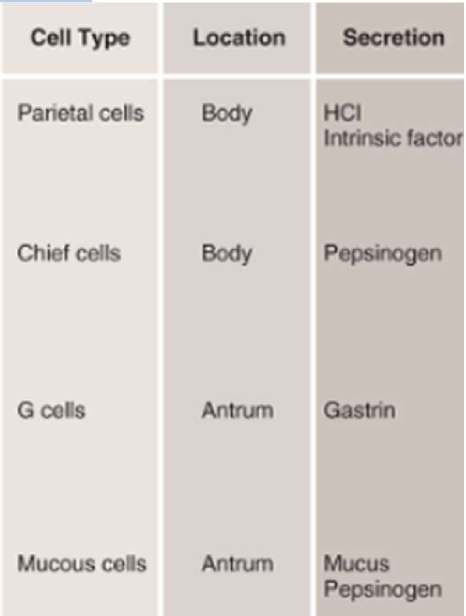
Cells of the gastric mucosa secrete what?
gastric juice
Contents of gastric juice
-HCl (protein digestion)
-pepsinogen (pepsin – protein digestion)
-intrinsic factor (vitB12 absorption in ileum)
-mucus (protects gastric mucosa from H+ : pH 1-2)
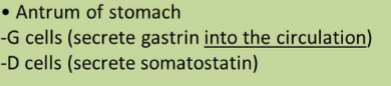
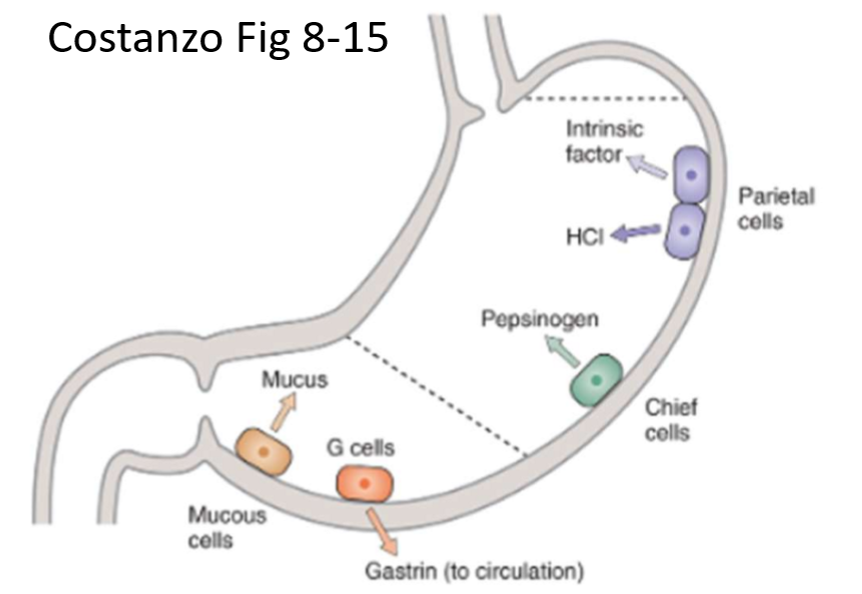
What secretory cells are in the antrum of the stomach & what do they secrete
Gastrin is a hormone secreted into circulation to stimulate parietal cells.
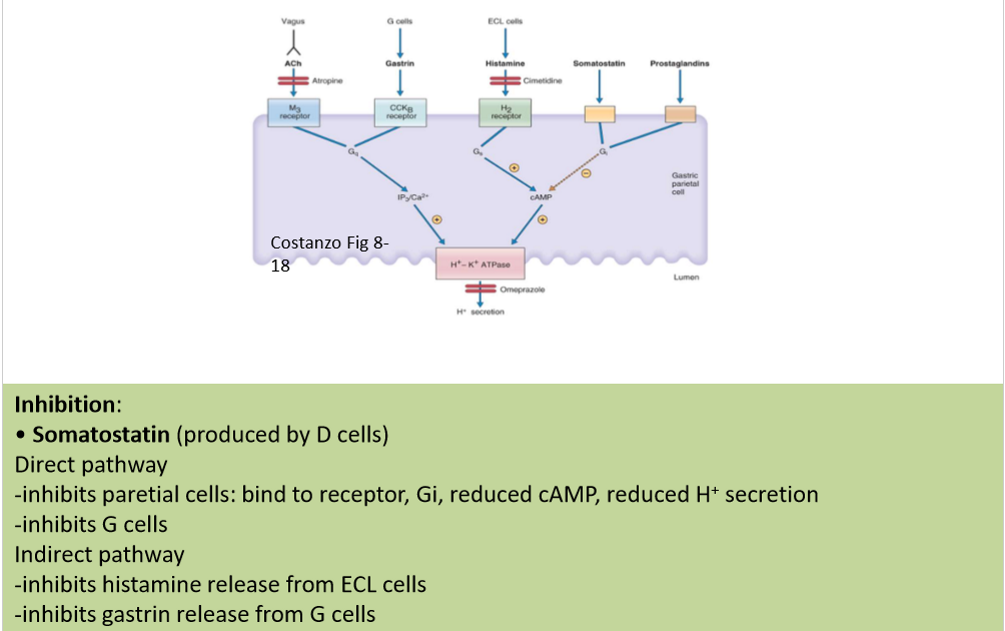
Somatostatin stops G cells and parietal cells (when pH gets too low)
What secretory cells are in the body of the stomach & what do they secrete
Parietal cells (secrete HCl and intrinsic factor)
Chief cells (secrete pepsinogen)
Gastric secretions are derived from from gastric invaginations called ________
Pits
Structure of pits
Pits are lined with many different secretory cells
-Parietal cells (secrete HCl and intrinsic factor)
-Chief cells (secrete pepsinogen)
-G cells (secrete gastrin into the circulation)
-D cells(secrete somatostatin)
-Mucus neck cells (secrete mucus, bicarbonate)
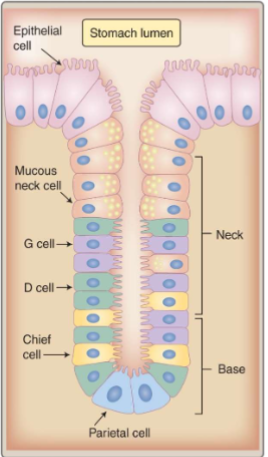
Is the structure of pits variable
Regional differences exist in the number of cell types lining a gastric pit
-near lower oesophagus/pyloric sphincter: mucus, HCO3-
-rest of stomach: digestive secretions (H+, pensinogen)
Where are H+-K+ ATPase, Cl- channels found
Apical membrane
Where are Na+-K+ ATPase, Cl--HCO3- exchangers found
Basolateral membranes
Where is carbonic anhydrase (catalyses CO2 + O2 to H2CO3; source of HCO3-) found
Epithelial cells
(they would need to be in epithelial cells to get the gases as they go by!)
How does H+ get into the lumen of the stomach? Diffusion? Primary/Secondary active transport?
H+ is secreted into lumen of stomach via primary active transport
How does Cl- make its way into the lumen of the stomach
Cl- follows H+ into the lumen (Cl- channels)
What happens HCO3- at the basolateral membrane
HCO3- is moved into interstitial space in exchange for Cl-
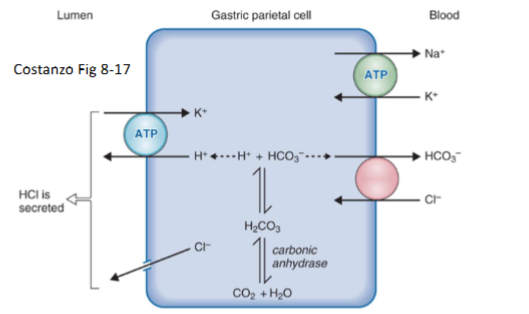
explain
This diagram, illustrates the mechanism of hydrochloric acid (HCl) secretion by gastric parietal cells in the stomach.
Key Processes in the Parietal Cell
Production of H⁺ (Proton Generation)
Inside the parietal cell, carbonic anhydrase catalyzes the reaction: CO2+H2O→H2CO3(carbonicacid)→H++HCO3−CO_2 + H_2O \rightarrow H_2CO_3 (carbonic acid) \rightarrow H^+ + HCO_3^-CO2+H2O→H2CO3(carbonicacid)→H++HCO3−
This reaction produces H⁺ (protons) and HCO₃⁻ (bicarbonate).
H⁺ Secretion into the Lumen (Stomach)
The H⁺-K⁺ ATPase (proton pump) actively transports H⁺ into the stomach lumen in exchange for K⁺.
This process requires ATP and is the primary driver of acid secretion.
Cl⁻ Secretion into the Lumen
Cl⁻ follows H⁺ into the lumen through chloride channels, forming HCl in the stomach.
This is necessary for digestion and activation of pepsinogen into pepsin.
HCO₃⁻ Exchange into the Blood ("Alkaline Tide")
The bicarbonate (HCO₃⁻) produced inside the cell is transported into the blood in exchange for Cl⁻ via the Cl⁻/HCO₃⁻ exchanger.
This increases blood pH temporarily after a meal, a phenomenon known as the "alkaline tide."
Na⁺/K⁺ ATPase (Basolateral Membrane)
This pump maintains the necessary ionic gradients by actively pumping Na⁺ out and K⁺ into the parietal cell.
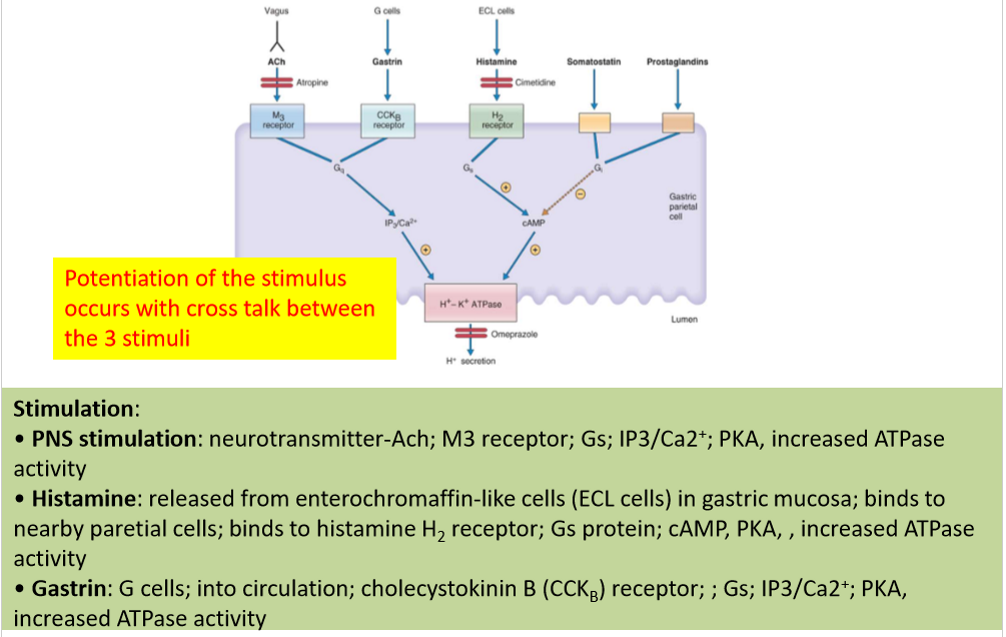
What stimulates H+ secretion by gastric parietal cells
What inhibits H+ secretion by gastric parietal cells
(Somatostatin inhibits everything!)
What stimulates H+ (acid) secretion in response to a meal
Vagus Nerve Innervation (Neural Control) which is stimulated by:
Cephalic Phase (Anticipation of Food)
Gastric Phase (Food in the Stomach)
Intestinal Phase (Food in the Small Intestine)
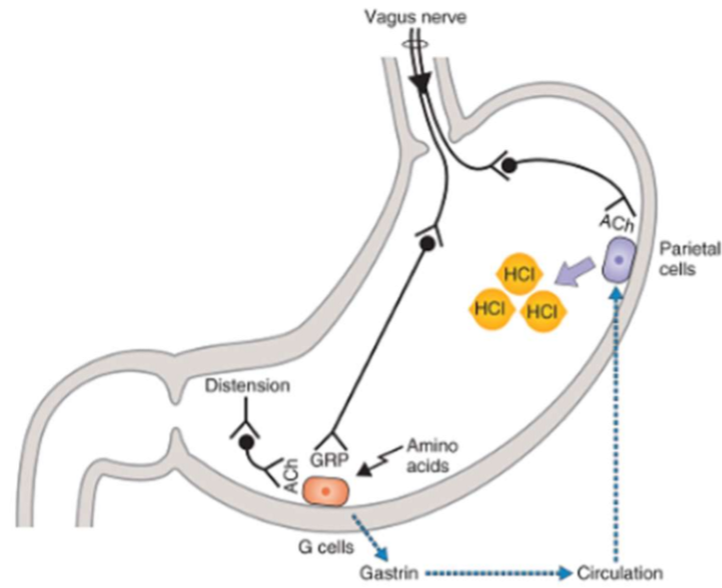
Explain how vagus nerve innervation stimulates H+ (acid) secretion in response to a meal
The vagus nerve causes the release of:
ACh - stimulates release of HCl from parietal cells (direct)
Gastrin-Releasing Peptide (GRP) - Stimulates G cells to release gastrin into the blood which travels to parietal cells, stimulating secretion of HCl (indirect)
What drug can be given to block some HCl
Muscarinic blocking agent (atropine) blocks some but not all HCl secretion
(Muscarine Mutes the Acid Party!)
Explain how the cephalic phase stimulates H+ (acid) secretion in response to a meal
This phase is a conditioned reflex that occurs before food enters the stomach and is mediated by the vagus nerve.
Sight, smell, taste, or thought of food triggers vagal stimulation, leading to ACh & gastrin release and increased HCl secretion
Cephalic phase accounts for what % of total HCl secretion
30%
Explain how the gastric phase stimulates H+ (acid) secretion in response to a meal
This phase begins when food reaches the stomach
Peptides & amino acids stimulate G cells to release gastrin, which acts on parietal cells to increase H⁺ secretion.
Distension of the stomach leads to direct & indirect vagal stimulation of parietal cells
Gastric phase accounts for what % of total HCl secretion
60%
Explain how the intestinal phase stimulates H+ (acid) secretion in response to a meal
Peptides & amino acids stimulate G cells to release gastrin, which acts on parietal cells to increase H⁺ secretion.
Intestinal phase accounts for what % of total HCl secretion
10%
Explain how the intestinal phase inhibits H+ (acid) secretion in response to a meal
Secretin, CCK & other duodenal hormones contribute to decreasing acid secretion
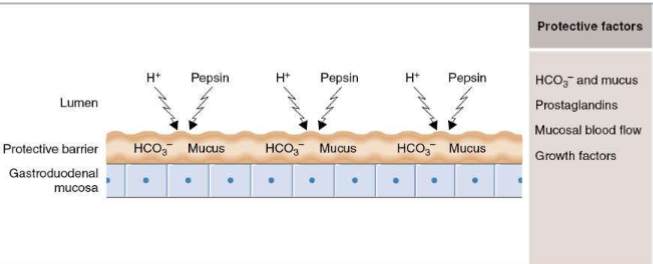
What can damage gastroduodenal mucosa
H+ & pepsin
Helicobacter Pylori
NSAIDs (Non-Steroidal Anti-Inflammatory Drugs)
Stress
Smoking
Alcohol
What protects the gastroduodenal mucosa from damage
Prostaglandins produce HCO3- & mucus (Prostaglandins protect)
Growth factors promote healing
what does the presence of Helicobacter pylori indicate
indicates a chronic bacterial infection in the stomach, which is strongly associated with gastric diseases
H. pylori is a major cause of gastric and duodenal ulcers.
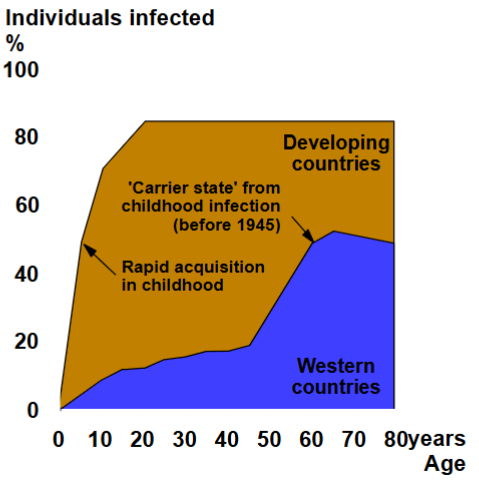
Is there a difference between the prevalence of H. pylori infections between developed and developing countries
Developing Countries (Brown Region)
H. pylori infection is acquired early in childhood, leading to a high prevalence (over 60%) by adulthood.
Many individuals remain in a "carrier state" from childhood infections, particularly in earlier generations (before 1945).
The infection rate is consistently high across all age groups.
Western Countries (Blue Region)
H. pylori infection is acquired more gradually, with lower prevalence in childhood.
The infection rate increases with age but remains significantly lower than in developing countries.
How is Helicobacter pylori (H. pylori) infection in the stomach diagnosed
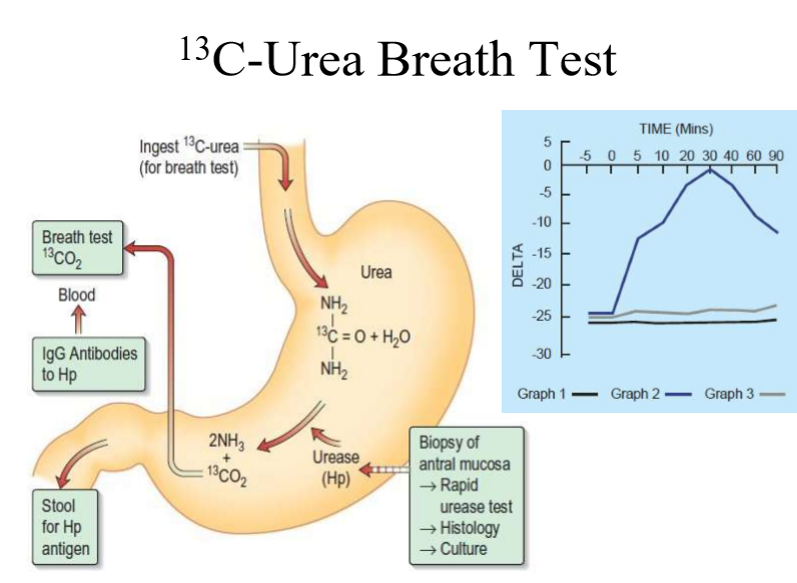
¹³C-Urea Breath Test
How does the ¹³C-Urea Breath Test work
Ingestion of ¹³C-Urea
The patient drinks a solution containing ¹³C-labeled urea.
Breakdown by H. pylori
If H. pylori is present in the stomach, its enzyme urease breaks down ¹³C-urea into ammonia (NH₃) and carbon dioxide (¹³CO₂).
Detection of ¹³CO₂ in Breath
The ¹³CO₂ is absorbed into the bloodstream and exhaled.
The patient’s breath is collected and analyzed for ¹³CO₂ levels.
Interpretation
A high level of ¹³CO₂ in the breath indicates the presence of H. pylori.
If H. pylori is absent, urea remains undigested, and ¹³CO₂ levels stay low
What is pepsinogen & what secretes it
Chief cells in the stomach secrete pepsinogen, an inactive enzyme precursor
Active form of pepsinogen
pepsin (a type of protease - protein-digesting enzyme)
What converts pepsinogen to pepsin (its active form)
The acidity in the gastric lumen
We know that parietal cells produce HCl. What else do they release
Intrinsic factor
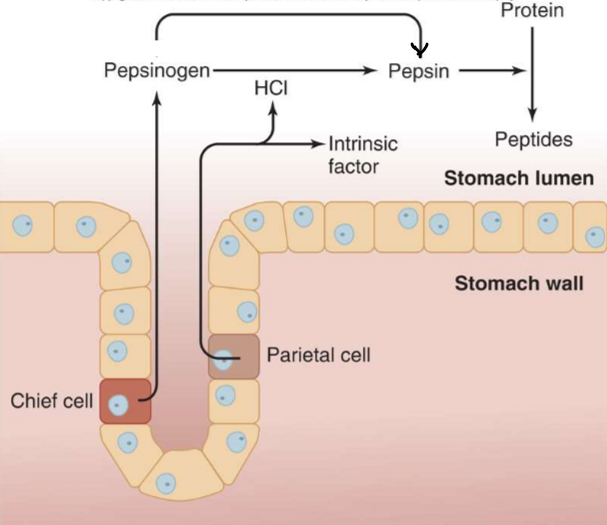
Function of intrinsic factors release by parietal cells
essential for vitamin B12 absorption in the small intestine