MEA 101 Exam 2 Tophat
 Call Kai
 Learn
Learn Practice Test
 Spaced Repetition
 Match
Match Flashcards
 Knowt Play
1/73

There's no tags or description
Looks like no tags are added yet.
Name | Mastery | Learn | Test | Matching | Spaced | Call with Kai | Chat |
|---|
No analytics yet
Send a link to your students to track their progress
74 Terms
Which element is the most common component of the Earth's crust?
a. Fe
b. O
c. Al
d. Si
e. Ni
f. N
b. O
Which element is the most common component of the entire Earth?
a. Fe
b. O
c. Al
d. Si
e. Ni
f. N
a. Fe
These are...
a. Elements
b. Minerals
c. Rocks
d. Photoshopped
b. Minerals

A(n) -------- is made up of minerals, which are made of ---------- .
a. element; rocks
b. rock; rocks
c. element; nutrients
d. rock; nutrients
e. rock; elements
e. rock; elements
Based on the definition of a mineral, would ice be classified as a mineral?
Yes
What is the ratio of silicon to oxygen here?
a. 1 Si, 4 O
b. 1 Si, 7 O
c. 2 Si, 7 O
d. 2 Si, 8 O
c. 2 Si, 7 O

Use the figure below to determine how many oxygen atoms are shared between tetrahedra in sheet silicates.
a. 2
b. 3
c. 4
d. 5

Which silicates will have the highest relative concentration of silica in them?
a. Isolated
b. Chain
c. Sheet
d. Framework
d. Framework
Which of the chemical compounds below represents a silicate mineral?
a. CaCO3
b. CaSO4.H2O
c. FeS2
d. NaAlSi3O8
d. NaAlSi3O8
What do geologists mean when they use the term "texture" in descriptions of igneous rocks?
a. The elements present in the common minerals found in the rocks
b. The size, shape and arrangement of the mineral grains
c. The distribution of colors among the minerals and in the whole rock
b. The size, shape and arrangement of the mineral grains
What is the most likely cooling rate and composition of a small grained, light-colored igneous rock?
a. Cooled rapidly, low silica
b. Cooled rapidly, high silica
c. Cooled slowly, low silica
d. Cooled slowly, high silica
b. Cooled rapidly, high silica
Which table on the image below is the most accurate classification scheme for igneous rocks?
A
B
C
D
D

Imagine that all minerals found in igneous rocks were the same color. What information would you no longer be able to infer?
a. Texture
b. Cooling Rate
c. Composition
c. Composition
Where does most of Earth's magma come from?
a. Melting of mantle rocks by multiple processes at plate boundaries
b. Plumes that carry magma upward to the surface from the mantle/core boundary
c. A layer of magma in the mantle where rocks are hot enough to melt
a. Melting of mantle rocks by multiple processes at plate boundaries
Magma at X forms as a result of which process?
a. Decompression melting
b. Melting with the addition of water
c. Increased heating of crust
d. A and B
e. A and C
e. A and C

Magma at X forms as a result of which process?
a. Decompression melting
b. Melting with the addition of water
c. Increased heating of crust
d. A and C
e. B and C
e. B and C

Partial melting of ultramafic mantle rock should produce what type of magma?
a. Ultramafic
b. Mafic
c. Intermediate
d. Felsic
b. Mafic
Which of the following statements about melting rock at subduction zones is correct? (Select all that apply)
a. Partial melting of oceanic crust generates intermediate magma forming new continental crust when it cools
b. Partial melting of continental crust generates felsic magma forming silica enriched rocks when it cools
c. Partial melting of continental crust generates mafic magma forming new ocean floor when it cools
a. Partial melting of oceanic crust generates intermediate magma forming new continental crust when it cools
b. Partial melting of continental crust generates felsic magma forming silica enriched rocks when it cools
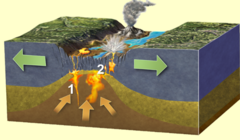
Assuming that partial melting is occurring at both locations, what type of magma would you expect to see at 1 and 2?
a. 1: Felsic, 2: Mafic
b. 1: Mafic, 2: Intermediate
c. 1: Mafic, 2: Felsic
d. 1: Intermediate, 2: Felsic
e. 1: Intermediate, 2: Mafic
c. 1: Mafic, 2: Felsic
If you were to partially melt a diorite, which of the following would be a volcanic rock which formed from this melt? (Remember what occurs during partial melting)
a. Basalt
b. Gabbro
c. Andesite
d. Rhyolite
e. Granite
d. Rhyolite
Which region would exhibit the most rapid rate of chemical weathering for the same rock type (e.g., limestone)?
a. A hot, dry state like Arizona
b. A cool, humid state like Oregon
c. A very cold region like Alaska
d. A warm, humid state like North Carolina
d. A warm, humid state like North Carolina
Which of these rocks contains sediments that were transported the longest distance before they were deposited?
a. A
b. B
c. C
d. D
b. B

What environment would most likely form this rock?
a. Lake
b. Stream channel
c. Sand dunes
d. Mountain
b. Stream channel

Write chemical, biochemical, or both in the blanks
Used to interpret geological history
Both
Write chemical, biochemical, or both in the blanks
Form from organisms (biosphere)
Biochemical
Write chemical, biochemical, or both in the blanks
Examples: gypsum, salt
Chemical
Write chemical, biochemical, or both in the blanks
May form under shallow marine conditions
Both
Write chemical, biochemical, or both in the blanks
Coal formed from dead plants
Biochemical
Write chemical, biochemical, or both in the blanks
Form due to changes in physical conditions
Chemical
Write chemical, biochemical, or both in the blanks
Can form by precipitation from a solution
Both
Write chemical, biochemical, or both in the blanks
Limestone is an example
Both
Which factor does NOT directly influence the texture of clastic sedimentary rocks?
A. Color of source rocks
B. Agent of erosion
C. Distance traveled from source
D. Energy of environment
A. Color of source rocks
Do these rocks indicate that the sea advanced over the land (transgression) or retreated from the land (regression) or both?
a. Transgression only
b. Regression only
c. Transgression followed by regression
d. Regression followed by transgression
c. Transgression followed by regression

Which of the following is not a change you would expect to see during metamorphism?
a. Change in the orientation of mineral grains
b. Change in the types of minerals in the rock
c. A decrease in the size of the crystal grains
d. Crystal grains become more similar in shape
c. A decrease in the size of the crystal grains
What type of tectonic stress would you most likely expect rocks to experience along a transform boundary?
a. Compression
b. Tension
c. Shear
c. Shear
What are the metamorphic conditions for rocks in the interior of an oceanic plate descending a subduction zone ?
a. High temperature, high pressure
b. High temperature, low pressure
c. Low temperature, high pressure
d. Low temperature, low pressure
c. Low temperature, high pressure
hich of the following rocks would you expect to form if you subjected shale to high grade metamorphism?
a. Slate
b. Quartzite
c. Phyllite
d. Gneiss
e. Marble
f. Schist
d. Gneiss
Which of the following rocks would you expect to form if you subjected sandstone to high grade metamorphism?
a. Slate
b. Quartzite
c. Phyllite
d. Gneiss
e. Marble
f. Schist
b. Quartzite
Different metamorphic rocks form under different temperature and pressure conditions.
Which list best ranks the rock types from lowest to highest temperature and pressure conditions?
a. Schist, Slate, Gneiss, Phyllite
b. Slate, Phyllite, Schist, Gneiss
c. Phyllite, Gneiss, Slate, Schist
d. Gneiss, Schist, Phyllite, Slate
b. Slate, Phyllite, Schist, Gneiss
The graph illustrates how the temperature changed with time for part of the rock cycle. Which of the following processes is best represented by the graph?
a. Sediment is lithified to form sedimentary rock.
b. Sedimentary rock is converted to metamorphic rock.
c. Metamorphic rock is uplifted to Earth's surface.
d. Magma cools to form plutonic igneous rock.
e. Sedimentary rock is converted to magma.
b. Sedimentary rock is converted to metamorphic rock.

The graph illustrates how the temperature changed with time for part of the rock cycle. Which of the following processes is best represented by the graph?
a. Magma forms a plutonic igneous rock that is then uplifted to Earth's surface
b. Sediment is lithified to form sedimentary rock and then metamorphosed
c. Magma cools to form a volcanic igneous rock that is melted to form new magma
d. Plutonic igneous rocks are uplifted and then weathered to form sediments
e. Sediment is lithified to sedimentary rock that is then weathered to form new sediment
c. Magma cools to form a volcanic igneous rock that is melted to form new magma

Made of minerals
igneous, sedimentary, metamorphic
Coal, coral, and chalk are examples of
Sedimentary rocks
Solidify under conditions of decreasing temperature
Igneous rocks
Form under conditions of increasing heat and pressure
sedimentary and metamorphic
Can form as a result of crystallization
igneous, sedimentary, metamorphic
May undergo weathering at Earth's surface to form sediment
igneous, sedimentary, metamorphic
May be composed of small grains or crystals
igneous, sedimentary, metamorphic
Which type of natural hazard is more likely to have historically resulted in large numbers of casualties and extensive damages?
a. Earthquakes
b. Volcanic eruptions
a. Earthquakes
Which map best represents the distribution of large earthquakes?
A
B
C
D
D

What type of fault is represented by the figure?
a. Normal
b. Reverse
c. Strike-Slip
a. Normal

X is located on...
a. The footwall of a normal fault
b. The hanging wall of a normal fault
c. The footwall of a reverse fault
d. The hanging wall of a reverse fault
b. The hanging wall of a normal fault

What type of movement occurred on the San Andreas fault?
a. right-lateral strike slip
b. left-lateral strike-slip
c. left-lateral dip-slip
d. right-lateral dip slip
a. right-lateral strike slip

If the San Andreas fault moves 500 cm (5 meters) per big earthquake, and plate movement is 2.5 cm/year (0.025 m/year): How many years of plate motions must accumulate to produce one big earthquake?
a. 20 years
b. 200 years
c. 2000 years
b. 200 years
2.5 cm x 200 years = 500 cm per big earthquake
Along what types of boundaries do we see our largest earthquakes occurring?
a. divergent
b. ocean-ocean convergent
c. continent-continent convergent
d. ocean-continent convergent
d. ocean-continent convergent
What type of faults are present in this outcrop?
a. Normal
b. Reverse
c. Strike-Slip
a. Normal

This drainage ditch has been offset by what type of fault?
a. Normal fault
b. Reverse fault
c. Right-lateral strike slip fault
d. Left-lateral strike slip fault
d. Left-lateral strike slip fault
Which of the lines represent strike for the surface illustrated below?
a. a, b, c, d, e
b. f only
c. a and c
d. e only
e. e and f
d. e only

The point on a fault where movement originated to trigger an earthquake is known as the ....
a. epicenter
b. strike
c. hypocenter/focus
c. hypocenter/focus
Examine the seismogram and identify the position on the graph that represents the arrival of the first S waves? Click on the letter.
B

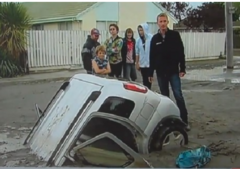
What type of earthquake hazard was responsible for this situation?
a. Tsunami
b. Landslide
c. Elevation change
d. Liquefaction
d. Liquefaction
What is the major type of volcanoes that make up Hawaii
a. Shield volcano
b. Cinder cone
c. Composite volcano
d. Lava dome
a. Shield volcano
If a shield volcano and a composite volcano formed with the same width, which volcano would be taller?
a. Shield volcano
b. Composite volcano
b. Composite volcano
iven the same volume of magma, which type of volcano would have a more dangerous/violent eruption?
a. Shield volcano
b. Composite volcano
b. Composite volcano
write "composite", "shield", or "both"
Associated with subduction zones:
Composite
write "composite", "shield", or "both"
An example is Mount St. Helens
Composite
write "composite", "shield", or "both"
Largest volcanoes on the planet:
Shield
write "composite", "shield", or "both"
Pyroclastic flows are likely to occur during an eruption
composite
write "composite", "shield", or "both"
Pose the greatest danger to human life:
Composite
write "composite", "shield", or "both"
Found in Hawaii
Shield
write "composite", "shield", or "both"
Mostly produce lava
Shield
write "composite", "shield", or "both"
Magma in this volcano may have formed from partial melting of mantle rock
Shield and Composite
Which of these statements is true? (more than one answer)
a. Felsic magmas have higher viscosity than mafic magmas
b. Mafic magmas have higher viscosity than felsic magmas
c. Magma from shield volcanoes has relatively low viscosity
d. The viscosity of magma is determined by the amount of silica in the magma
a. Felsic magmas have higher viscosity than mafic magmas
c. Magma from shield volcanoes has relatively low viscosity
d. The viscosity of magma is determined by the amount of silica in the magma
Geologists discover two rocks that were both originally formed as lava. Rock A is dark-colored, rock B is light-colored. Which rock formed from lava with the higher viscosity?
a. Rock A
b. Rock B
c. No difference
b. Rock B