Astronomy & Cosmology Chap 2 : Waves and the nature of light
 Call Kai
 Learn
Learn Practice Test
 Spaced Repetition
 Match
Match Flashcards
 Knowt Play
1/54

There's no tags or description
Looks like no tags are added yet.
Name | Mastery | Learn | Test | Matching | Spaced | Call with Kai | Chat |
|---|
No analytics yet
Send a link to your students to track their progress
55 Terms
Emission
the object emits light on its own and that light reaches our eyes

Reflection
Light from a source bounces off the object and then reaches our eyes

Emitted lights
holds a lot of "secret" information about the object that emitted the light

Astronomical distances
looking farther away = looking more into the past

1 light year away
light takes 1 year to reach us
Sun
8 light minutes away

Sir Issac Newton
Passed sunlight through a prism 300 years ago
Band of rainbow
comes out the other side

White light Spectrum
composed all the other colors
Continuous spectrum
no colors missing

Graph of Brightness vs color
spectrum

Spectrum of white light
the colors of the optical spectrum
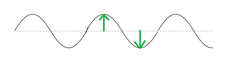
Wave
Regular disturbance that travels at a constant speed through a medium or material

Waves types
Waves on a guitar string, sound waves, water waves, light waves, waves on a rope

Waves properties
wavelength (λ), frequency (f), wave speed (v), amplitude (A)

Frequency (F)
how often the waves "waves". how often the source of the wave produces a bump. Measured in numbers per seconds or Hertz (Hz)

Wavelength (λ)
the distance between each subsequent bump. Measured in meters (m)

Speed (V)
Speed of the wave or how fast the wave travels forward
v = f λ

v
fixed for light in a particular material
Amplitude (A)
how big the wave is or how tall a crest or bump is
light is unusual
does not need a medium or material to travel
electromagnetic wave
combination of strengthening and weakening electric and magnetic fields.

light speed
c = 3.0 x 10^8 m/s

higher frequency (f) light
bluer has shorter wavelength

lower frequency (f) light
redder has longer wavelength

larger amplitude (A)
a brighter light

smaller amplitude (A)
a dimmer light

electromagnetic spectrum
different wavelengths of light together
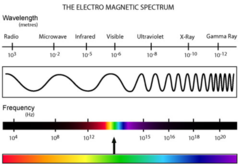
optical/ visible part
this is the part of the spectrum our eyes can see.
the wavelength is from 400nm to 700nm
short wavelengths -> long wavelength
gamma ray, xrays, ultraviolet, infrared, microwaves, radio waves
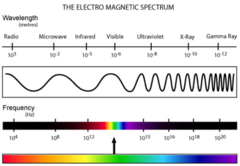
newton's explanation
light is made up of corpuscles (particles) of different energies for different colors.
duality of light
light behaves both as a wave and a particle depending on the situation
photons
composed of many tiny massless particles

photon has
some amount of energy

shorter wavelengths (photons)
higher energy photons (bluer)

longer wavelengths (photons)
lower energy per photon (redder)

therefore shorter wavelengths (photons)
more energetic and damaging
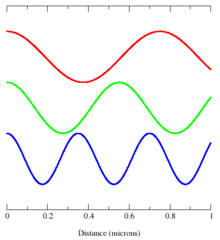
high energy photon
blue light
lower energy photon
red light
low energy photon
infrared light
should be invisible
energy of a photon equation
h f = h c / λ

energy of a photon
h = planck's constant (a fixed number)
f = frequency
c = speed of light
λ = wavelength
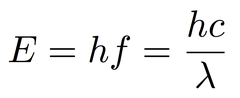
higher frequency (shorter wavelength)
more energy in each photon
lower frequency (longer wavelength)
less energy in each photon
light properties
both particle and a wave

Quantum Theory
the branch of physics that explains how matter and energy behave at the smallest, subatomic levels
observing celestial objects
give us much more information that just observing in a single wavelength

specialized telescopes and sensors
built to collect light of different wavelengths
body that is producing the light
1. the temperature of the body
2. the chemical composition of the body
3. the speed at which the body is moving towards or away from us
what does the atmosphere let through
acts like a large filter. doesn't let different wavelengths of EM radiation though equally
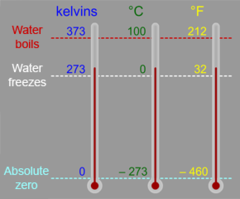
temperature scales
fahrenheit, celsius, kelvin
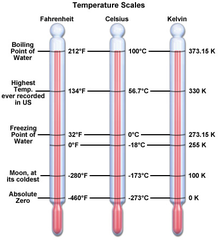
absolute zero, 0 K
lowest possible temperature (273° C or -459°F)
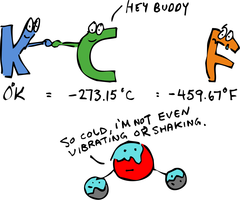
fahrenheit
how humans feel temperature

celsius
how water feels temperature

kelvin
how the universe feels temperature