0010 Week 4 — Learning
 Call Kai
 Learn
Learn Practice Test
 Spaced Repetition
 Match
Match Flashcards
 Knowt Play
1/48

There's no tags or description
Looks like no tags are added yet.
Name | Mastery | Learn | Test | Matching | Spaced | Call with Kai | Chat |
|---|
No analytics yet
Send a link to your students to track their progress
49 Terms
What is the definition of learning?
A relatively lasting change in behavior or knowledge that results from experience
A loud sound makes you startle. Learning or not?
Not learning — it is a reflex (no experience-driven change demonstrated)
After hearing the same harmless sound repeatedly, you startle less. Learning or not?
Learning — habituation (a relatively lasting decrease in responding from experience)
You make more errors on a task late at night than that morning. Learning or not?
Not learning — likely fatigue; need more information before concluding
Give two reasons researchers study learning in animals.
1) They can control an animal's experiences and measure how its behavior changes; 2) findings can reveal shared learning principles across species
What limits generalization from animal learning studies to humans?
Species differences limit generalization
What did Breland & Breland study, and when?
A field of applied animal psychology (1951); "The misbehavior of organisms" (1961)
What was Breland & Breland's key finding about training animals?
Training depends partly on an animal's existing behavioral tendencies — a behavior may be physically possible yet difficult to establish or maintain (biology constrains learning)
Name the three types of learning and what each is about.
1) Non-associative — learning about a single stimulus (habituation, sensitization); 2) Associative — learning a relationship between 2 stimuli or between a stimulus and response (classical, operant/instrumental conditioning); 3) Observational (social) — learning by watching others or by instruction (modeling, vicarious learning)
What is non-associative learning? Give examples.
Learning about a single stimulus; examples: habituation and sensitization
What is associative learning? Give examples.
Learning a relationship between 2 stimuli or between a stimulus and response; examples: classical and operant (instrumental) conditioning
What is observational (social) learning? Give examples.
Learning by watching how others behave or by instruction; examples: modeling and vicarious learning

What is a reflex? Give the slide example.
Elicited behavior — a stimulus elicits a response; example: touch to face → rooting response

What is a fixed action pattern?
A relatively stereotyped behavioral sequence triggered by a specific cue

What is a sign stimulus? Give an example.
A feature that elicits a fixed action pattern; example: the cue triggering the three-spined stickleback fish's patterned response
What organized behavioral sequence does rat grooming follow?
A fixed action pattern — an organized, stereotyped sequence of actions

What is imprinting?
In some species, experience during an early sensitive (critical) period strongly influences which individual a young animal follows or recognizes

Give the slide example of imprinting.
A newly hatched gosling follows the person (first moving figure) it encountered soon after hatching
What is habituation?
A response decreases with repetition of a (harmless) stimulus
When does a decreased response NOT demonstrate habituation?
If the response drops because the person is tired (fatigue) or the sound is no longer audible
What is dishabituation?
A habituated response returns when there is a change in the stimulus — sensitivity to any change in the parameters of a stimulus to which one has previously habituated

What is sensitization?
Repeated (or highly salient) experience leads to a response INCREASE — more sensitivity than would be expected
Contrast habituation and sensitization.
Habituation: repeated stimulation decreases responding. Sensitization: repeated or highly salient stimulation increases responding. The same repeated stimulation can produce either, depending on stimulus salience/intensity.
Summary table: a newborn turns toward a touch on the cheek and opens its mouth. What changed with experience?
Nothing learned — the rooting reflex was already possible; no learned change demonstrated
Summary table: a newly hatched gosling follows the person it encountered soon after hatching. What changed with experience?
Early experience influenced WHOM it follows — imprinting
Summary table: you initially startle at a new refrigerator's loud click but barely notice it after a few days. What changed?
Repeated harmless clicks reduced the startle/orienting response — habituation
Summary table: after a nearby car backfires, you become unusually jumpy at subsequent sudden sounds. What changed?
The startling event temporarily heightened responding — sensitization
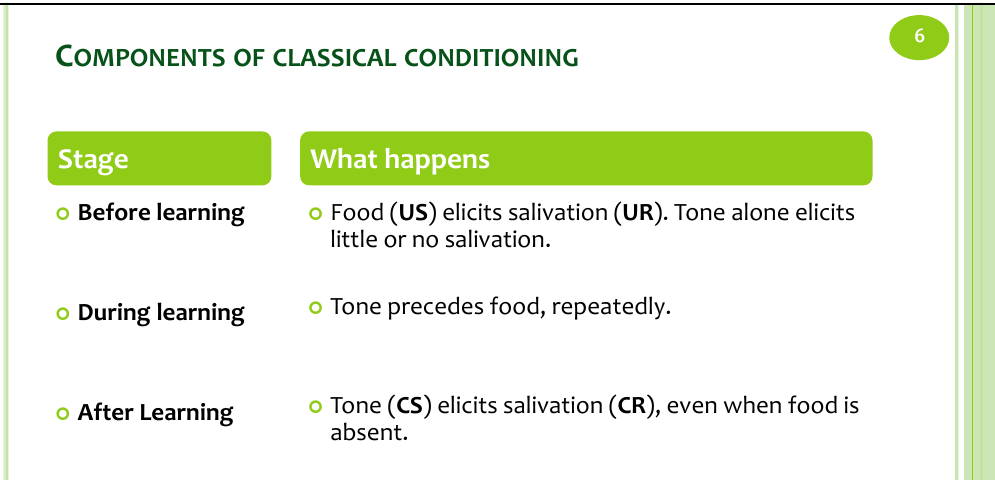
What is classical conditioning? (Pavlov, 1849–1946)
A previously neutral stimulus comes to elicit a response through its association with a stimulus that already elicits that response — learning that one event predicts another
In Pavlov's setup, what are the US and UR?
US (unconditioned stimulus) = food; UR (unconditioned response) = salivation elicited by food
Before learning, what does the tone elicit?
Little or no salivation — it is a neutral stimulus
What happens during learning in classical conditioning?
The tone (CS) precedes food (US), repeatedly — successive CS–US pairings
After learning, what are the CS and CR?
CS (conditioned stimulus) = tone; CR (conditioned response) = salivation elicited by the tone alone, even when food is absent
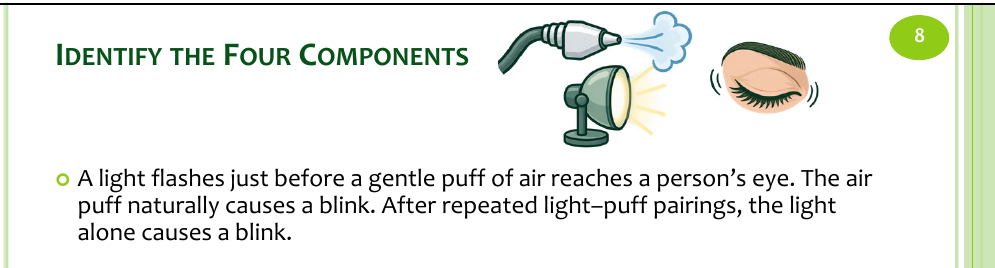
Air-puff example: identify the US, UR, CS, and CR.
US = air puff; UR = blink in response to the air puff; CS = light, after repeated pairings with the air puff; CR = blink in response to the light alone
What is appetitive conditioning?
A conditioning procedure in which the US is desirable or appetitive
What is aversive conditioning?
A conditioning procedure in which the US is undesirable or aversive

What is acquisition?
The CS and US are presented together repeatedly, producing/growing the CR to the cue

What is extinction?
Repeated presentations of the CS without the US reduce the CR
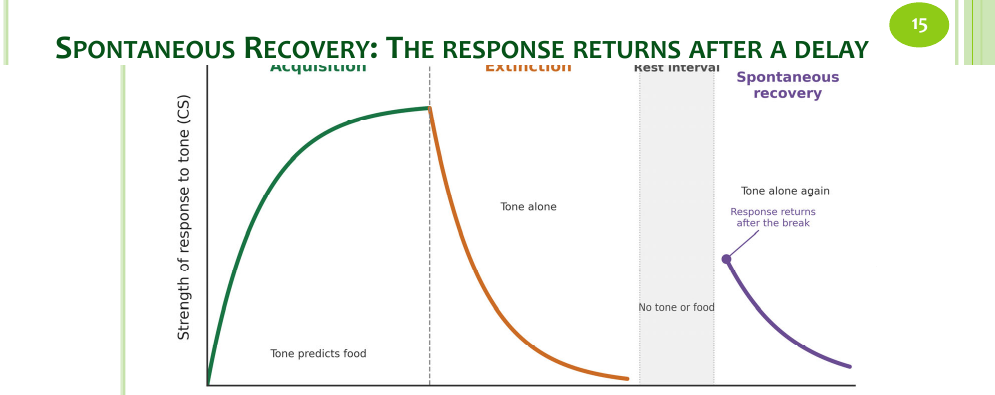
What is spontaneous recovery?
After extinction and a rest period, the CS can again elicit the conditioned response without any new CS–US pairings
What is stimulus generalization?
Similar cues can elicit the learned response

What happened in the Little Albert experiment (Watson & Rayner, 1920)?
A white rat was paired with a loud noise, producing a conditioned fear response that generalized to other furry animals and objects

In Little Albert, how did fear magnitude vary across test stimuli?
Fear was strongest to the white rat/snow and weaker to less similar stimuli such as a fur coat (generalization gradient)
What is stimulus discrimination?
Similar cues come to elicit DISTINCT responses when those cues predict different outcomes (one cue predicts the US, a similar cue does not)
What experience would teach stimulus discrimination?
Experience in which one cue predicts the outcome but a similar cue does not

What is second-order (higher-order) conditioning?
Something else gets paired to the CS (not the US) and comes to elicit the same CR
Define contiguity vs contingency in classical conditioning.
Contiguity = how close the CS and US occur in time; contingency = whether the CS changes the likelihood of the US

Situation A: tone predicts food (food usually follows the tone). Situation B: tone does not predict food (food arrives just as often without it). In which does the tone tell the dog food is more likely?
Situation A — the tone is informative about food's likelihood
Why does contingency matter more than mere contiguity?
The CS and US can occur close together in both situations, but conditioning is strongest when the CS is informative — i.e., changes the likelihood of the US
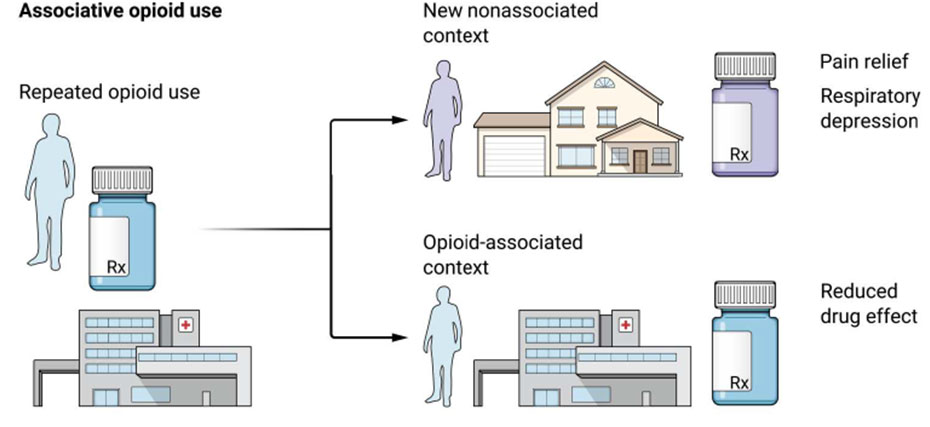
What is a compensatory response in drug conditioning (McKendrick & Graziane, 2020)?
Through repeated drug–context pairings, the context itself comes to elicit a compensatory response that OPPOSES the drug's effects

What happens to drug effects in a NEW drug context (Farahbakhsh & Siciliano, 2023)?
Weaker conditioned compensation in the new context leaves more of the drug's effect unopposed