BIOL 207 Lecture 1 - Overview and General Concepts (Questions)
 Call Kai
 Learn
Learn Practice Test
 Spaced Repetition
 Match
Match Flashcards
 Knowt Play
1/24

There's no tags or description
Looks like no tags are added yet.
Name | Mastery | Learn | Test | Matching | Spaced | Call with Kai | Chat |
|---|
No analytics yet
Send a link to your students to track their progress
25 Terms
What are the dual functions of genes? During which step of the central dogma are these functions occurring?
Operational function: encodes gene products via its sequence, during translation (RNA and protein created)
Transmission function: carries genetic information from one generation to the next, during duplication (cell division for reproduction)

What can a gene product be?
RNA and protein: encodes RNA that will then encode a protein
RNA alone: tRNA/rRNA that does not encode a protein
Which organisms have circular DNA? Linear?
Prokaryotes (bacteria): circular
Eukaryotes (humans): linear and circular (mtDNA is circular and contained within the genome)
How are double-stranded nucleic acid strands named based on their use?
+ strand: the strand thats genetic sequence is create protein during translation, being directly made into RNA
- strand: the complementary, non-coding strand that is duplicated to create the + strand
What are the multiple factors that can affect gene activity of a coding strand?
Level of transcription: a more active gene may create more RNA, which will then create more protein and be more strongly expressed
Amount of protein created: an RNA strand may create more protein per strand, thus being more strongly expressed

Is a gene simply the region that is transcribed into RNA? Explain.
Gene includes every part necessary in order for transcription: transcribed region, regulatory sequences
The transcription cannot happen without starting sequence, end sequence, middle regions, etc.

What is the conceptual difference between genetics and omics disciplines?
Genetics seeks to describe and find the function of genes in an individual, such as which is required for a biological process
Genomics is descriptive, seeking only to see what genes respond at all to a certain stimulus
Ex. flies to the light
Transcriptomics/proteomics isolates any mRNA/proteins that respond to a certain stimulus, via comparing tissues from flies that are not exposed to light to tissues from flies that do respond to the light
Genetics finds a mutant that can’t fly to the light, then tests whether the gene functions directly in the biological process
What is the benefit of using a genetics approach as opposed to an omics approach?
Factors that respond to a stimulus may not be relevant to the problem/process being observed (experimental findings of omics)
Ex. wings mutation that doesn’t allow flight does not mean it is biologically relevant to the behaviour of flying towards light
What are the advantages and disadvantages of forward genetics?
Advantages: unbiased and powerful (identify genes previously not linked to the biological process being studied)
Disadvantages: slow, difficult to identify mutated gene in organisms
What are the advantages and disadvantages of reverse genetics?
Advantages: specific and versatile, able to see how a specific modification/gene affects the organism
Disadvantages: biased, gene modified may not have an obvious phenotype
What are the levels of DNA structure, and which makes up each?
Nucleotides → single strand → double helix → 3D loops

What are the four factors needed by DNA in order to be a viable carrier of genetic information in organisms?
Able to encode the characteristics of organisms
Replicable (able to be copied)
Transmissable: passed from parents to offspring during reproduction
Variation: subject to occasional modifications (mutations) that allow genetic diversity
Does genetic identicality mean phenotypes and traits will be exactly the same? Explain.
No, environmental differences (ex. access to nutrition, stress/physical damage, etc.) can change how an individual’s genes are expressed
Reaction norm is different depending on the environment
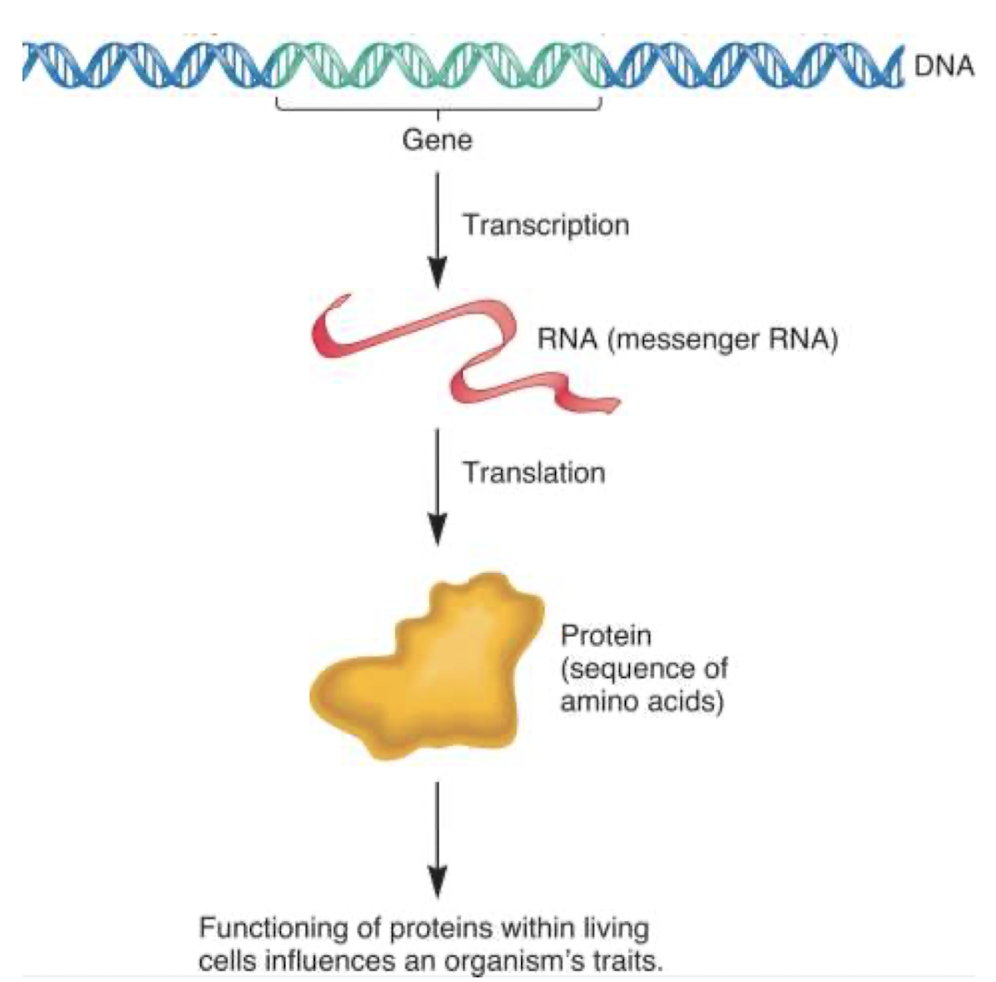
How does the central dogma lead to a trait being expressed?
DNA → mRNA → protein
Information is copied and translated into a protein, which then carries out a function in the organism that expresses the genetic information
What is the difference between a race/subspecies and a morph?
A subspecies or race forms its own genetically distinct, isolated population
Ex. tabby cat and sphinx cat are separate races/subspecies. Black jaguar and regular jaguar would be a morph
How do keratinosomes (skin and hair follicle cells) receive melanin?
Keratinosomes receive melanosomes from melanocytes and store the melanin in them, giving the skin pigmentation
Describe how eumelanin is created, including necessary genes, hormones, and receptors in the process. How is it inhibited, and what is the product of this?
POMC gene encodes alpha-MSH hormones → systemically acts on entire cell to stimulate MC1R receptors → eumelanin is created (dark hair)
ASIP gene encodes ASIP hormones → locally acts on cell to repress MC1R receptor → eumelanin is not created → pheomelanin is created in its stead (light hair)
Describe the MC1R receptor activity present in these phenotypes: black jaguar morph, human red hair, spirit bear. Compare to the common phenotype.
Black jaguar: MC1R always active, agouti locus inactive. No pheomelanin produced in any cells → no yellow spots, only black
Red hair: MC1R inactive. Pheomelanin is produced instead of eumelanin in the hair
Spirit bear: MC1R inactive.
Compare continuous and discontinuous variations in terms of their linkage to certain genes.
Continuous: linked to many genes (ex. height, weight, skin colour, behaviours)
Discontinuous: linked to one gene (ex. blood type, albinism)
What is the relationship between a morph, and a polymorphism?
A morph is an individual form of polymorphism
Is there any difference in how polymorphisms and mutants arise?
No, both are chance mutations in the genetic material. How rare it is is a separate factor
How are homologs different from alleles?
Alleles: different versions of a gene within the species. Phenotypic variations within the species
Homologs: different versions of a gene between species.
What is the result of a mutation in the BRCA-1 gene?
Rate of cancer due to DNA damage increases by 6x
What is the shape of chromosomes in eukaryotes compared to prokaryotes? What are the terminologies used for virus and mitochondrial chromosomes?
Eukaryotic chromosomes are linear, prokaryotic are circular
Virus = viral genome
Mitochondrial = mtDNA
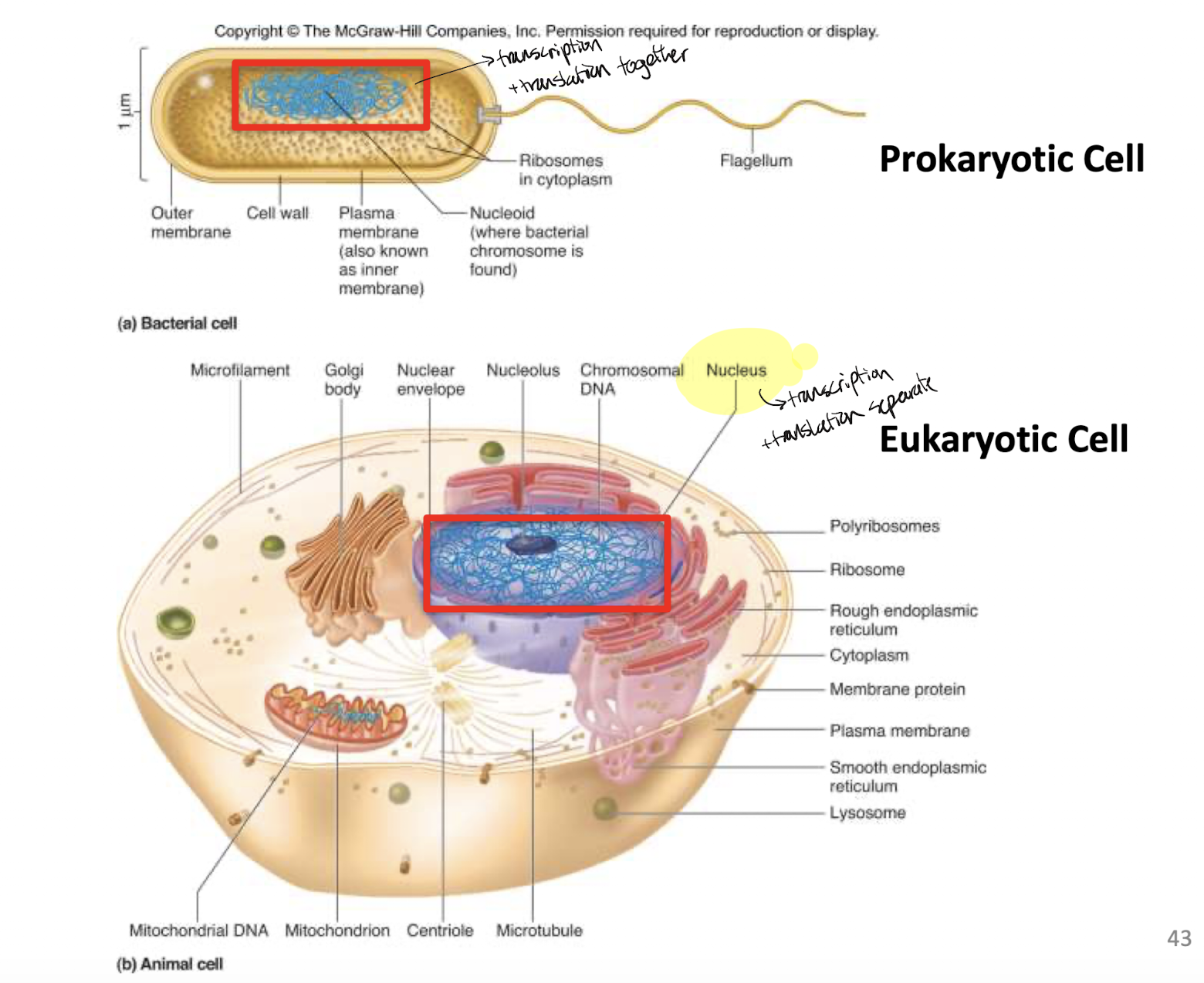
Where are chromosomes located in prokaryotes and eukaryotes? Relate this to their methods of translation/transcription.
Prokaryotes: chromosomes located throughout the cell, localized. Transcription and translation happen together
Eukaryotes: chromosomes located in the nucleus. Transcription occurs in nucleus, translation occurs outside (separate)