PSY220 Lecture 6: Social Cognition
 Call Kai
 Learn
 Practice Test
 Spaced Repetition
 Match
 Flashcards
 Knowt Play
1/49

There's no tags or description
Looks like no tags are added yet.
50 Terms
Key Premise
Human mind has a limited capacity to process social information
People are cognitive misers
Frugal of how want to use cognitive resources
We take shortcuts to understand our world
We assume social cognition is logical, but it is not always that way
We take shortcuts, have biases, that move cognition away from being solely logical
What are Heuristics?
Heuristics are mental shortcuts that people use to make judgements quickly, though sometimes inaccurately, for decisions about uncertain events
They…
Save time
“Good enough” much of the time
Prone to systematic error
Issue is sometimes inaccurate
If certain about something don’t use heuristics, if uncertain use mental short cuts
They save time, don't have unlimited time
Can lead us astray
What are Biases?
Biases are a systematic error or deviation from rational judgment, which occurs due to the reliance on certain heuristics
Biases related
Discrimination, prejudice
Because rely on heuristics have larger systematic biases
Biases based upon the use of heuristics
Impressions & Attributions about Others
Impression we make about people & attributes about others behaviours
How do we form impressions about other people?
1) Snap judgments
What are Snap Judgments?
A quick decision made without extensive deliberation or careful consideration of all the available information
Gut feelings
First impressions
When form impressions, make them very quickly, call them snap judgements
Sometimes "gut feelings" or first impressions
Happen quickly
If you're in danager, make snap judgement protective & personal safety important
When can they be bad?
Based on deeper stereotypes, not processing information in logical way, bringing own bias to bar
Judging Faces
Research relies on faces as stimuli, remove other features, hair & background
Show participants
Asking participants to look at face & rate on these qualities
Manipulated how long participants had to make judgments
One condition look as long as you need, look at face, make ratings (Gold standard)-as long as you need to make judgement
1 condition 1s
Another condition 0.5
Last condition 100ms
Not long time to look at face & make judgement
Ratings in other conditions highly correlated with top group
Getting as much time as needed wasn’t producing wildly different results
Suggest we doing a lot of processing of faces very quickly, making snap judgements of whether competent, likeable and do that very fast
Initial impression happens very quickly, doesn't seem to change

Judging Faces: Trustworthy vs. Dominant
Most trustworthy = less dominant
Least trustworthy = more dominant
2 traits one's people make very snap: trustworthy, dominance
High trustworthy faces look very different than non trustworthy an
Negatively associated
Eyebrows: dominant pronounced, eyebrow ridge, smaller eyes
Eyes big in trustworthy, low dominance
Dominant hyper-masculine, low dominance baby face

Are snap judgments accurate?
Not always but can be predictive of what actually is going on
If totally wrong would be selected out, can be useful but not always the way to go
Reflect our own biases we bring in
Making Attributions
We are meaning makers
We seek to determine the cause of something
We make attributions
When have longer time more thoughtful
Motivated to make attributions
We are meaning makers
How we create a predictable world
Interested in making attributions of why others ask the way they did.
Making Attributions about Others: What is the Covariation Principle?
1) Consensus
2) Distinctiveness
3) Consistency

What is the Covariation Principle?
One way individuals go about making attributions and whether hearing or seeing reflection of person saying it or the actual environment
Imagine friend of yours telling you there's a really good movie, do I spend money on this movie or this more of a reflection of this person, how should I make this attribution
3 covariations people attune to
1) Consensus
What would most people do in a given situation?
If consensus high "yes" other people also raving about this movie
If low, ask other friends and they tell you it sucks
Starting to see things differently
2) Distinctiveness
What does the individual do in different situations?
Does this friend rave about other films, that would mean low on distinctiveness, they always say that
Versus friend doesn't like a lot of movies, and say I like this movie.
3) Consistency
What does the person do in a given situation on different occasions
Has to be high for you to make attribution, always
Have to expect it was amazing on Monday, the same on wed, not totally different view
Depending on pathways make very different attributions
Imagine friend tells you movie amazing, other people don't think its amazing, always raves about the film, think its something about them , not going to pay and watch this movie
Alternately other people rave, friend doesn’t rave, then maybe something about stimulus, world, movie that is generally good
Use these 3 principles generally, to figure out how make attribution
About that person vs. reality, stimulus talking about

(1) Making Attributions: Is the cause internal (dispositional) or external (situational)?
Go on a first date, have great time, then go on second date and say no not interested
Try to make attributions to find out what happened
Location of the cause
Internal to person or external (situational)
Maybe they have different personality and decided your not a good fit for them (internal)
External: maybe wrong restaurant, loud, make different attribution if think external cause outside that person

(2) Making Attributions: Is the Cause Stable or Unstable?
Is the cause stable or unstable?
Maybe fundamental different between you two, won't change over time
Maybe something specific at that one moment; bad day at work, stressed, in bad mood, unstable,

(3) Making attributions: Is the cause global or specific?
Global or specific?
Global cause effects many areas: other social areas, maybe that person doesn't like close relationships, impact friendships, romantic relationships, work ones, not into closeness with other people
More specific: strong idea of what looking for in partner, doesn't extend to friendships
Change how you approach situation
Unstable cause, external, more specific can try to address it, push for second date
If internal, stable & global reason best to give up and move on
Use this to decipher how should behave
What is Self-Serving Bias?
Tendency to attribute failure and other bad events to external circumstances and to attribute success & other good events to oneself (more internal reasons)
Sports Study that shows Self-Serving Bias
Attribution for own team wins and losses
Blue bar ref calls or luck
Orange outcome comes from own teams performance
Self serving bias (team as yourself)
If win, own performance
If loss, attribute to some external (back calls or ref calls)
Example of how people make attribution in self serving bias

What is the Fundamental Attribution Error?
The tendency for people to underestimate situational influences and to overestimate person influences on other people’s behaviour
Tend to think about other people behaviour driven by own internal dispositions and underestimated by external
When driving: someone cuts someone off, vs. when we do it
Overreliance on internal qualities for other people
Castro Study
In this study people asked to right short cogent essay defending or criticizing Castros Cuba
Essay in support or against Castro
Either assigned to condition or choose to write the essay

Castro Study

Fundamental Attribution Error in the real World
would treat meanly, don’t take into account actor and think had some qualities as characters
Internal attributions for other peoples behaviour
Why do we make the fundamental attribution error?
People are more salient than situations
Actor-observer Bias: tendency to focus on situational influences when you are an actor, but internal influences when you are an observer
“everyone is responsible for their own behaviour… except me”
Actor observer bias
Protective bias
Combining fundamental and self serving
Fundamental only about other people
Self serving only about you
Judgement & Decision Making
Biases in Judgement & Decision Making
1) How information is presented
2) How we seek information
3) How we process information
1) How Information is Presented to us: What are Framing Effects?
The influence on judgment from the way information is presented (including the order in which information is presented or the words used to describe the information)
Prob go towards 80% fat free, sounds better
Influences perception of it
Its same yogurt just different descriptions

Order Effects
Things in beginning of sequence remembered & attended to more and end of sequence

Temporal Framing
Its august ask to go to Muskoka October 17, paid for, you agree
Now it’s the 14th stressed, need to study, colder than realized, car ride going to be long won't have enoyg
All these concrete things coming to mind

Temporal Framing: What is Construal Level Theory?
Psychological distant actions & events are thought about in abstract terms
Actions & events that are close at hand are thought about in concrete terms
Moving Study
Participants imagine 7 different activities
One condition think about moving a year from now, another group moving tomorrow, describe activities
Ras went through and rated on whether abstract or concrete
When thinking 1 year from now, listed more abstract activities
Tomorrow: boxes, packing, specific activities, most activities were coded by Ras as concrete

Tedtalk: The Paradox of Choice
Having lots of choices, seems like a good thing but when faced with lots of options/choices, makes us less happy
2) How we Seek Information
What is Confirmation Bias?
Tendency to test a proposition by search for evidence that supports it
Have certain belief, look for info in way confirming belief
E.g. how search information matters, biased in how we do that
Interview Study
Researchers asked participants to interview someone
One group asked to determine whether interviewee extrovert, or introverted (shy)
Participants trying to find extroverts asked more questions about being sociable
Leading question
In contrast those looking for introverted picked questions more focused on social withdrawal: not choosing same questions from list of possible questions
Quickly questions about social connection, sociability (extrovert)

How news feed algorithms superchange confirmation Bias
3) How we Process Information
What is Top-down Processing? What is Bottom up processing?
Top-down
Theory driven
Individual filters & interprets new information in light of pre-existing knowledge & expectations
Bottom up
Data-driven
Individuals form conclusions based on stimuli encountered in the environment
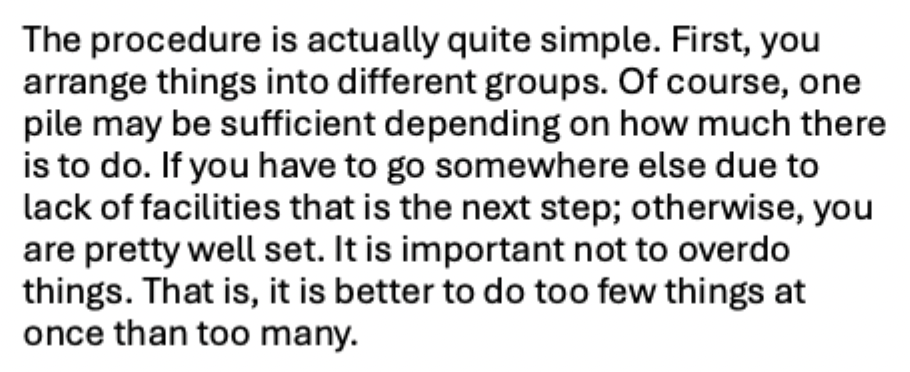
Example
Means nothing to you
Imagine given schema: Washing Clothes
Top-down
Makes more sense
Schemas help us make sense of the world
What is a Schema?
A mental structure that helps people organize knowledge about a stimulus
Have schemas about everything
Schemas:
Guides attention
e.g., count how many times the players wearing white pass the basketball
Gorilla suit
Gets filtered out, actually look at it
Influences memory
Guide Behaviour
Because tell us what to expect, can affect how we behave
Librarian/Waitress Study
Watched video of husband and wife, half told wife librarin, half waitress
Asked what kind of book wife received
When told wife librarian recall she received a history book, schema of librarian,
Participant told she was waitress, was romance novel
How remember things influenced by schemas we have

Schemas Impact Behaviour: What is Self-Fulfilling Prophecy?
We have expectations about what another person is like
It influence how we act towards that person
This causes that person to behave consistently with our original expectation


Behaviour Example: Self-Fulfilling Prophecies
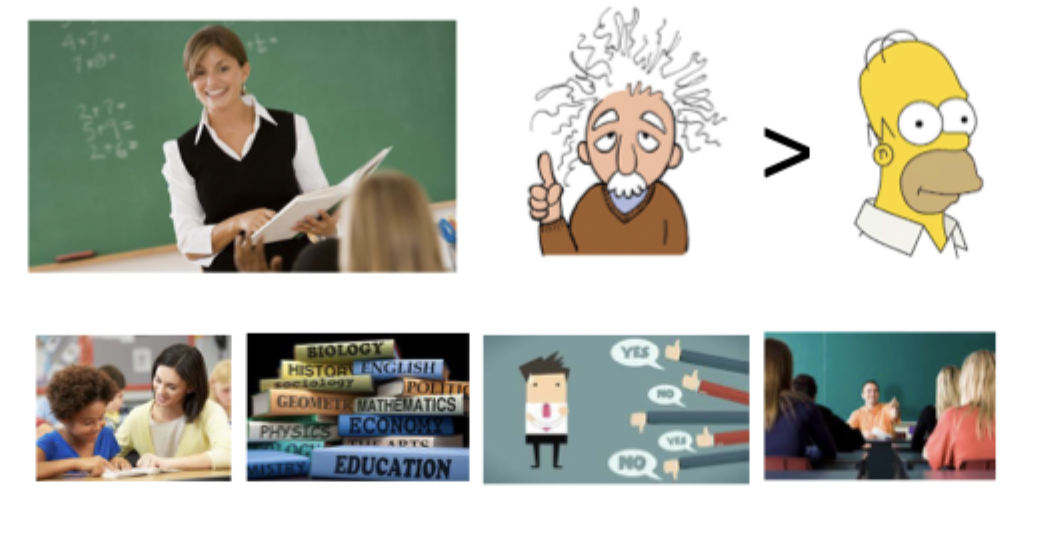
Done with elementary school kids and teachers
Given IQ test, regardless of how tested some told scored highly (bloomers), or very low
Chosen totally randomly did not reflect how students did
Knowing 2 conditions create different expectations how does it change teachers behaviour
teachers treated "bloomers" differently, more personal attention in classroom, more motivation and support
Gave them more and better feedback on word, more material to learn, more difficult material
More opportunities in class, pick on them
Impacts how treated students
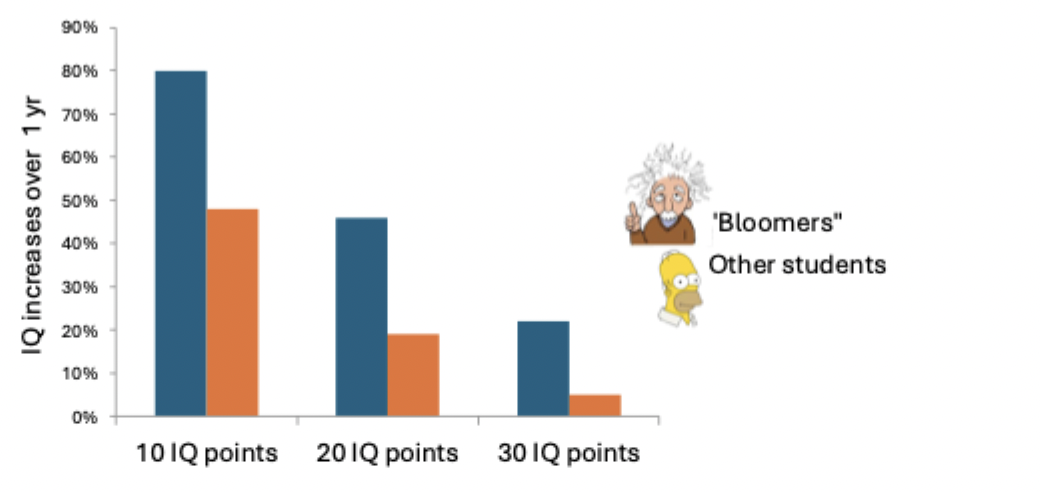
Behaviour Example: Self-Fulfilling Prophecies Results
Everyone increasing
Bloomers always increased more, doing better
Getting different environments by their teachers
These students doing better bc expectation of teachers such, created better environment
Heuristics vs. Rational Thinking

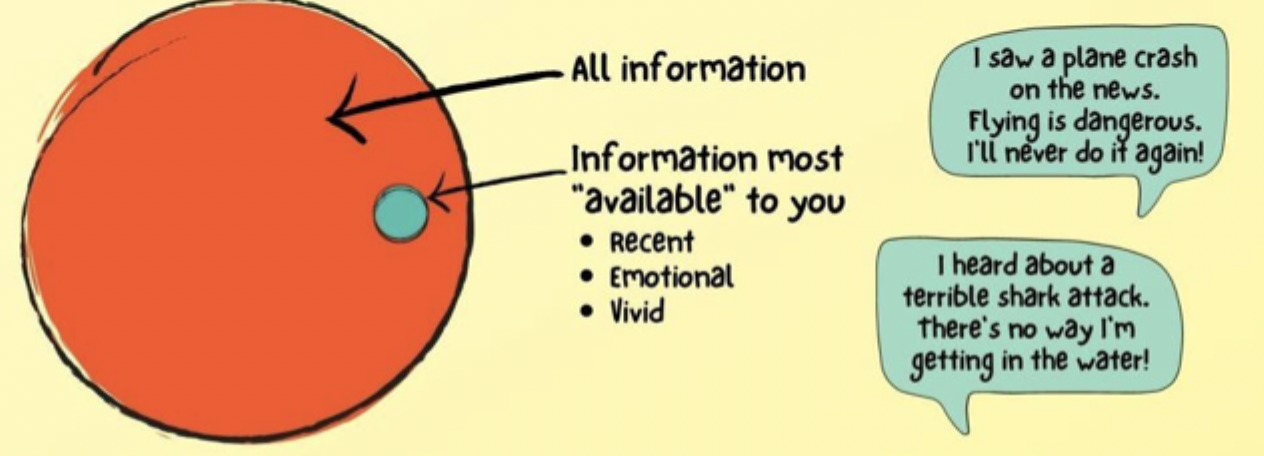
What is the Availability Heuristic?
The tendency to judge the frequency or likelihood of a event by the ease with which relevant instances come to mind
causes people to overestimate the danger of a plane crash even though quite rare
WHat is Representativeness Heuristic?
The tendency to judge the frequency or likelihood of an event by the extent to which it resembles the typical case
Stereotype of what a doctor looks like
Idea of what prototypical case of something is, when encounter case not prototypical struggle with it

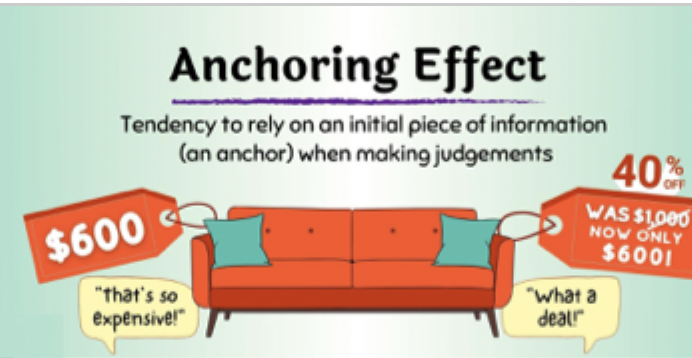
What is the Anchoring Heuristic?
People’s estimates of unknown quantities are easily biased by what values the consider, even when those values are obviously arbitrary & irrelevant
Anchoring Heuristic Study
One condition not given any anchor
Then in another given different anchor "suggested among 5 dollar for example)
Control, no anchor
Selling online, price higher anchor, negotiation

Why are Anchors so effective?
They are sometimes believed to be informative
In cases of extreme uncertainty, any value that comes to mind will seem plausible
Anchors are defaults
move off them
Other Heuristics