BIOCHEM CARBS + LIPIDS
 Call Kai
 Learn
 Practice Test
 Spaced Repetition
 Match
 Flashcards
 Knowt Play
1/19

There's no tags or description
Looks like no tags are added yet.
20 Terms
CARBOHYDRATES
• true polymers;
exhibit all 3 polymer properties
limited set of monomers
created by dehydration synthesis
broken down by hydrolysis
• composed of C,H & 0 in a 1:2:1 ratio
• -ose ending; commonly called SUGARS and STARCHES
• major biochemical functions
IMMEDIATE source of E
cell identification
glucose storage
cell structure
CARBOHYDRATE MONOMERS
monomer = MONOSACCHARIDE
• glucose, fructose, galactose, ribose, deoxyribose
C5 or C6 organic rings
• most common = glucose (C6H12O6)
MONOSACHHARIDES

GLYCOSIDIC LINKAGE
special covalent bond formed between 2 monosaccharides via dehydration synthesis
CARB POLYMERS


DISACCHARIDES
• TWO monosaccharides joined by a glycosidic linkage created by dehydration synthesis
• IMMEDIATE E source for cells
• Ex: sucrose, maltose, lactose

OLIGOSACCHARIDES
• 3 -10 monosaccharides in a chain joined by glycosidic linkages created by dehydration synthesis
• play important roles in CELL IDENTIFICATION; (cell-to-cell recognition)
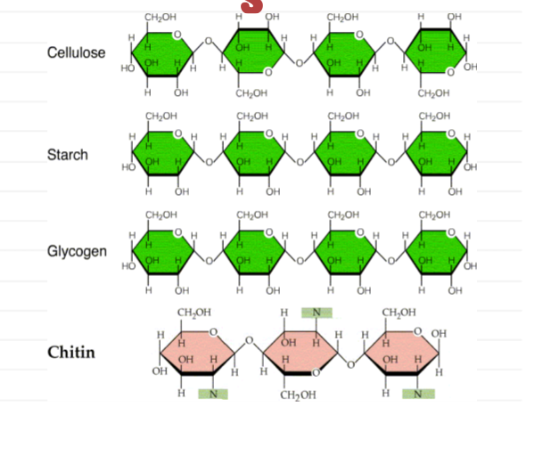
POLYSACCHARIDE
• HUNDREDS of monosaccharides joined by glycosidic linkages created by dehydration synthesis
function in GLUCOSE STORAGE or CELL STRUCTURE
ex.
Cellulose; STRUCTURAL plant cell walls
Chitin; STRUCTURAL strengthens exoskeletons in insects and fungal cell walls
Starch; plant GLUCOSE STORAGE potatoes and grains
Glycogen; animal GLUCOSE STORAGE stored in liver and muscle cells
LIPIDS
• mainly C, H & O (in no particular ratio) sometimes P
• DIVERSE group of molecules
• NOT all considered true polymers
• NO true monomer
• "sort of" monomers = FATTY ACIDS + GLYCEROL
• ONLY found in 2 out of the 3 lipid families
UNIFYING LIPID PROPERTY
• all lipids are HYDROPHOBIC & "H2O fearing"
• extremely NONPOLAR
mainly chains or rings of HYDROCARBON
comprised entirely of nonpolar covalent bonds

GLYCEROL
• lipid monomer
• 3-carbon chain that contains 3 hydroxyl groups

FATTY ACIDS
• lipid monomer
• long HYDROCARBON CHAIN with a CARBOXYL group
• fatty acids that contain ONLY single bonds between C atoms are SATURATED
• fatty acids that contain double bonds between C atoms are UNSATURATED
UNSATURATED FATTY ACIDS
• contain at LEAST one DOUBLE bond between the C in the hydrocarbon chain
• create a "kink" at every double bond

ESTER LINKAGE (BOND)
• covalent bond created via dehydration synthesis between the glycerol
molecule and a fatty acid
• formed between one of the glycerol hydroxyl groups and the fatty acid carboxyl group

TRIGLYCERIDES
• true polymer
• created by dehydration synthesis using 3 fatty acids and 1 glycerol
• major functions - LONG TERM E STORAGE and INSULATION
• held together by 3 ESTER LINKAGES
• created by dehydration synthesis
• 3 fatty acids + 1 glycerol
• removes 3 H,O molecules

TRIGLYCERIDE FATS & OILS
FAT;
triglycerides in animals
• solid at room temperature contain only saturated fatty acids
• fatty acids stack close together
OIL
• triglycerides in plants
liquid at room temperature
contain unsaturated fatty acids
• "kinks" prevent fatty acids stacking close together
PHOSPHOLIPIDS
• major component of ALL biological membranes
• modified polymer; only partially created by dehydration synthesis
• 1 glycerol molecule attached to 2 fatty acids & a PHOSPHATE group
PHOSPHOLIPIDS HYDROPHILIC/PHOBIC
HYDROPHILIC head; "water-liking"
polar because of negatively charged phosphate group
head comprised of the glycerol + phosphate
HYDROPHOBIC tails; "water-fearing"
nonpolar because of fatty acid hydrocarbon chains
tails comprised of the fatty acids
STEROIDS
• not a polymer —> not created by dehydration synthesis
functions:
• animal cell membrane structure
• cell communication as hormones
• C-skeleton of 4 fused rings
CHOLESTEROL
• most ABUNDANT steroid in humans
• ONLY steroid utilized in animal cell membranes