B3.1 Gas exchange
 Call Kai
 Learn
 Practice Test
 Spaced Repetition
 Match
 Flashcards
 Knowt Play
1/68

There's no tags or description
Looks like no tags are added yet.
69 Terms
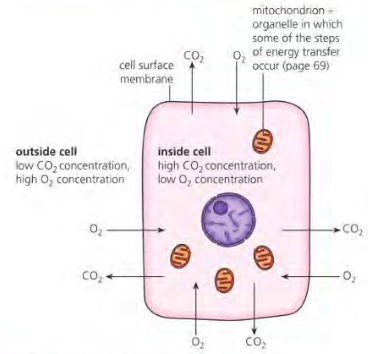
gas exchange
exchange of respiratory gases between an organism and its surroundings
in animals: the uptake of oxygen and release of CO2
in humans: the transfer of oxygen and carbon dioxide between the air in the alveoli and the blood in the surrounding capillaries
in plants: uptake of oxygen and release CO2 at night and take in carbon dioxide and release oxygen during the day
cellular respiration
a set of metabolic reactions that convert nutrients like glucose and oxygen into usable energy in the form of ATP, releasing carbon dioxide and water as waste products, it occurs continuously in living cells (in mitochondria of eukaryotes and cytoplasm of prokaryotic cells).
diffusion
the passive movement of molecules from high to low concentration by which the gases move across the alveolar-capillary membrane
factors determining the rate of diffusion
size of the surface area- greater surface area=greater rate of diffusion
concentration gradient- greater gradient=greater diffusion , rapidly respiring organism has lower concentration of oxygen in the cells and higher than normal concentration of carbon dioxide
length of the diffusion path- shorter diffusion path=greater rate of diffusion
temperature- higher temperature= faster diffusion due to increased kinetic energy of molecules (not in warm-blooded animals)
challenges of gas exchange
increase with the size of an organism due to decrease in their surface area-to-volume ratio, and the distance to the centre of an organism to exterior increases
increase in active organism due to increased metabolic rate
properties of gas-exchange surfaces
permeability- allow gasses across
thin tissue layer- to make the shortest distance for diffusion
moisture- gasses dissolve in moisture, helping them to pass across
large surface area- large quantities of gases can cross at the same time
concentration gradient
the difference in concentration of a substance between one area and another
how are concentration gradients maintained?
capillaries provide a large surface area for diffusion, blood carries the gases (in red blood cells-oxygen, and in plasma- carbon dioxide)
continuous blood flow- carries oxygen away from the gas-exchange surfaces in the capillaries and carbon dioxide to them
ventilation- brings oxygen to the gas exchange surfaces and removes carbon dioxide
gas exchange in mammals
lungs provide large, thin, moist surface area however they are in protected position inside thyroax so air must be brought to respiratory surface there - they must be ventilated
ventilation system
pumping mechanism driven by the diaphragm and rib muscles that moves air into and out of the lungs, maintaining concentration gradients for diffusion, it refreshes the air inside the alveoli
diffusion in mammals is improved by:
blood circulation system- rapidly moves oxygen and maintains concentration gradient in the lungs
respiratory pigment- increases oxygen-carrying ability of blood
thorax
in mammals the upper part of the body separating the abdomen, an airtight chamber formed by the ribcage and its muscles, with a domed floor- diaphragm

structure of lung of mammals
lungs in the thorax
intercostal muscles
diaphragm
pleural membrane with pleural fluid

intercostal muscles
muscles between the ribs involved in ventilation
external contract to expand chest
internal contract to expell air from lungs
diaphragm
sheet of muscle separating thorax from abdomen, during inhalation it contracts moving down and flattening, during exhalation it relaxes curves up
pleural membrane
lines lungs and thorax cavity, it secretes pleural fluid, suction in the space keeps the lungs tied to the movement of the rib cage and diaphragm
trachea
windpipe that clears the air from dust and germs
bronchus/bronchi
tube connecting trachea with the lungs
bronchiole
small terminal branch of a bronchus
aveolus/aveoli
air sac in the lung, oxygen from the air passes through it and into the blood, carbon dioxide moves from the blood into the alveoli so you can breathe it out. Surfactant coats the inside of each sac to keep it from collapsing
gas exchange in humans
mouth/nose->pharynx->larynx->trachea->bronchus->bronchioles-> aveoli->walls->capilarries->bloodstream with oxygen->heart-> lungs->exhale carbon dioxide
pulmonary artery
deoxygenated blood from the right side of the heart to the lungs and returns oxygenated blood to the left side of the heart to be pumped to the rest of the body
aveoili and surface area
they have a large surface area for gas exchange which is caused by their small size and large quantities not due to its spherical shape
surfactant
is secreted by cells in the wall of aveoli, lines the inner surface of the aveoli and reduces friction, lowers the surface tension, permiting the aveoli to flex easilly
adaptations of lung for gas exchange
presence of surfactant
branched network of bronchioles
extensive capilary beds
large surface area
diffusion in lungs
As blood flows past the aveoli, gaseous exchange occurs by diffusion. Oxygen dissolves in the aveolar surface film of water, diffuses across into the blood plasma and into the red blood cells, where it chemically combines with haemoglobin to form oxyhaemoglobin. At the same time, carbon dioxide diffuses from the blood into the aveoli
on inspiration
the volume of the thorax increases
the walls of aveolus and terminal bronchiole is stretched
external intercostal muscles contract
internal intercostal muscles relax
diaphragm muscles contract and go down
air is drawn in
ribs moved upwards and outwards
on expiration
the volume of the thorax decreases
the aveolus and terminal bronchiole revert to resting size, due to recoil of the elastic fibres
external intercostal muscles relax
internal intercostal muscles contract
diaphragm muscles relax
air is expelled
ribs moved downwards and inwards and the diaphragm up
tidal
air enters and leaves by the same route in lungs of mammals
features of aveoli for gas exchange
surface area
wall- thin squamous (flattened) epithelium so diffusion pathway is short
capillary supply- maintains the concentration gradient of O2 and CO2
surface film of moisture- O2 dissolves in water lining the aveoli, and diffuses into the blood
surfactant producing- reduces surface tension and stops aveoli walls from sticking together, keeping aveoli open
ventilation of lungs
air is drawn into aveoli when the air pressure in the lungs is lower than atmospheric pressure and conversly. Pressure changes in the lungs occur when the volume of the thorax changes.
spirometer
used to analyse the pattern of change in lung volume during breathing
tidal volume
volume of air normally exchanged in breathing
inspiratory reserve
difference between maximum infpiratory level and tidal volume
expiratory reserve
difference between maximum expiratory level and tidal volume
Vital capacity
total amount of air exhaled after maximal inhalation
calculated by adding tidal volume, inspiratory reserve volume and expiratory reserve volume
ventilation rate
number of inhalations or exhalations per minute
adaptations for gas exchange in leaves
thin epidermis so very short diffusion distance
large surface to volume ratio which maximizes the absorption of sunlight and allows more room for stomata.
vascular bundles supply the water needed for transpiration and cell turgidity while removing photosynthetic products
palisade mesophyll containing stomata
spongy mesophyll containing air spaces ensuring gases can quickly diffuse directly to and from the palisade mesophyll
cell walls inside are moist which allows gases to dissolve before diffusing
epidermis
outer layer of cells
mesophyll tissue
parenchyma cells containing chloroplasts, there two types of mesophyll tissue:
Palisade Parenchyma: upper layer of tall, tightly packed cells that hold the most chloroplasts to capture sunlight.
Spongy Parenchyma: lower layer of loosely packed, rounded cells with big air gaps that let gases move around
vascular tissue
xylem and phloem of plants
vascular bundle
strands of xylem and phloem separated by cambium; the site of water and flood movements up and down the stem
palisade mesophyl
columnar cells containing many chloroplasts found beneath the upper epidermis in leaves, performs most of the plant's photosynthesis
spongy mesophyll
rounded cells in the leaf that are loosely packed, creating air spaces where air circulates, providing a large surface area for gas exchange, contains chloroplasts but fewer than palisade mesophyl

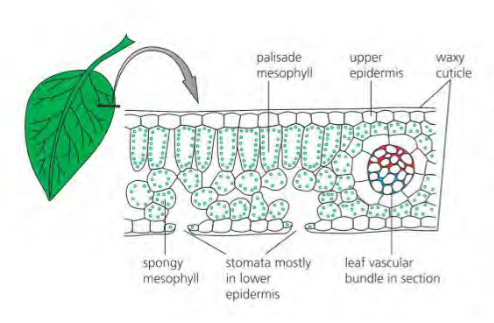
waxy cuticle
upper epidermis
palisade mesophyll
part of vascular bundle in section-running parallel to the plane of section
spongy mesophyll
lower epidermis (contains stomata)
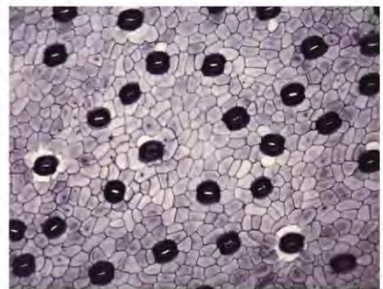
stoma/stomata
pore in the epidermis of a leaf surrounded by two guard cells which open or close due to the change in turgor pressure
turgid
condition where the vacuole of plant cells is full of water, pushing the cell membrane against the cell wall
flaccid
plant cell that has become soft and less rigid than normal because the cytoplasm shrunk and contracted away from the cell walls through loss of water
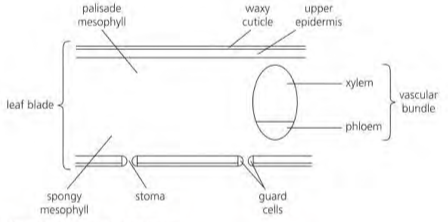
adaptations of leaf for gas exchange
waxy cuticle
epidermis
air spaces
spongy mesophyll
stomatal guard cells
veins (vascular bundle)
waxy cuticle
forms impermeable barrier so gases must leave via stomata allowing gas exchange and water loss controlled
epidermis
form the outer protective skin layers that sandwich the inner tissues of a plant leaf
upper epidermis (adaxial side)- covered by thick waxy layer to prevent water loss in direct sunshine, usually lacks stomata
lower epidermis (abaxial side)- contains many pores (stomata) that facilitate gas exchange
air spaces
allow gases to circulate around loosley packed spongy mesophyll cells maintaining concentration gradient between air and cells
spongy mesophyll
Sits below the palisade layer and above the lower epidermis, provides large surface area for gas exchange- CO2 entering, O2 leaving
stomatal guard cells
open and close to control gas exchange and water loss
veins (vascular bundle)
carry water to the leves which is then lost by stomata in transpiration. water is needed for photosynthesis- CO2 too, and so ongoing photosynthesis in the leave,s driven by water supply via veins and carbon dioxide through stomata, maintains concentration gradient of both molecules
transpiration
The evaporation of water vapor from plant surfaces
plants take up water in the roots which then travels through xylem and when reaches the epidermis the evaporation of water vapour from spongy mesophyll tissue starts and its subsequent diffusion through the stomata
factors affecting the rate of transpiration
temperature- causes evaporation of water.
humidity- high=slow transpiration
wind- sweeps away water vapour
light intensity- stomata open in light resulting in loss of water vapour
potometer
investigation of the effect of one abiotic variable on the rate of transpiration, it measures water uptake
stomatal density
higher stomatal density can greatly increase water loss and carbon dioxide uptake, it can vary between different species
performing a leaf cast to determine stomatal density
spread nail vanish thinly on underside of leaf
let it dry and take piece of transparent tape and place it on
pick up the tape and put it sticky side up on a slide
view under miscroscope
partial pressure
the pressure of specific gas in a mixture of gases
oxygen dissociation curve
graph of percentage saturation (with oxygen) of haemoglobin against concentration of available oxygen
haemoglobin
is an allosteric protein and occurs in red blood cells and is built of four interlocking polypeptide subunits which are composed of large globular protein with non-protein haem group attached, containing iron. Each haemoglobin can transport four molecules of oxygen: Hb+4O2→ HbO8
cooperative binding
process where the addition of a substance to the subunit of macromolecule increases the affinity of a neighbouring subunit for the same substance
the shape of haemoglobin is altered as each oxygen molecule binds, making each successive binding of oxygen easier.
adaptations of foetal haemoglobin for transport of oxygen
foetal haemoglobin has higher affinity of oxygen- foetus can only access to an oxygen supply via the placenta
allosteric protein
protein that can exist in multiple conformations depending on the binding of a molecule (at a site other than the catalytic site)
allosteric effector of haemoglobin
carbon dioxide attaches to haemoglobin, making it more difficult for oxygen to bind, lowering the affinity of haemoglobin for oxygen
Bohr effect
the decrease in the oxygen affinity of haemoglobin in response to decreased blood pH, resulting from increased carbon dioxide concentration in the blood