Conceptual/Image identification
 Call Kai
 Learn
 Practice Test
 Spaced Repetition
 Match
 Flashcards
 Knowt Play
1/5

There's no tags or description
Looks like no tags are added yet.
6 Terms

Identify the platyrrhine and catarrhine using at least three structural features
The platyrrhine has broad nostrils, three molars, no bony ear tube, and zygomatic-parietal contact
The catarrhine has narrow nostrils, two premolars, a bony ear tube, and frontal-sphenoid contact

Which teeth belong to an Old World Monkey (catarrhine), and which belongs to an ape?
They indeed have different molars, even though apes are also catarrhines:
The Old World monkey has bilophodont lower molars with two transverse ridges
The Ape has a Y-5 lower molar with 5 cusps separated by a Y-shaped groove

Identify the colobine and cercopithecine and predict their diets
First of all, they are both a type of catarrhine:
Colobines mostly live in Asia:
they have narrow incisors
a deep jaw
high cusps
a complex stomach (gut)
long hindlimbs and tail
mostly leaf eaters
Cercopithecines mostly live in Africa:
they have broad incisors
a shallow jaw
low cusps
cheeck puches
similar arm and leg length features
fruit eating and omnivory

what type of primate is this?
This is prehensive tail, so that means this primate is a platyrrhine
only platyrrhines has prehensive tails
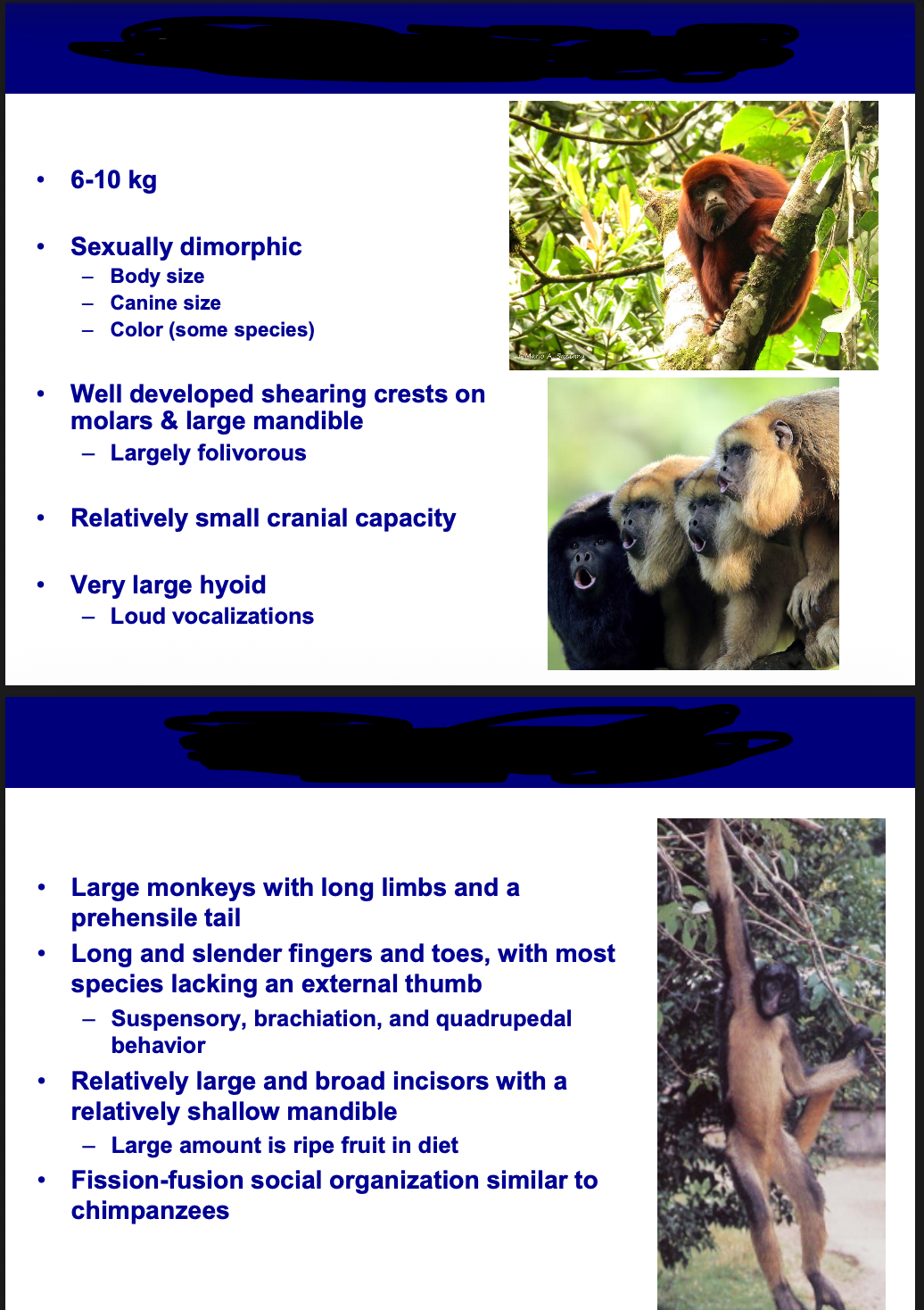
Which is the howler and which is the spider monkey?
The howler has a robust jaw and shearing molars for leaf-eating, plus a large hyoid for loud calls.
The spider monkey has long limbs, a prehensile tail, slender fingers, and usually a reduced external thumb for suspension and brachiation.
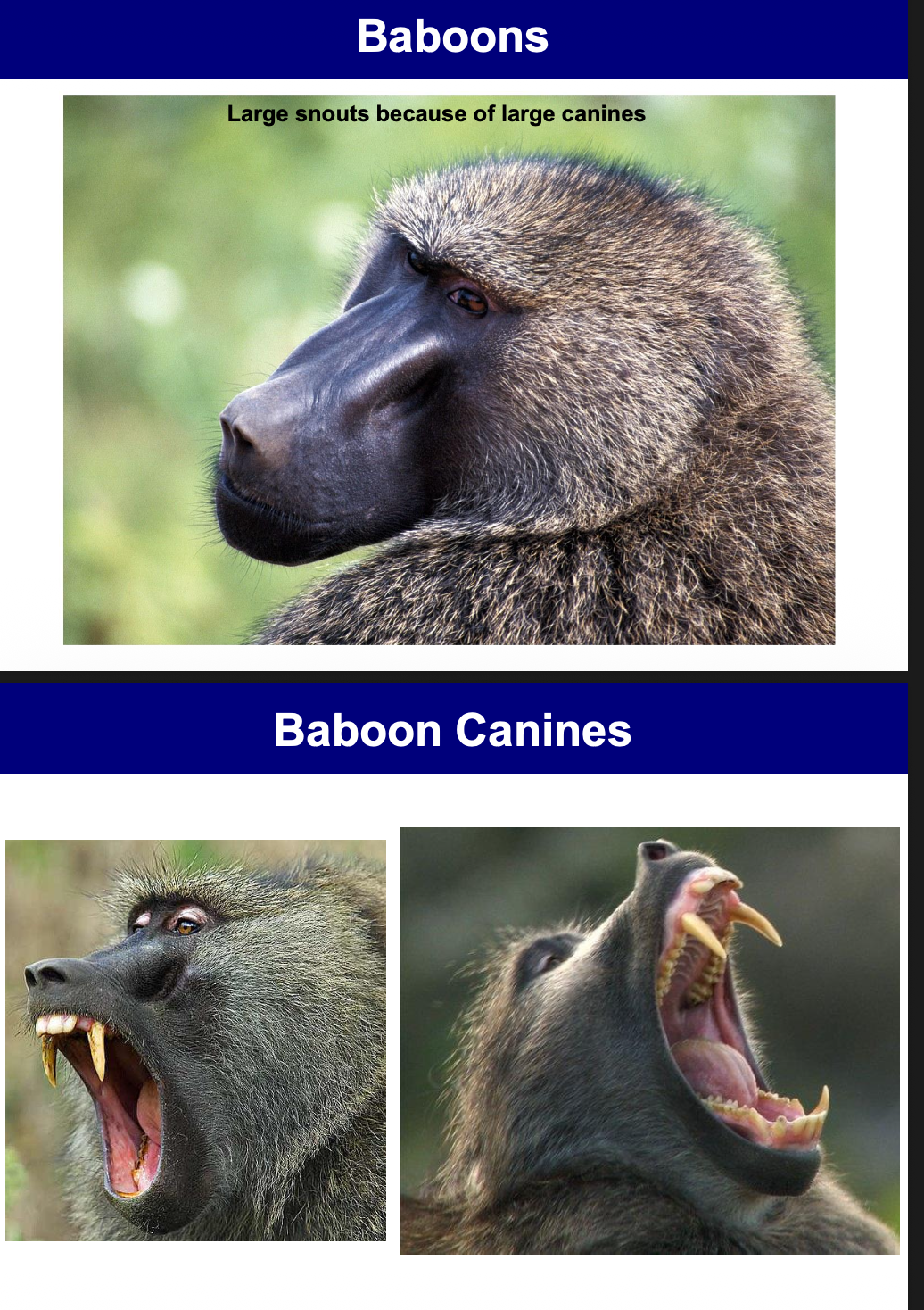
Why do baboons have long, robust snouts, and what pattern accompanies this anatomy?
The snout accommodates very large canines. Baboons are also strongly sexually dimorphic: males are generally larger and have larger canines than females.
So the males are bigger for sexual selection for females/male competition