Deck General Q111
 Call Kai
 Learn
 Practice Test
 Spaced Repetition
 Match
 Flashcards
 Knowt Play
1/209

There's no tags or description
Looks like no tags are added yet.
210 Terms
Bulk cargo refers to which of the following statements?
A. A cargo which requires refrigeration during the passage
B. A homogeneous cargo not enclosed in a container
C. A cargo which is very dense in relation to its volume
D. A cargo which occupies a large volume of space on a vessel
B. A homogeneous cargo not enclosed in a container
You must load as much of a large shipment of case goods as possible into a hold which has 24,400 cubic feet of space. Each case measures 2 feet by 2 feet by 4 feet and weighs 448 pounds. If you allow for broken stowage of 15%, how many long tons can be loaded?
A. 259
B. 207
C. 351
D. 54
A. 259
When the dew point of the outside air is lower than or equal to the dew point of the air in the cargo hold, you should __________.
A. shut down the exhaust blowers
B. secure all ventilation
C. ventilate the cargo holds
D. shut down the intake blowers
C. ventilate the cargo holds
Given a dry bulb temperature of 78° F and wet bulb temperature of 66.5° F, what is the dew point?
A. 47.0° F
B. 51.5° F
C. 59.0° F
D. 70.0° F
C. 59.0° F
Under the Carriage of Goods by Sea Act of 1936, a vessel will be liable for damage to a cargo when the damage arises out of which event?
A. Fire caused by lightning
B. Inherent vice
C. Overloading
D. Poor stowage of cargo in a container
C. Overloading
You are using an automatic tension winch by yourself. If you get caught in the turns of the line as they lead into the gypsyhead __________.
A. you may be pulled into the winch and injured or killed
B. the safety cutout will stop the winch before you're injured
C. the line will part and snap back
D. None of the above are correct
A. you may be pulled into the winch and injured or killed
According to the Chemical Data Guide, fuel oil number 6 has a flash point (degrees F) of __________.
A. 65
B. 80 - 100
C. 110 - 140
D. 150 - 430 (cc)
D. 150 - 430 (cc)
According to the IMO Code, what are the minimum number of securing points that should be on each side of a "road vehicle", whose gross vehicle mass is between 30 tons and 40 tons, when carried on Ro-Ro vessels?
A. One
B. Two
C. Three
D. Four
D. Four
Using the available references, if the dry bulb temperature is 92° and the wet bulb temperature is 85°, what is the relative humidity in a cargo hold?
A. 75 percent
B. 81 percent
C. 84 percent
D. 88 percent
A. 75 percent
What does it mean to "shore up" the main deck for the stowage of deck cargo?
A. Strengthen the main deck by placing pillars underneath it in the tween decks
B. Package the cargo in wooden crates so it will not damage the deck
C. Distribute the weight of the cargo by placing fore-and-aft planks on the main deck
D. Weld pad eyes on deck in proper position to secure the cargo
A. Strengthen the main deck by placing pillars underneath it in the tween decks
Segregation of cargoes refers to __________.
A. separating cargoes by destination
B. listing the cargoes in order of their flammability
C. classifying cargoes according to their toxicity
D. separating cargoes so that the inherent characteristics of one cannot damage the other
D. separating cargoes so that the inherent characteristics of one cannot damage the other
How should you signal the crane operator to raise the boom?
A. Extend arm with fingers closed and point thumb upward.
B. With forearm vertical and forefinger pointing up, move hand in small horizontal circles.
C. Extend arm with the thumb pointing up and flex the fingers in and out.
D. Place both fists in front of the body with the thumbs pointing upward
A. Extend arm with fingers closed and point thumb upward.
What does "level-luffing" accomplish during crane operations?
A. It maintains the height of the load above the deck.
B. It prevents the load from swinging when the boom level is adjusted.
C. Less power is needed when topping the boom with a load on the hook.
D. All of the above
D. All of the above
Which statement is FALSE concerning precautions during fueling operations?
A. Fuel tanks should be topped off with no room for expansion.
B. All windows, doors, hatches, etc. should be closed.
C. A fire extinguisher should be kept nearby.
D. All engines, motors, fans, etc. should be shut down when fueling.
A. Fuel tanks should be topped off with no room for expansion.
In order to reduce the accumulation of static electricity while loading petroleum products, you should __________.
A. use the overall method of loading only
B. start to load slowly
C. increase the air flow into the tank
D. start to load at maximum pressure
B. start to load slowly
A tank vessel transferring non-flammable hazardous cargo in bulk must display warning signs. These signs must __________.
A. use black lettering on a white background
B. be visible from both sides and from forward and aft
C. be displayed only while transferring cargo and fast to a dock
D. indicate "NO SMOKING"
A. use black lettering on a white background
According to U.S. regulations, how many emergency outfits are required to be carried onboard all tankships over 1,000 gross tons?
A. Three emergency outfits
B. Two emergency outfits
C. Four emergency outfits
D. One emergency outfit
B. Two emergency outfits
Which statement is TRUE concerning cargo hose on tank barges?
A. Cargo hose must be able to withstand the shut-off head less the static head of the cargo pump but no less than 100 psi.
B. Cargo hose must be able to withstand the static head of the cargo pump but no less than 100 psi.
C. Cargo hose must be able to withstand at least 150 psi.
D. Cargo hose must be able to withstand the shut-off head plus the static head of the cargo pump.
C. Cargo hose must be able to withstand at least 150 psi.
What form of venting of cargo tanks is allowed for a tank barge certificated to carry grade B petroleum products?
A. Gooseneck vents with flame screens
B. Individual pressure-vacuum relief valves with flame screens
C. Straight vents with flame screens
D. Gooseneck vents only
B. Individual pressure-vacuum relief valves with flame screens
A tanker is loaded with 12,000 barrels of #2 fuel oil. The temperature of the product is 88° F. API gravity is 39°. The volume correction factor (VCF) is .0005. The net amount of cargo in gallons, loaded is __________.
A. 496944
B. 511056
C. 650760
D. 669240
A. 496944
You are loading 475,000 barrels of cargo oil. At 0800 on 8 July, you find that you have loaded 174,000 barrels. At 1000, you find that you have loaded 192,000 barrels. If you continue loading at the same rate, you will finish at approximately __________.
A. 1752, 8 July
B. 1940, 8 July
C. 0143, 9 July
D. 1727, 9 July
D. 1727, 9 July
The flame screens installed on tank vents that may contain combustible gases, are designed to prevent explosions by which of the following?
A. absorbing any flammable vapors in the vicinity
B. allowing the escape of flammable vapors
C. preventing flammable vapors from entering the tank
D. dissipating the heat of an external flame
D. dissipating the heat of an external flame
The main underdeck pipeline on a tankship is connected to individual tanks by __________.
A. tank drops
B. line drops
C. crossovers
D. branch lines
D. branch lines
What is the first action you should take to prevent oil from escaping into the sea when ballasting through the cargo piping system?
A. open block valves, then start the cargo pump
B. open sea suction valves, then start the cargo pump
C. open sluice valves, then start the cargo pump
D. start the cargo pump, then open sea suction valves
D. start the cargo pump, then open sea suction valves
You start a centrifugal cargo pump to discharge cargo. The pump works for a while and then loses suction. This could be caused by __________.
A. the pump running backwards
B. the discharge head being too high
C. incomplete priming
D. All of the above
C. incomplete priming
What is an advantage of a gate valve over a butterfly valve?
A. More compact
B. Cheaper
C. Less frequent maintenance
D. Faster operation
C. Less frequent maintenance
The primary hazard of liquefied petroleum gas and liquefied natural gas is __________.
A. flammability
B. temperature
C. pressure
D. toxicity
A. flammability
What is the preferable way to extinguish an LNG fire?
A. Apply mechanical foam.
B. Apply "Purple K" dry chemical.
C. Shut off the source of the gas feeding the fire.
D. Apply water fog
C. Shut off the source of the gas feeding the fire.
Where will the complete details of a crude oil washing system aboard your vessel, including the operating sequences and procedures, design characteristics, a description of the system, and required personnel be found?
A. Code of Federal Regulations
B. Crude Oil Washing Operations and Equipment Manual
C. Oil Transfer Procedures Manual
D. Crude Oil Washing addendum to the Certificate of Inspection
B. Crude Oil Washing Operations and Equipment Manual
What is NOT a precaution to be taken when topping off?
A. Notify the engine room of the procedure.
B. Maintain communications with the dock man.
C. Reduce the loading rate.
D. Give the operation your undivided attention.
A. Notify the engine room of the procedure.
While loading bulk liquid cargo, a tank valve jams open, what is the first action you should take?
A. unplug the deck scuppers
B. call the chief engineer
C. order the shore facility to shut down
D. run out the vessels fire hose
C. order the shore facility to shut down
You start a centrifugal cargo pump to discharge cargo. The pump works fine for awhile and then loses suction. What could have caused this?
A. incomplete priming
B. the pump running backwards
C. the discharge head being too high
D. head pressure on the suction side of the pump
A. incomplete priming
Why is a warning sign displayed at the gangway or access point of a barge during cargo transfer?
A. To keep visitors away from the barge
B. To designate smoking areas
C. To indicate any health risk if applicable
D. To indicate if the cargo is a marine pollutant
A. To keep visitors away from the barge
What is the required gas supply capacity of an inert gas system?
A. 125 percent of shore side loading rate
B. 125 percent of cargo pump capacity
C. 125 percent of forced draft rate
D. 125 percent of fan capacity
B. 125 percent of cargo pump capacity
Which of the following vessels is NOT exempt from mandatory requirements on ballast water management for control of non-indigenous species in waters of the United States?
A. A passenger vessel equipped with a USCG approved system designed to kill aquatic organisms in ballast water.
B. A crude oil tanker engaged in the coastwise trade.
C. United States Navy frigate.
D. A vessel engaged in the foreign export of Alaskan North Slop Crude Oil.
D. A vessel engaged in the foreign export of Alaskan North Slop Crude Oil.
You are offloading garbage to another ship. Your records must identify that ship by name and show her __________.
A. home port
B. Master
C. official number
D. next port-of-call
C. official number
No vessel may use or carry an oil transfer hose unless it meets certain requirements. Which of the following is NOT among those requirements?
A. Metallic reinforcement
B. A bursting pressure that is at least four times the sum of the relief valve setting and the static head
C. A working pressure that is more than the sum of the relief valve setting and the static head
D. Identification markings
A. Metallic reinforcement
A 100-GT vessel, constructed before July 1,1974, is loading diesel fuel. What is the minimum capacity of the drip
pans required for placement under or around each fuel tank vent, overflow, and fill pipe?
A. 1 gallon
B. 5 gallons
C. 1 barrel
D. 2 barrels
B. 5 gallons
How long must a "Declaration of Inspection" be kept on board?
A. One week
B. Two weeks
C. One month
D. Three months
C. One month
You are shifting a gas free tank barge to dry dock for repairs. The barge must have onboard which document?
A. A Permit to Proceed and Hot Work Permit
B. A Gas Free Certificate
C. A valid Certificate of Inspection
D. All of the above
C. A valid Certificate of Inspection
The recessed areas on a wildcat are called __________.
A. devil's claws
B. pockets
C. sockets
D. pawls
B. pockets
Vessels in ocean service shall carry __________. (small passenger vessel regulations)
A. sufficient inflatable buoyant apparatus for all persons on board
B. life floats for 50 percent of all persons on board
C. buoyant apparatus for all persons on board
D. life jackets for 50 percent of all persons on board
A. sufficient inflatable buoyant apparatus for all persons on board
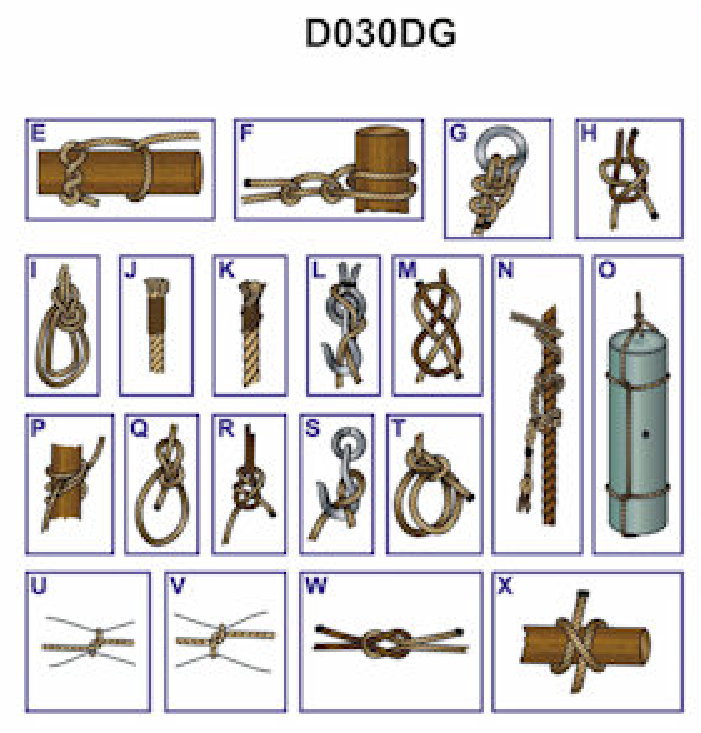
What is the MAIN use of the knot lettered M in in illustration D030DG below?
See Diagram: D030DG
A. provide a seat for a man to work over the side
B. marry two hawsers
C. secure a heaving line to a hawser
D. form a temporary eye in the end of a line
B. marry two hawsers

Which letter in illustration D030DG below represents a plain whipping?
See Diagram: D030DG
A. F
B. V
C. E
D. J
D. J
Which statement is TRUE about nylon line?
A. Nylon stoppers should be used with nylon line.
B. Nylon line is excellent for use in alongside towing.
C. A normal safe working load will stretch nylon line 50 percent.
D. Manila line will usually last longer than nylon line.
A. Nylon stoppers should be used with nylon line.
A piece of small stuff (small line) secured to an object to prevent it from going adrift is a __________.
A. lanyard
B. keeper
C. stopper
D. noose
A. lanyard

In illustration D044DG below, what is the mooring line labeled "A" called?
See Diagram: D044DG
A. offshore stern line
B. after spring line
C. after breast line
D. onshore stern line
A. offshore stern line
In order to pay out or slack a mooring line which is under strain, you should take which action?
A. Stopper the line
B. Sluice the line
C. Surge the line
D. Slip the line
C. Surge the line
Chafing gear __________.
A. reduces and prevents wear caused by the rubbing of one object against another
B. prevents corrosion of running rigging
C. reduces and prevents corrosion of standing rigging
D. protects the body against extreme cold
A. reduces and prevents wear caused by the rubbing of one object against another
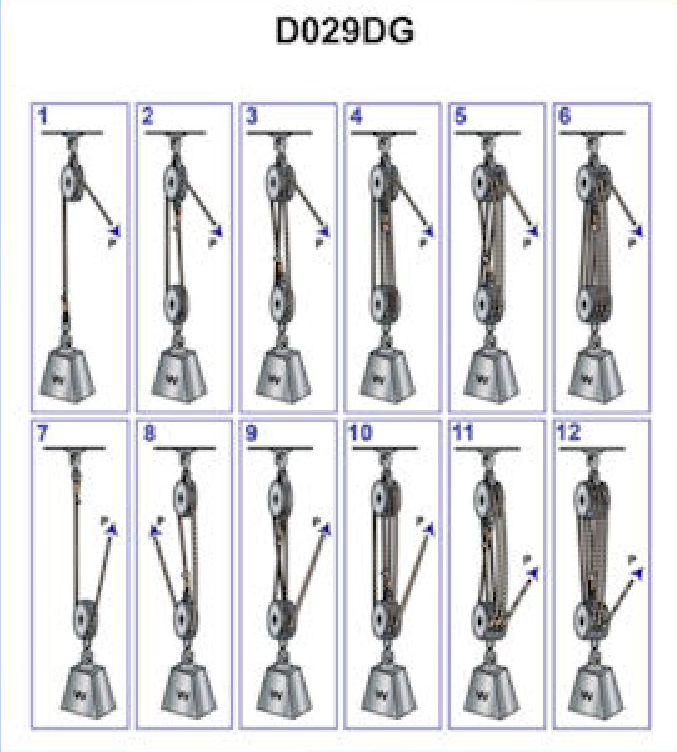
You are using tackle number 7 in illustration D029DG below to lift a weight of 100 lbs. If you include 10 percent of the weight for each sheave for friction, what is the pull on the hauling part required to lift the weight?
See Diagram: D029DG
A. 150 lbs.
B. 110 lbs.
C. 55 lbs.
D. 200 lbs.
C. 55 lbs.

You are using tackle number 5 as shown in illustration D029DG below to lift a weight. The hauling part of this tackle is bent to the weight hook of tackle number 9. What is the mechanical advantage of this rig?
See Diagram: D029DG
A. 20
B. 9
C. 5
D. 4
A. 20

What is the mechanical advantage, neglecting friction, of tackle number 5 as shown in illustration D029DG below?
See Diagram: D029DG
A. 2
B. 4
C. 5
D. 5.5
C. 5
How much force would be required to lift a weight of 200 lbs. using a gun tackle rigged to disadvantage (do not
consider friction)?
A. 50 lbs.
B. 100 lbs.
C. 150 lbs.
D. 200 lbs.
B. 100 lbs.
What is meant by veering the anchor chain?
A. Locking the windlass to prevent more chain from running out
B. Heaving in all the chain
C. Bringing the anchor to short stay
D. Paying out more chain
D. Paying out more chain
When is a vessel wind rode?
A. When the vessel is backing into the wind
B. When the vessel must carrying lee rudder
C. When it is necessary to apply a leeway correction to the course
D. When the vessel is at anchor and heading into the wind
D. When the vessel is at anchor and heading into the wind
How is the size of chain determined?
A. Links per fathom
B. Length of link in inches
C. Diameter of metal in link in inches
D. Weight of stud cable in pounds
C. Diameter of metal in link in inches
When anchoring, good practice requires 5 to 7 fathoms of chain for each fathom of depth. Which is TRUE when
anchoring in deep water?
A. Use less chain for each fathom of depth
B. Veer more chain for each fathom of depth
C. Use two anchors with the same ratio of chain
D. Use the same ratio
A. Use less chain for each fathom of depth
Using a scope of five, determine how many feet of chain you should put out to anchor in 12 fathoms of water.
A. 60 feet (18 meters)
B. 450 feet (137 meters)
C. 360 feet (110 meters)
D. 72 feet (22 meters)
C. 360 feet (110 meters)
You are arriving in port and are assigned to anchor in anchorage circle B-4. It has a diameter of 500 yards and your vessel's LOA is 484 feet. If you anchor in 8 fathoms at the center of the circle, what is the maximum number of shots of chain you can use and still remain in the circle?
A. 3 shots
B. 4 shots
C. 6 shots
D. 5 shots
A. 3 shots

In illustration D038DG below, what part of the anchor is indicated by the letter "J"?
See Diagram: D038DG
A. tip
B. bill
C. shank
D. crown
B. bill
Which is a predictable result of a vessel nearing a bank or edge of a steep banked channel?
A. The vessel continues in a straight line, but with greatly reduced maneuverability
B. The bow sheers toward the bank
C. The vessel will be drawn bodily into the bank unless the engines are stopped
D. The stern is drawn to the bank as the bow sheers off
D. The stern is drawn to the bank as the bow sheers off
You are piloting your vessel in a narrow channel. How will the vessel react to a steep bank on your starboard side?
A. the vessel will be bodily pushed away from the bank
B. the bow will swing away from the bank, and stern will swing into the bank
C. the bow will swing toward the bank, and the stern will swing away from the bank
D. the vessel will be bodily drawn into the bank
B. the bow will swing away from the bank, and stern will swing into the bank
Which action reduces the yawing of a vessel in a following sea?
A. Shifting weights to the bow
B. Increasing GM
C. Shifting weights to the stern
D. Pumping out tanks aft
C. Shifting weights to the stern
Which term defines when a vessel is swinging from side to side off course due to quartering seas?
A. Yawing
B. Pitchpoling
C. Rolling
D. Broaching
A. Yawing
In general, an un-reinforced vessel can safely navigate in ice provided the concentration does not exceed how many tenths?
A. 9 - 10 tenths
B. 1 - 3 tenths
C. 4 - 6 tenths
D. 6 - 8 tenths
B. 1 - 3 tenths
In general, a reinforced vessel can safely navigate in ice provided the concentration does not exceed how many
tenths?
A. 1-2 tenths
B. 3-4 tenths
C. 5- 7 tenths
D. 8- 9 tenths with icebreaker assistance
C. 5- 7 tenths

You have determined the maneuvering characteristics of your vessel by taking the radar ranges and bearings of an isolated light while making a turn. The results are listed in illustration D035DG below. Based on this data what is the tactical diameter of the turning circle?
See Diagram: D035DG
A. 755 yards
B. 780 yards
C. 820 yards
D. 880 yards
D. 880 yards
If a tug equipped with flanking rudders is to be turned in a confined circle, when going astern, which is the best action to take to make the stern move to port?
A. The rudder is hard to port and the flanking rudders are hard to starboard
B. The rudder is hard to port and the flanking rudders are hard to port
C. The rudder is amidships and the flanking rudders are hard to port
D. All of the rudders are hard to starboard
B. The rudder is hard to port and the flanking rudders are hard to port
What is the function of the "rudder adjustment" control on an autopilot steering stand?
A. To set the departure from base course before actuating the rudder
B. To align the rudder angle indicator with the true rudder angle
C. To set the rate at which the rudder responds
D. To set the number of degrees of rudder per degree of course error
D. To set the number of degrees of rudder per degree of course error
The "Mode" selector switch can be positioned and select all of the following EXCEPT __________.
A. automatic gyro
B. hand-electric steering
C. non-followup control
D. weather adjustments
D. weather adjustments
You are going to load bales of wool having a stowage factor of 96 in #3 lower hold which has a bale cubic of 84,000. How many tons of wool can be stowed in the compartment?
A. 577
B. 602
C. 654
D. 875
D. 875
A half-height container is used __________.
A. to carry cargoes of low density
B. to carry cargoes such as steel products or drums
C. when stowage space is ample
D. to double the stowage capacity of the vessel
B. to carry cargoes such as steel products or drums
With the buttress securing system, containers of different heights must be stowed __________.
A. on the top tier
B. next to the buttress tower
C. on the bottom tier on deck
D. in the hold
A. on the top tier
When the dew point of the outside air is higher than the dew point of the air in the cargo hold, which action should you take?
A. Energize the exhaust blowers
B. Do not ventilate the cargo holds
C. Ventilate the cargo holds
D. Energize the intake blowers
B. Do not ventilate the cargo holds
In accordance with U.S. regulations for cargo vessels, what is the maximum number of sleeping accommodations a barge may have before it is required to have fire pumps, hydrants, hose, and nozzles installed?
A. 5
B. 8
C. 12
D. 15
C. 12
For a given weight of cargo, the stress on the heel block of a cargo boom __________.
A. increases as the cargo closes the head while hoisting
B. increases if the cargo runner is doubled up
C. is determined by the thrust stresses on the boom
D. decreases as the boom is topped to a greater angle
D. decreases as the boom is topped to a greater angle
For vessels fitted with cargo gear, an initial test of the units under a proof load shall be conducted. Subsequent tests and exams of the same nature shall be carried out at what time interval?
A. 1 year
B. 3 years
C. 4 years
D. 5 years
D. 5 years
According to the Chemical Data Guide, fuel oil number 6 has a flash point (degrees F) of __________.
A. 65
B. 80 - 100
C. 110 - 140
D. 150 - 430 (cc)
D. 150 - 430 (cc)
Using the available references determine the dew point when the dry bulb temperature is 74° F (23° C) and the wet bulb temperature is 60° F (16° C).
See Diagram: D008DG
A. 14° F
B. 20° F
C. 28° F
D. 50° F
D. 50°
Using the available references, if the dry bulb temperature is 77° and the wet bulb temperature is 69°, what is the
relative humidity in a cargo hold?
See Diagram: D008DG
A. 67 percent
B. 70 percent
C. 77 percent
D. 81 percent
A. 67 percent
Segregation of cargoes refers to __________.
A. separating cargoes by destination
B. listing the cargoes in order of their flammability
C. classifying cargoes according to their toxicity
D. separating cargoes so that the inherent characteristics of one cannot damage the other
D. separating cargoes so that the inherent characteristics of one cannot damage the other
Which of the following statements is TRUE regarding crane operations?
A. The aft cranes can be operated from the aft steering station.
B. Radio communications allow the crane operator to disregard the use of hand signals.
C. The crane operators and signalman must be familiar with the correct hand signals.
D. The forward cranes can be operated from the bridge.
C. The crane operators and signalman must be familiar with the correct hand signals.
The most likely time for oil pollution while bunkering is when __________.
A. final topping off is occurring
B. hoses are being blown down
C. first starting to receive fuel
D. hoses are disconnected and being capped
A. final topping off is occurring
What is NOT a requirement for the safe and effective use of a crude oil washing system?
A. Use portable washing machines to reach areas obscured by structural members in the tanks.
B. Decant one meter from the source tank for the tank cleaning machines.
C. Use an inert gas system while washing tanks.
D. Strip all tanks and remove the bottom residue.
A. Use portable washing machines to reach areas obscured by structural members in the tanks.
A tank vessel transferring non-flammable hazardous cargo in bulk must display warning signs. These signs must __________.
A. use black lettering on a white background
B. be visible from both sides and from forward and aft
C. be displayed only while transferring cargo and fast to a dock
D. indicate "NO SMOKING"
A. use black lettering on a white background
The Federal Water Pollution Control Act requires the person in charge of a vessel to immediately notify the Coast Guard as soon as he/she knows of any oil discharge. Failure to notify the Coast Guard can lead to a monetary fine and imprisonment of what time period?
A. 3 years
B. 5 years
C. 1 year
D. 2 years
B. 5 years
When you notice oil on the water near your vessel while taking on fuel, what should your first action be?
A. notify the senior deck officer
B. notify the terminal superintendent
C. stop loading
D. determine whether your vessel is the source
C. stop loading
Cargo hose carried on tank vessels must be designed to withstand the pressure of the shutoff head of the cargo pump or pump relief valve setting, but in no case should it be less than __________.
A. 100 psi
B. 150 psi
C. 200 psi
D. 250 psi
B. 150 psi
A cargo of 10,000 barrels of gasoline is loaded at a temperature of 90° F, and a cargo temperature of 55° F, is expected on this voyage. It has a coefficient of expansion of .0006. How many barrels would you expect to discharge at your destination?
A. 9790
B. 9994
C. 10210
D. 10410
A. 9790
You are loading 475,000 barrels of cargo oil. At 0800 on 8 July, you find that you have loaded 174,000 barrels. At
1000, you find that you have loaded 192,000 barrels. If you continue loading at the same rate, you will finish at
approximately __________.
A. 1752, 8 July
B. 1940, 8 July
C. 0143, 9 July
D. 1727, 9 July
D. 1727, 9 July
Sounding tubes and access openings for fuel oil tanks on cargo vessels are permitted by U.S. regulations to be
located in which of the listed spaces?
A. Laundries
B. crew lounge
C. Washrooms
D. none of the above
D. none of the above
What will NOT increase friction of a liquid flowing in a pipe and cause a loss of suction head?
A. Pipeline valves
B. Backing rings for pipe welds
C. Slowing the pumping rate
D. Bends in the piping
C. Slowing the pumping rate
What should you use when hooking up a cargo hose to your vessel manifold?
A. self-contained breathing apparatus
B. insulating flange or single length of non-conducting hose
C. international shore connection
D. oxygen analyzer
B. insulating flange or single length of non-conducting hose
Centrifugal pumps have what advantage(s) over reciprocating pumps?
A. They pump more cargo in less time.
B. They are less expensive.
C. They are smaller for equivalent pumping ability.
D. All of the above
D. All of the above
Cargo pump relief valves are piped to the __________.
A. crossover lines interconnecting two pumps
B. cargo pump pressure gauges
C. atmosphere through pump vents
D. suction side of pumps
D. suction side of pumps
Which of the following statements is true?
A. LNG contains smaller quantities of a heavier hydrocarbon known as pantene
B. LNG is a pure substance and has no other component
C. LNG contains smaller quantities of a heavier hydrocarbon known as NGL
D. NGL contains smaller quantities of a heavier hydrocarbon known as LNG.
C. LNG contains smaller quantities of a heavier hydrocarbon known as NGL
What is the preferable way to extinguish an LNG fire?
A. Apply mechanical foam.
B. Apply "Purple K" dry chemical.
C. Shut off the source of the gas feeding the fire.
D. Apply water fog.
C. Shut off the source of the gas feeding the fire.
You have water washed your cargo tanks using the fixed machines. What should you do before using portable machines to clean areas screened from the wash of the fixed machine by structural members?
A. Attach the water supply hose to the portable machine after the cleaning head is positioned inside the tank.
B. Ground the fixed machines to eliminate any electrostatic buildup on the cleaning head.
C. Insure that the tanks are not stripped until the final wash is started.
D. Ventilate the tank to eliminate any electrostatically charged mist.
D. Ventilate the tank to eliminate any electrostatically charged mist.
According to U.S. regulations, which conditions would not disqualify a nonmetallic hose as being suitable for use in transferring oil?
A. A small cut in the hose cover which just pierces the reinforcement.
B. A leak in the flange gasket while hydrostatically testing the hose.
C. A slight oil seepage between the hose and flange connection.
D. Evidence of internal or external deterioration.
B. A leak in the flange gasket while hydrostatically testing the hose.
You start a centrifugal cargo pump to discharge cargo. The pump works fine for awhile and then loses suction. What could have caused this?
A. incomplete priming
B. the pump running backwards
C. the discharge head being too high
D. head pressure on the suction side of the pump
A. incomplete priming