Biology U4 mistakes
 Call Kai
 Learn
 Practice Test
 Spaced Repetition
 Match
 Flashcards
 Knowt Play
1/44

There's no tags or description
Looks like no tags are added yet.
45 Terms
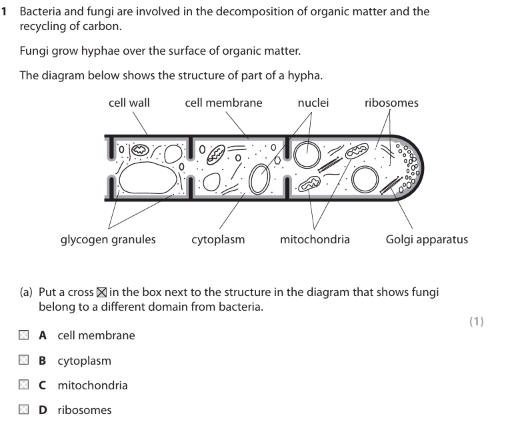
C (mitochondria) because bacteria have no membrane bound organelles.
Explain the role of the Golgi apparatus in the decomposition of organic matter. (3)
Named organic molecule can be proteins (broken down by protease)

Named organic molecule:
Starch → broken down by __________
Protein → broken down by ____________
Lipid / triglyceride → broken down by ________
Cellulose → broken down by ___________
DNA/RNA → _______________
Named organic molecule:
Starch → broken down by amylase
Protein → broken down by protease
Lipid / triglyceride → broken down by lipase
Cellulose → broken down by cellulase (very relevant for fungi decomposing plant matter!)
DNA/RNA → nucleases
Glycosidic bond (in __________)
Peptide bond (in__________)
Ester bond (in ___________)
Phosphodiester bond (in _____________)
Glycosidic bond (in starch/cellulose)
Peptide bond (in proteins)
Ester bond (in triglycerides)
Phosphodiester bond (in DNA/RNA)
Sepsis is caused when bacteria get into the bloodstream. As a result, an inflammatory response occurs that can destroy body organs and result in death.
(a) Explain how inflammation is a response of the body to infection. (2)

What is histamine?
Histamine is a chemical messenger (a local hormone) released by mast cells and basophils in response to injury, infection, or allergens.
1.Vasodilation — it causes arterioles (small arteries) to widen. This increases blood flow to the area (causing redness and heat).
Increased capillary permeability — it makes the walls of capillaries "leaky" by creating gaps between the endothelial cells. This allows white blood cells and antibodies to leave the blood and enter the tissue fluid at the site of infection.
Explain the meaning of the term antibiotic (2)
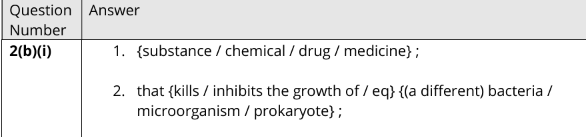
Explain why scientists need to develop alternative treatments for bacterial infections. (2)

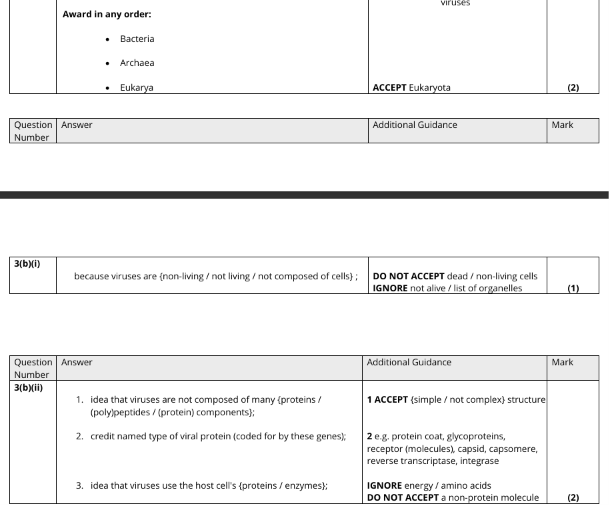
Name two structures found in all viruses? (2)
Protein coat / caspid (1)
Genetic material / nucleic acid
Suggest why different types of virus have to be injected into different parts of the chicken embryo. (2)


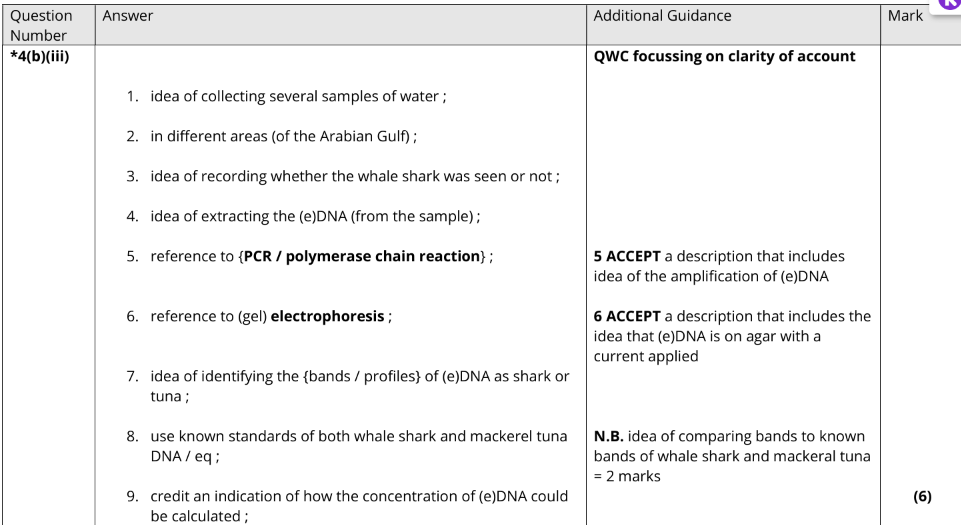
*(iii) Describe how the data shown in the graph could have been collected and analysed. (6)
Suggest why there are only 4 trophic levels in this food chain? (2)


C

*(ii) Explain why the mother will produce antibodies to the rhesus antigen, in Step 2. (6)


Explain why an increase in temperature increases the rate of production of GALP. (3)


C
*Describe how GALP is used to produce lipids?

The presence of pollen in peat bogs can be used as evidence for global warming. (a) Describe the role of the nuclei in pollen. (2)

Explain how DNA profiling can be used to identify the species of plant that the pollen came from. (3)


*Describe the role of tRNA in protein synthesis. (3)


Species found in only 1 area is called?
Endemic
Distinguish between the terms abundance and distribution. (2)

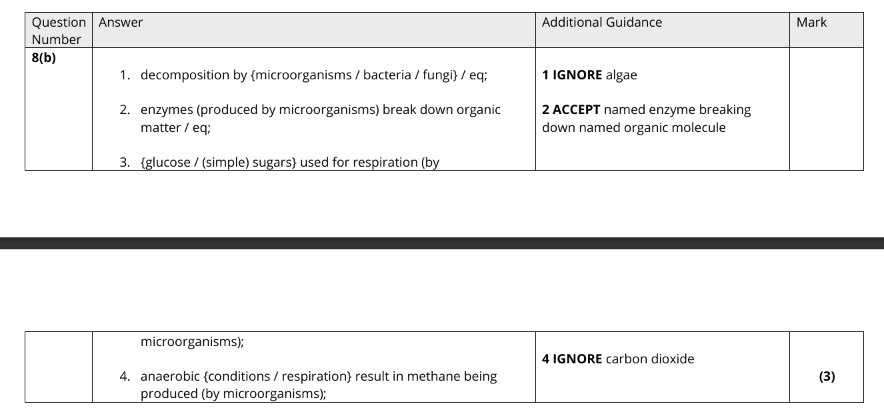
Explain how parts of cattail plants falling into the water result in the production of methane. (3)
Characteristics of inflammation apart from swelling?

Describe the role of two of these characteristics of inflammation in response to a cut to the skin. (2)

Explain the role of gut flora in protecting the body from infection. (2)

Explain why antibiotics can affect gut flora. (2)


The more people in a population who are vaccinated against a disease, the less likely it is for non-vaccinated people to become infected.
Suggest why vaccination is more successful when a greater proportion of people are vaccinated. (2)

Anthropogenic climate change?

Explain why light energy is converted into energy stored in ATP. (2)

Explain the role of light energy in the light-dependent reactions. (3)

Explain why the use of an enzyme to cut the DNA results in fragments, of different lengths, that can be separated by gel electrophoresis. (3)

Examples of circular DNA found in cells?

Give two differences between the structure of circular DNA and that of linear DNA, other than their shapes. (2)


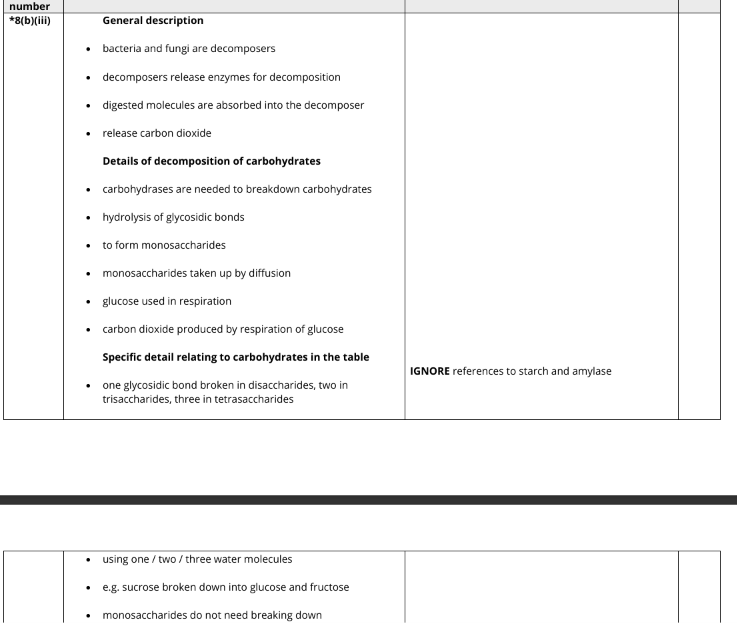
(iii) Explain the role of decomposition in returning the carbon present in the carbohydrates in the quince fruit back into the atmosphere. Use the information given in part (b) to support your answer. (6)
How is GALP converted to proteins
Galp is converted to glucose
amino acids are made from glycose and nitrates
amino acids are joined together by peptide bonds in condensation reactions
the glucose is respired to make ATP fo protein synthesis
how is light converted into chemical energy in the form of ATP
- light is absorbed by photosystem / chlorophyll
- electrons are excited
- electrons are passed along a series of carriers
- therefore energy is released to the phosphorylate ADP to ATP (cyclic)
- and the phosphorylation of ADP into ATP via the proton gradient (non-cyclic)
Role of light energy in light-dependant reactions
To release electrons from chlorophyll
so that electrons can be used for phosphorylation
Photolysis to
a. replace electrons lost by chlorophyll
b. to provide protons for reduced NADP
To produce ATP and reuced NAP for the calvin cycle
Write the summary of calvin cycle
1. Carbon dioxie combines with 5C sugar RuBp by enzyme rubisco
2. 6-C caompound produced ad unstable so splits into two 3C molecule (glycerate 3-phosphate (GP))
3. Carbon is fixed (removed from external enviroment and part of cell)
4. ATP's energy ad reduced NADP's hydrogen are used to reduced 2 3C GP molecules into two 3C mlecules of GALP
5. Some carbons of GALP go towards the production of useful organic molecules such as glucose and the rest are used to generate RuBP requiring TP
Ratio: in 2 GALP molecules (6C total) 1 out of 6 are used in the production of glucose.