Arch and Sculpture in the Maya World Exam
 Call Kai
 Learn
 Practice Test
 Spaced Repetition
 Match
 Flashcards
 Knowt Play
1/19

There's no tags or description
Looks like no tags are added yet.
20 Terms
Miller 1992
Essay “People and Nature” from an exhibition catalogue “Art from Sacred Landscapes”. Miller argues that the natural world and cycles of nature deeply informed Maya cosmology and spiritual beliefs, emphasizing the importance of the planting and regrowth of Maize as an allegory for human life, the anthropomorphization of the earth as a Cauac Monster and the importance of the sacred mountain, and the significance of the movements of celestial bodies for the Maya. Touches on impersonation and world turtle.
Runggaldier 2022
This chapter, titled “Tikal Temple I”, is part of a larger edited volume about significant architectural works around the world. In the article, Runggaldier describes the architectural characteristics of the building, for whom it was built, and how its appearance would have differed at the time of its construction, with polychrome stucco ornamentation which has degraded over time. The article takes a close look at the cultural significance of the Tikal Temple I, both to the ancient and Modern Maya, and suggests that the structure was a iconic and important facet of public life then, and a symbol of cultural heritage and pride, for both the Maya and Guatemala, now.
Reents-Budet 1994
Essay titled "Collecting Pre-Columbian Art and Preserving the Art Historical Record” from the exhibition catalogue “Painting the Maya Universe”, argues that looting is extremely problematic for the art historical record and strips vital contextual information from the piece. Uses the Buenavista vase as an example. (manufactured in Naranjo, excavated in Buenavista del Cayo). Reents-Budet suggests more care and adherence to legal guidelines of the country of origin on the part of collectors and museums, and education programs in the countries of origin to encourage protection of their cultural heritage.
Matsuda 1998
Matuda argues that the stereotype of the full-time malicious artifact looter is largely a myth, and that the clandestine excavations of indigenous artifacts in Latin America is mostly carried out by subsistence diggers who are forced by their economic circumstances to supplement their income with digging. He urges readers to consider the sociopolitical pressures and institutions which have led to this being a viable survival strategy, and examine who actually has claim to valid ownership rights over the artifacts in question. Finally, he argues that any attempt to conserve archeological information and cultural patrimony must take these complexities into account, and a war waged against the mythic stereotypical looter promises to be just as ineffectual as it is unethical.
Mathews and Garber 2004
In their article “Models of the Cosmic Order”, Mathews and Garber explore the significance of quadripartite partitioning for the Maya. They posit that the significance of a world divided into four parts horizontally and many vertical layers permeated every class and facet of Maya life, informing the placement and arrangement of alters and caches on level one, buildings, tombs, and milpas on level two, and palaces and ceremonial centers on level three. They also mention the existence of important quadripartite glyphs representing the completion of cycles. Emphasis is placed on the inter-class nature of this significance of partitioning, which informed the lives of commoners as well as the elite. (Bacabs at world corners, cieba at center, east and west most significant direction, 9 layers to underworld, 13 to upperworld).
Estrada-Belli 2011
This article explores site planning in the Preclassic, with particular focus on E-groups at Cival, triadic groups, and their relationships to ritual practice and the Cardinal directions. It goes into some depth around the efforts of the Preclassic Maya to transform their local environment in a way that was conducive to city planning, flattening hilltops, etc, in which massive amounts of earth were moved in order to create an ideal base for a ceremonial center (Cival). This article also includes information about a quadripartite cache found on an E-group at Cival.
Matsumoto 2025
Mallory Matsumoto writes about the significance of Maize in the “Milpa” chapter of her book, “The Maya Myths”. The chapter gives an overview of Classic Maya beliefs about the death and resurrection of the maize god, using an example from the Boston MFA plate. It mentions Chac, K’awiil, and the Hero Twins’ variable roles in the resurrection process. Then the chapter dives into modern myths dealing with the discovery and farming of maize in Maya culture, illustrating that the plant has remained a staple of cultural and spiritual life throughout the centuries.
Taube 2009
In Karl Taube’s article “The Maize God and Dance”, Taube argues that maize and its personified deity are closely tied to dance in Maya culture and related Olmec and Veracruz cultures. Taube also notes the integration of avian aspects into the Maize god and his regalia, and posits that flight and birds were heavily associated with dance for the Maya. The role of dance in the Maize god’s resurrection, with examples from the San Bartolo murals, is also emphasized in the article.

Title: Boston MFA Plate
Material: Polychrome Ceramic
Location: Unknown
Date: Late Classic
Hunahpu on the left, and Xbalanque on the right, assist the resurrection of their father, the Maize god. The Maize god emerges from a cleft in the earth, represented by a turtle. The maize god emerges from a severed head, possibly symbolic of Xibalba, or his own severed head that was won back by the Hero Twins. The head may represent a kernal of corn, sprouting into a new plant. Below the turtle, illustrations of water lily pads and flowers allude to the watery underworld.

Title: Quincunx Cache/Cival Cache 4
Material: Ceramic vessels, jade beads and celts
Location: Cival, Guatemala
Date: Preclassic (c. 700 BCE)
This cache was found in the central structure of the eastern platform of part of an E-group. It was arranged in a with one vessel at each of the cardinal directions, with the red one in the south, and a fifth jar with a collection of jade (including several celts) in a lower pit in the center. The finest of the celts was in a third layer in the center of the central pit below the fifth jar. Jade associations: go.

Title: San Bartolo Murals
Material: Polychrome Stucco Mural
Location: San Bartolo, Guatemala
Date: Late Preclassic (c. 100 BCE)
The image on the right shows a human couple emerging from the mouth of a Cauac monster, on the left, the maize god is reborn, attended by two aspects of Chaac, representing flowing and stagnant water respectively. He is dancing and beating a drum as he reemerges from the back of the quadripartite turtle shell that represents the earth. Note naturalistic vs stylized representation when differentiating supernatural entities.

Title: Structure E-VII Sub
Material: Pyramid with Stucco Masks
Location: Uaxactun, Guatemala
Date: Late Preclassic
This radial pyramid belongs to part of an E-group, consisting of a pyramid to the west and platform with three small structures to the east. These complexes were named after this site, which was the first E group to be identified. E-groups are everywhere throughout the preclassic, though, this is actually a pretty late example. It has stucco facing and large zoomorphic masks, it would have been used as the viewing area for the platform to the east. It was buried under later construction programs, and uncovered by archeologists peeling back the layers.

Title: Structure 5C-2nd
Material: Pyramid with Stucco Masks
Location: Cerros, Belize
Date: Late Preclassic
Pyramid faces south, aligning the four huge stucco masks which flank the front staircase to align with the daily movements of celestial bodies. The lower levels of masks represent the sun rising (right, east) and setting (left, west) and the upper levels of masks represent the rise and set of the morning and evening stars respectively.
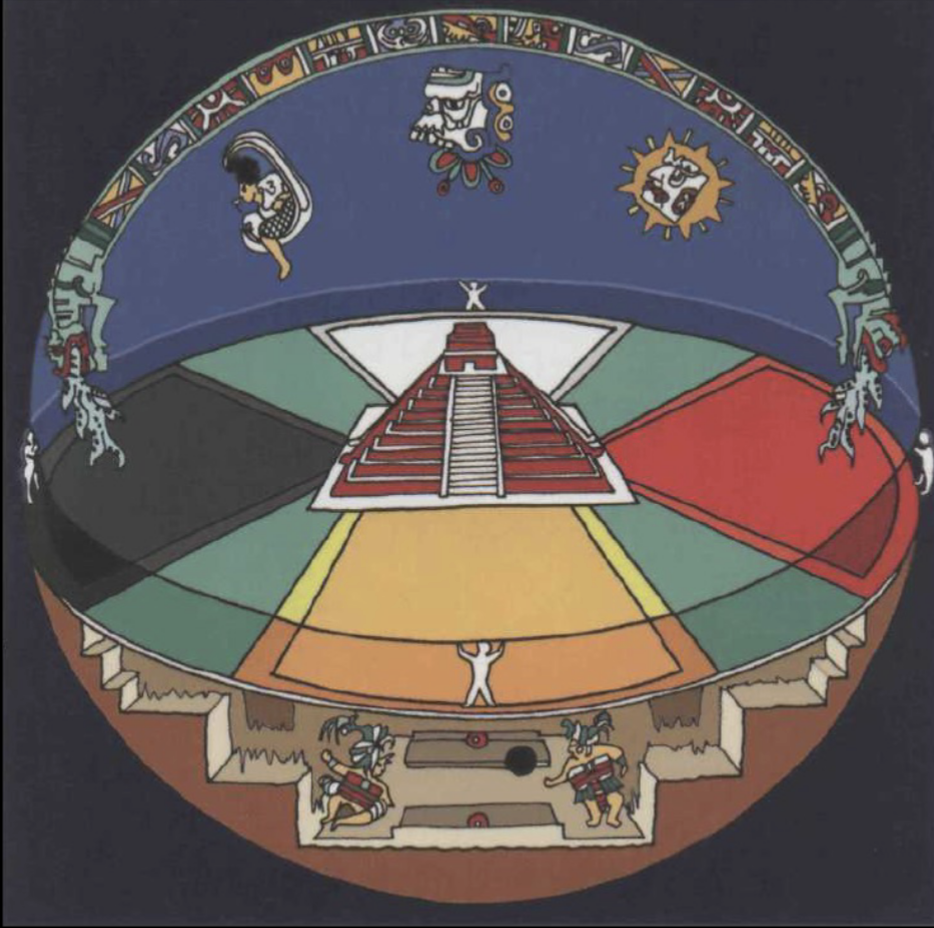
This is a diagram illustrating Maya beliefs about the universe and its partitioning. It depicts the world as a quincunx, with 4 cardinal directions, East (red) West (black) North (White) and South (Yellow), and a center indicated by the pyramid and traditionally associated with blue/green. A sky band encloses the heavens, and the underworld is depicted below, complete with a ball court which was heavily associated with the underworld and the cycle of human life and death. Four pillars hold up the world (these are usually trees, or “Bacabs” figures in the diagram) and the daytime sun makes its way across the sky, recognizable with crossed eyes.
Title: Buenavista Vase
Material: Polychrome Ceramic
Location: Buenavista del Cayo, Belize.
Date: c. 700 CE (Late Classic)
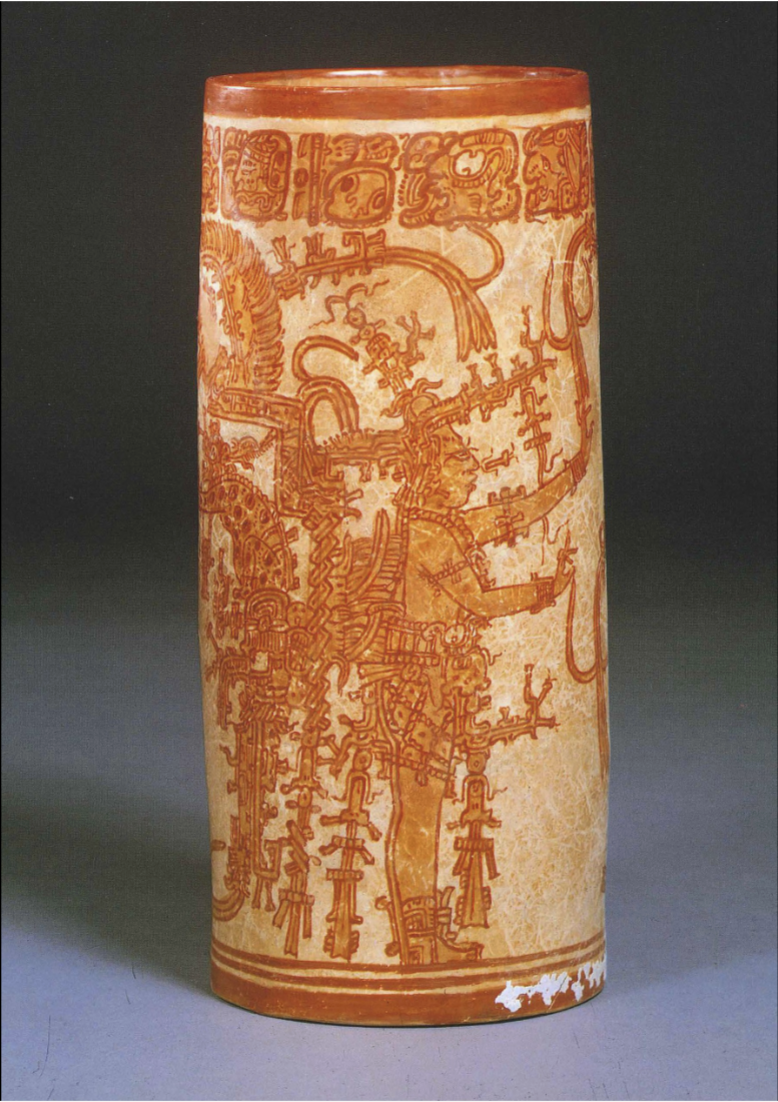
Likely manufactured in Naranjo, the vase in an example of the Homul pottery style. It was made for drinking cacao and commissioned for a Naranjo ruler, who presumably gifted it to the young Buenavista nobleman in whose tomb it was found. Depicts a dancer, likely the maize god, emerging from the underworld wearing a large back rack.

Title: Stela 1 (Bottom)
Material: Stone (Limestone?)
Location: Stela 1, Bonampak, Mexico
c. 780 (Late Classic)
Depicts a Cauac monster representing the earth, with maize gods rising from the cleft head. The lower jaw is implied to be underground. Circular “bunch of grapes” elements suggest stalactites growing in a cave.

Title: Tikal Temple I
Material: Limestone (Lime plaster and red pigment back in the day)
Location: Tikal, Petén, Guatemala
Date: c. 734 (Late Classic)
This is a funerary pyramid built for Jasaw Chan K’awiil, commissioned either by himself or by his son. Unlike many other Maya pyramids, it was built in a single building program rather than in successive layers. It’s part of the North Acropolis of Tikal, situated across from Temple 2 on the east-west axis. It would have been brightly decorated at the time it was built. The temple embodies the Maya idea of a sacred mountain, burying a ruler under it placed them in a underworld, with the temple atop it serving as a cave portal.

Title: Young Maize God
Material: Carved Limestone
Location: Temple 22, Copán, Honduras
Date: c. 775 (Late Classic)
Personified maize, note swaying posture and silk hair, jade adornments
Xbalanque/Yax Bahlam
Younger hero twin depicted with patches of jaguar fur
Hunahpu/Jun Ajaw
Older hero twin represented with black spots on cheeks