Chem 105a Midterm #3
 Call Kai
 Learn
 Practice Test
 Spaced Repetition
 Match
 Flashcards
 Knowt Play
1/54

There's no tags or description
Looks like no tags are added yet.
55 Terms
2 electron domains, 0 LP
Linear

3 electron domains, 0 LP
trigonal planar

3 electron domains, 1 LP
bent

4 electron domains, 0 LP
tetrahedral

4 electron domains, 2 LP
bent

4 electron domains, 1 LP
trigonal pyramidal
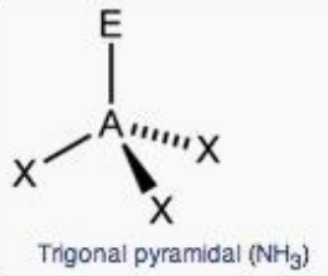
5 electron domains, 0 LP
trigonal bipyramidal

5 electron domains, 1 LP
seesaw

5 electron domains, 2 LP
t-shaped
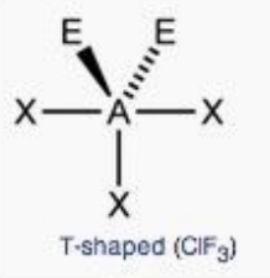
5 electron domains, 3 LP
linear
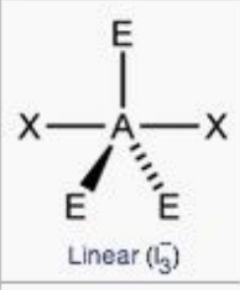
6 electron domains, 0 LP
octahedral
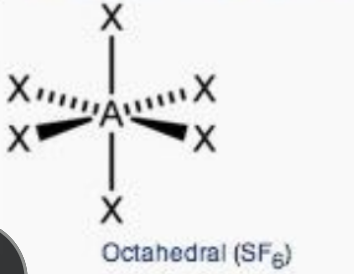
6 electron domains, 1 LP
square pyramidal

6 electron domains, 2 LP
square planar

6 electron domains, 3 LP
t-shape
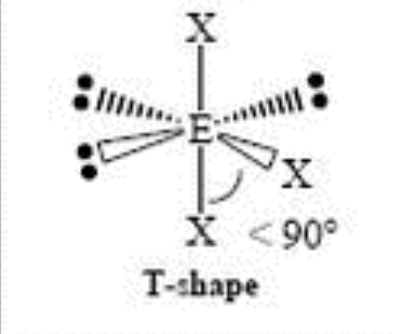
6 electron domains, 4 LP
linear

2 electron domains
linear
3 electron domains
trigonal planar
4 electron domains
tetrahedral
5 electron domains
trigonal bipyramidal
6 electron domains
octahedral
any linear
180°
trigonal planar
120°
bent (2BD/1LP)
~120°
tetrahedral
109.5°
trigonal pyramidal
~109.5°
bent (2BD/2LP)
~109.5
trigonal bipyramidal
120°/90°
seesaw
120°/90°
t-shape (any)
90°/180°
octahedral
90°
square pyramid
90°
square planar
90°
t-shape
90°/180°
bond energy
potential energy held in covalent bonds
lattice energy
potential energy held in ionic bonds
energy of atomization
the energy required to break down a molecule to individual atoms
enthalpy of reaction (ΔHrxn)
the change in enthalpy that occurs during a chemical reaction at constant pressure
atomic radius trend
largest in bottom left corner, smallest in top right
is a change in period or change in group more significant for periodic table trends?
period
born-haber cycle
shows two routes to forming an ionic compound in individual steps, used to calculate lattice E
ionization energy shorthand
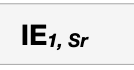
electron affinity shorthand

dissociation shorthand

electron affinity
electron is added (energy of)
type of electron domain in order of repulsive ability
lone pairs > triple bonds > double bonds >single bonds
preferred location of LP
in central plane
geometries where LP placement is arbitrary
linear, trigonal planar, tetrahedral
preferred location of LP
opposite of other LP
adjacent to other LP
VSEPR
Valence Shell Electron Pair Repulsion theory
valence bond theory
covalent bonds are formed by the
overlap of half-filled atomic orbitals
in-phase overlap???
a double bond has
1 unhybridized p orbital (sp2)
triple bond has
2 unhybridized p orbitals (sp)
2 double bonds have
2 unhybridized p orbitals (sp)