Chapter 12: Assessment and Treatment of Cognitive Disorders
 Call Kai
 Learn
 Practice Test
 Spaced Repetition
 Match
 Flashcards
 Knowt Play
1/41

There's no tags or description
Looks like no tags are added yet.
42 Terms
Name the cognitive assessment principles

What to consider when selecting a cognitive assessment
Body structure
body function
Activity-level functions
participation-level functions
What did this look like before their injury
Cognitive assessment should use ______ ________ testing assessment
Contextualized hypothesis
What is included in contextualized hypothesis testing assessment
Determine strengths
determine weakness
key principles
what are the key principles of contextualized hypothesis testing assessment
Ongoing process in multiple contexts
use realistic & functional contexts
use a collaborative process-employ various people in various contexts
use hypothesis testing to assess the impact of internal & external factors
what is included in assessment of attention
Visual attention
auditory attention
Manipulation of complexity
Questionnaires & structured conversations
What are the levels of manipulation complexity assessed during assessment of treatment
Number of stimuli present
number of stimuli to monitor & respond to
type of response required
type of distractor present
level of interest or familiarity with stimuli
Why do we use questionnaires & structured conversations during assessment of attention
can help you identify easier/more challenging tasks, settings, or contexts
What to consider during assessment of executive function
Consider ecological validity
Consider additional domains/demands
What to consider when assessing awareness
use questionnaires (explicit awareness)
Observe behavior (implicit awareness)
Consider extent of experience of deficits
what is considered during assessment of memory
visual memory
verbal memory
consider prospective
consider meta-memory
consider short-term memory
consider working memory
what is considers during assessment of social cognition
Assessments often focus on individual components
Consider ecological validity
Consider naturalness of tasks
Include observations and naturalistic interactions to supplement standardized assessments
Goal attainment scaling: this goal should be framed in the ____/_____ ___ or words they agree upon and understand
client/family’s words
Goal attainment scaling: monitoring
beginning of the session: _____ states _____
end of session: client _____ _____
clinician poses questions to ________ & ____ rating
clinician reviews _____ if rating is inaccurate
client ___-____
Client states goals
Client rates performance
Poses questions to corroborate & validate rating
reviews criteria if rating is inaccurate
Client reassesses
Cognitive treatment principles
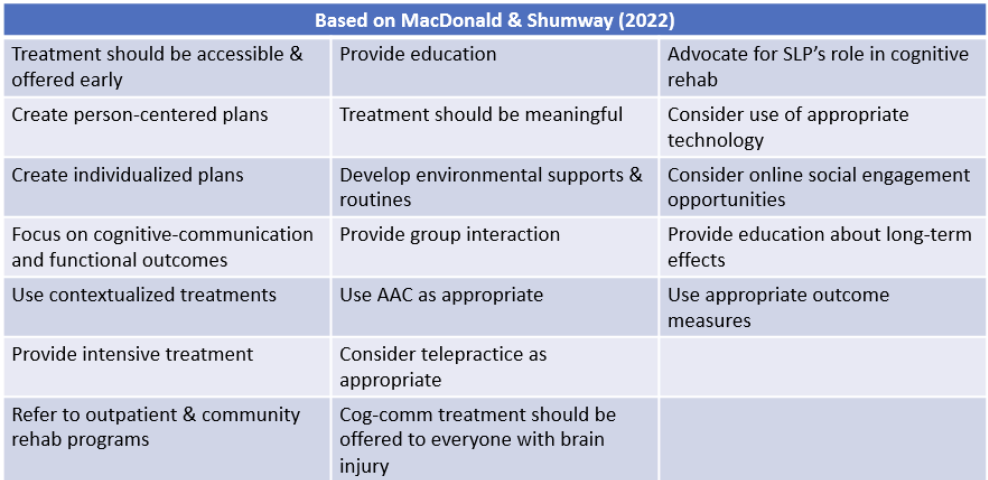
Cognitive treatment: ________ _________ ________- breaking down task into smaller steps
Metacognitive strategy training (MST)
Why use Metacognitive Strategy Training
Useful for executive functioning, attention, and social cognition deficits
Create strategies in collaboration with the patient
Based on strengths & weaknesses
Consider level of awareness
Education important
explaining strategy, when it should be used, why it should be used
Components of Metacognitive Strategy Training

List the cognitive treatment for attention
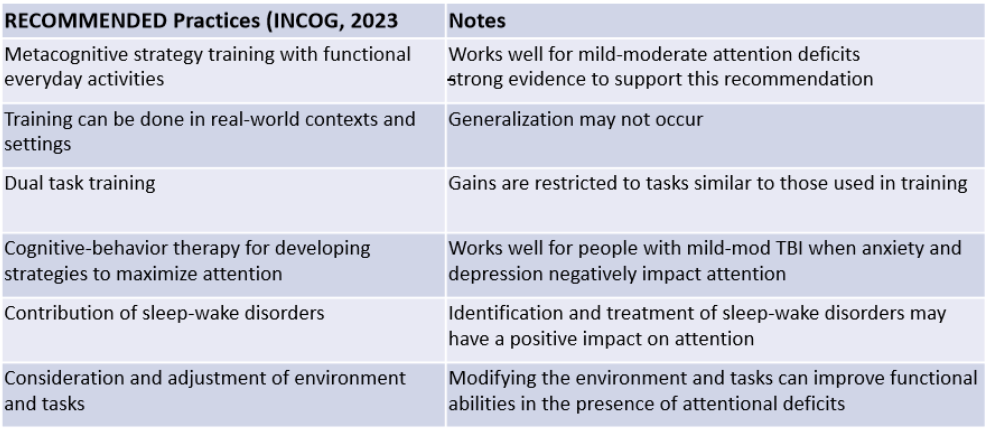
which cognitive treatment of attention is being described:
works well for mild-moderate attention deficits
strong evidence to support this recommendation
Metacognitive strategy training with functional everyday activities
which cognitive treatment of attention is being described:
generalization may not occur
Training can be done in real-world context and settings
which cognitive treatment of attention is being described:
-Gains are restricted to tasks similar to those used in training
Dual task training
which cognitive treatment of attention is being described:
Works well for people with mild-mod TBI when anxiety and depression negatively impact attention
Cognitive- behavior therapy for developing strategies to maximize attention
which cognitive treatment of attention is being described:
Identification and treatment of sleep-wake disorders may have a positive impact of attention
contribution of sleep-wake disorders
which cognitive treatment of attention is being described:
modifying the environment and tasks can improve functional abilities in the presence of attentional deficits
consideration and adjustment of environment and tasks
Cognitive treatment for Executive Function
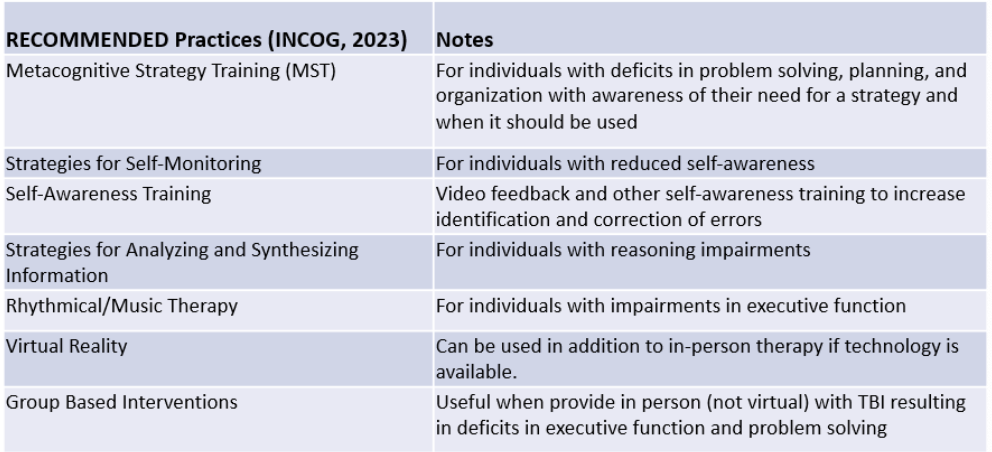
which cognitive treatment for executive function is being described:
For individuals with deficits in problem solving, planning, and organization with awareness of their need for a strategy and when it should be used
Metacognitive strategy training
which cognitive treatment for executive function is being described:
For individuals with reduced self-awareness
strategies for self-monitoring
which cognitive treatment for executive function is being described:
Video feedback and other self-awareness training to increase identidication and correction of errors
Self-awareness training
which cognitive treatment for executive function is being described:
for individuals with reasoning impairments
Strategies for analyzing and synthesizing information
which cognitive treatment for executive function is being described:
For individuals with impairment in executive function
Rhythmical/music therapy
which cognitive treatment for executive function is being described:
can be used in addition to in-person therapy if technology is avaliable
Virtual reality
which cognitive treatment for executive function is being described:
Useful when provide in person (not virtual) with TBI resulting in deficits in executive function and problem solving
Group based interventions
Types of cognitive treatment for awareness
direct corrective feedback
video modeling
Which cognitive treatment for awareness is being described:
corrective feedback given from clinician, peer in group treatment, or video recording
Direct corrective feedback
Which cognitive treatment for awareness is being described:
Natural interaction videotaped in natural setting (conversation with family at home)
videos reviewed with clinician
guided discussion of strengths & weaknesses
video modeling
Cognitive treatments for memory include:
internal compensatory strategies
external aids, environmental supports and reminders
selection of external memory aids, should be based on personal factors
group-based intervention
Which cognitive treatment for memory is being described:
for individuals with mild-mod impairments and/or preservation of some executive functions; can include instructional or metacognitive strategies
Internal compensatory strategies
Which cognitive treatment for memory is being described:
for individuals with memory impairment, especially severe deficits high-tech and low-tech options can be considered
caregivers/family must also be trained to use the supports
External aids, environmental supports and reminders
Which cognitive treatment for memory is being described:
personal factors include: ages, severity of memory impairment, pre-morbid use of memory devices, cognitive strengths and weaknesses, physical limitations
selection of external memory aids, should be based on personal factors
Which cognitive treatment for memory is being described:
use with clients with mild-moderate memory deficits
group-based interventions
how should explicit and implicit awareness be assessed?
Observations for explicit
Questionnaires for implicit