Chemistry: Intro to Org Chem, Isomerism and Reaction Mechanisms
 Call Kai
 Learn
Learn Practice Test
 Spaced Repetition
 Match
Match Flashcards
 Knowt Play
1/43

Earn XP
Description and Tags
learning outcomes: (a) interpret, and use the nomenclature, general formulae and displayed formulae of the following classes of compound: (i) hydrocarbons (alkanes, alkenes and arenes) (ii) halogen derivatives (halogenoalkanes and halogenoarenes) (iii) hydroxyl compounds (alcohols and phenols) (iv) carbonyl compounds (aldehydes and ketones) (v) carboxylic acids and derivatives (acyl chlorides and esters) (vi) nitrogen compounds (amines, amides, amino acids and nitriles) (b) describe sp3 hybridisation, as in ethane molecule, sp2 hybridisation, as in ethene and benzene molecules, and sp hybridisation, as in ethyne molecule (c) explain the shapes of, and bond angles in, the ethane, ethene, benzene, and ethyne molecules in relation to and carbon-carbon bonds (d) predict the shapes of, and bond angles in, molecules analogous to those specified in (c)
Name | Mastery | Learn | Test | Matching | Spaced | Call with Kai | Chat |
|---|
No analytics yet
Send a link to your students to track their progress
44 Terms
sp3 hybridisation
one s and three p orbitals combine to form 4 equivalent hybrid orbitals
shape: tetrahedral about C atom
bonds: 4 sigma bonds
bond angle: 109.5 degrees

sp2 hybridisation
one s and two p orbitals combine to form 3 equivalent hybrid orbitals
shape: trigonal planar about C atom
bonds: 3 sigma bonds, 1 pi bond
bond angle: 120 degrees

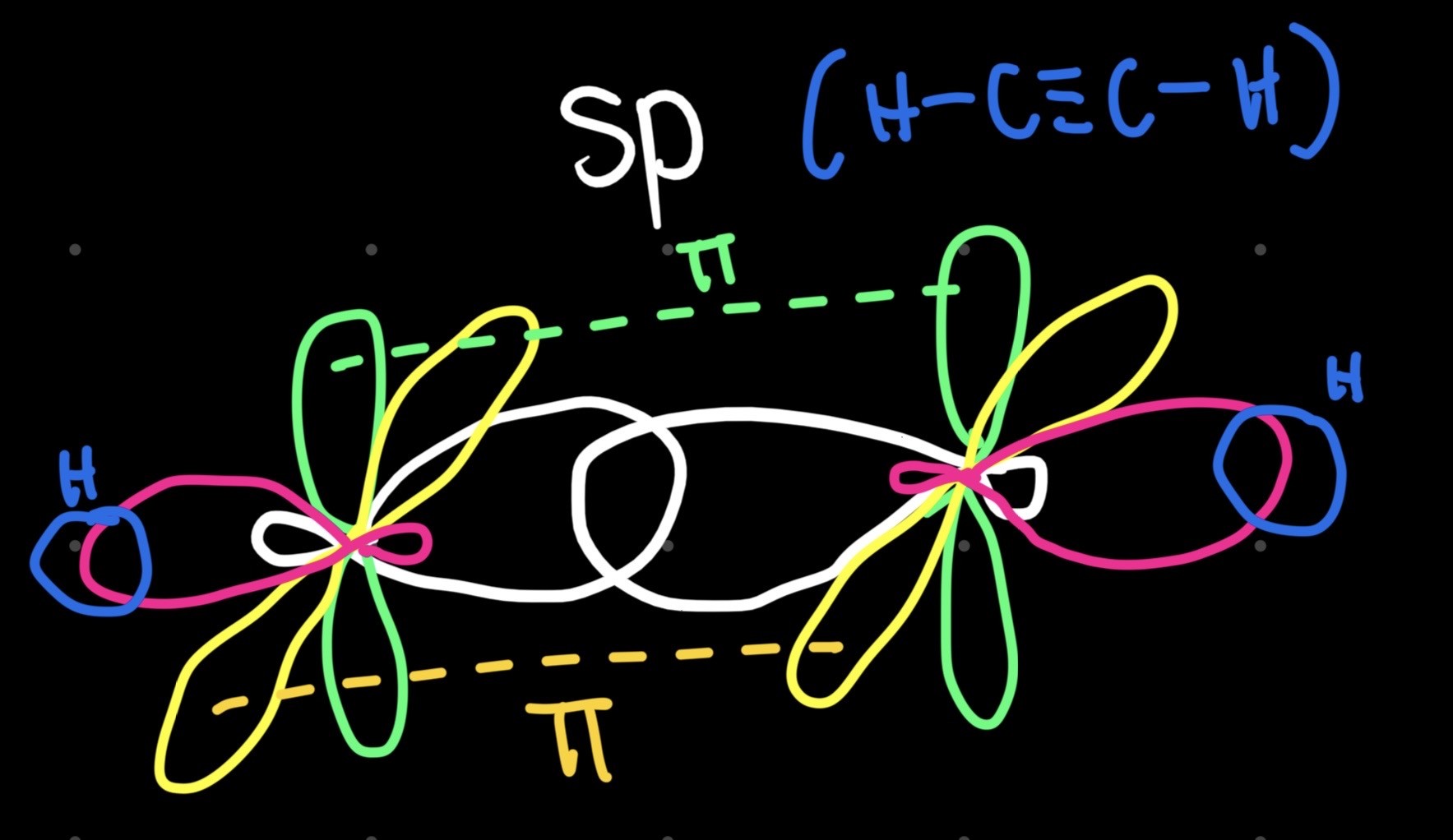
sp hybridisation
one s and 1 p orbitals combine to form 2 equivalent hybrid orbitals
shape: linear about C atom
bonds: 2 sigma bonds, 2 pi bonds
bond angle: 180 degrees
why is that C=C bond length shorter than C-C
C=C, both carbon atoms are sp2 hybridised, bond is formed by sp2-sp2 overlap.
C-C, both carbon atoms are sp3 hybridised, bond is formed by sp3-sp3 overlap.
there is higher percentage of s character in sp2 (33%) than sp3 (25%).
thus e- of sp2 are closer to the nucleas thus bond is shorter (and stronger).
how are sigma and pi bonds formed in (insert hybridised molecule)
sigma: head on overlap of sp3/sp2/sp hybrid orbitals (with 1s orbital of H, if the molecule got H)
pi bonds: side on overlap w adjacent unhybridised p orbitals
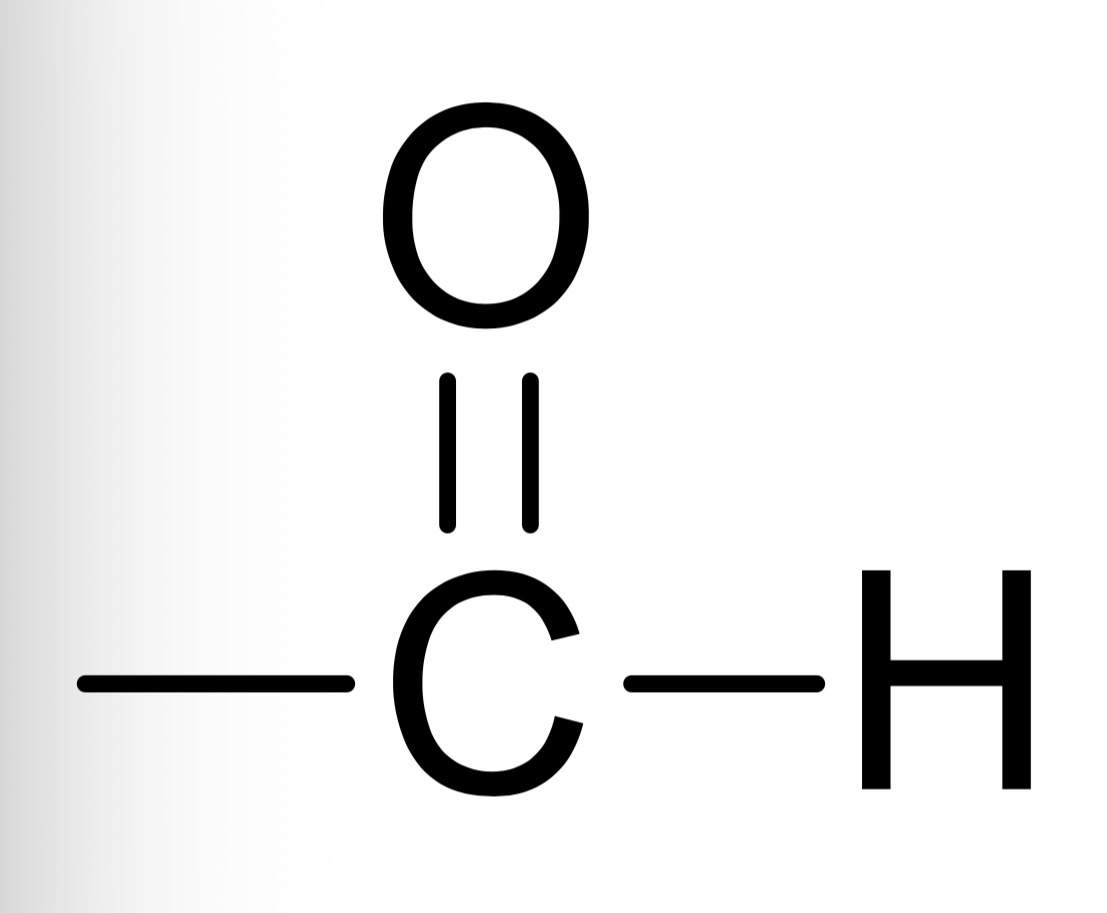
aldehyde
CHO
ketone
C=O
there is no H.
acyl chlorides
COCl

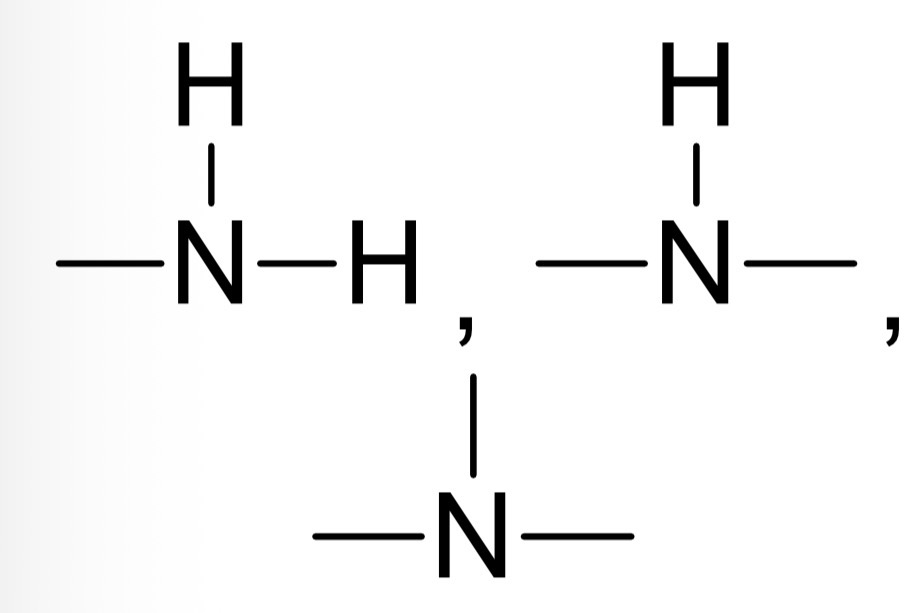
amine
RNH2 or R2NH or R3N
amides
CON(H)

amino acid
amine and carboxylic acid are attached to the same carbon

true or false: constitional isomers may differ in their chemical properties
true. constitutional isomers can have diff functional grps, thus chemical properties
cis vs trans isomers
cis: same grp attached to same side
trans: same grp attached to diff side
in pic attached, the same grp refers to the H atom

how to know if a compound exhibits cis-trans isomerism?
Cis–trans isomerism arises from restricted rotation around a C=C bond due to the π bond
occurs when each carbon in the bond is attached to two different groups.
no. of cis-isomers formula
2^n where n = no of double bonds with different sets of groups on each end

why can’t the above structure exhibit cis-trans isomerism despite having C=C
C=C in the ring: cant form trans isomer due to ring strain of a small ring structure
C=C in side chain: one of the C atoms is attached to two identical H atoms
racemic mixture
1:1 ratio of two enantiomers in the mixture
why are smell detecting receptors in our nose chiral?
only one enantiomer with the correct spatial arrangment can bind to one particular receptor resulting in different smells being detected
constituitional isomerism
same molecular formula but different structural formula
why does mpt of cis isomer differ from trans isomer?
mpt of trans > cis
trans isomers are more closely packed than cis [thus, larger surface area of contact —> stronger idid, more energy to overcome. this is for simple covalent molecules]
![<p>mpt of trans > cis</p><p>trans isomers are more closely packed than cis [<em>thus, larger surface area of contact —> stronger idid, more energy to overcome. this is for simple covalent molecules]</em></p>](https://assets.knowt.com/user-attachments/685d348e-df24-4e44-b0c3-88e415657cb7.jpg)
chiral molecule
has a chiral centre (aka the centre is attached to four diff grps) + no internal plane of symmetry
what entails a pair enantiomers?
a chiral molecule and its non-superimposable mirror image. (like our hands)
total number of stereoisomers
2^n where n = no. of chiral centres + no. of C=C bond or C–C bond (part of a ring structure) with cis-trans isomerism.
why does cis and trans isomer bpt differ?
cis: polar, pdpd, trans: non-polar, idid
pdpd stronger than idid, thus more energy to overcome
true or false: enantiomers have the same physical properties
partially true. they have identical physical properties except they rotate plane–polarised light in opposite directions.
true or false: enantiomers have the same chemical properties
they have identical chemical properties except towards chiral reagents
why does a racemic mixture not rotate plane-polarised light
pair of equal amounts of enantiomers will rotate the plane of polarised light by the same extent but in opposite directions
cw rotation caused by one enantiomer is exactly cancelled by the acw rotation of the other enantiomer as the.
no net effect on the passage of plane-polarised light and the sample is optically inactive.
what forms a carbocation? (heterolytic fission or homolytic fission)
heterolytic fission of CH bond
nucleophiles
electron rich species, can donate a lone pair of electrons to form a new bond
(attack the atom with partial positive charge)
addition reaction
two or more moleculse combine to form a single product, involves breaking of pi bonds
elimination reaction
Removal of atoms or groups of atoms from two adjacent atoms to form a pi bond
condensation reaction
two functional groups from different molecules react with each other to form a larger molecule and a small molecule (usually H2O) is released as a byproduct
extra info: other than water, sometimes ammonia and hydrogen chloride may also be a byproduct
hydrolysis
adding water to one larger molecule to break it into smaller molecules.
(usually acids or bases are catalysts)
how does a carbocation become stable when theres an alkyl group
alkyl grp exerts electron donating inductive effect which helps to disperse the positive charge on the carbocation, stabilising the carbocation.
degree of substitution of R grps
primary carbon - attached to one other carbon atom
secondary - 2C, tertiary - 3C, quaternary - 4C
carbocation
ion with a positive charge on the carbon atom
electrophile
electron poor, can accept an electron pair to form a new bond
free radical
species with an unpaired electron, thus highly reactive
homolytic fission
covalent bond breaks, two shared electrons split equally to form free radicals
half arrow
heterolytic fission
two share electrons split unequally. one atom keeps both electron and the other is electron deficient. full arrow. show the charge on the products.
resonance effect
three of more adjacent p orbitals overlap, so pi electrons move over a greater region in spacs, aka pi electrons are delocalised
steric hindrance
occurs when large groups on a molecule get in the way and thus hinder the reaction
electron withdrawing inductive effect
let G - e- withdrawing grp. then electrons move towards G. can stabilise anion (disperse negative charge), destabilise cation
electron donating inductive effect
let G - e- donating grp. then electrons move away from G. can stabilise cation (disperse +ve charge), destabilise anion