0010 Attention
 Call Kai
 Learn
Learn Practice Test
 Spaced Repetition
 Match
Match Flashcards
 Knowt Play
1/73

There's no tags or description
Looks like no tags are added yet.
Name | Mastery | Learn | Test | Matching | Spaced | Call with Kai | Chat |
|---|
No analytics yet
Send a link to your students to track their progress
74 Terms
How did William James (1890) define attention?
"The taking possession by the mind, in clear and vivid form, of one out of what seem several simultaneously possible objects or trains of thought. Focalization, concentration of consciousness are of its essence. It implies withdrawal from some things in order to deal effectively with others."
What does attention do, and what are its limits?
Attention prioritizes information for processing and action; our ability to process competing information is limited; current goals influence priority, but salient events can draw attention away from goals.
What can attention select?
A location, an object, a feature, or a stream of information.
Distinguish inattentional blindness from change blindness.
Inattentional blindness: an unexpected stimulus goes unnoticed because attention is engaged elsewhere. Change blindness: a difference between views goes unnoticed; detecting change requires selecting and comparing relevant information (Simons & Levin, 1997).
What do inattentional and change blindness imply about visual detail?
We do not store detailed representations from one view to the next — we get the gist of a scene and ignore visual details; changes in the center of a scene are detected more readily.
Distinguish early from late selection.
Early selection: selection limits further processing before meaning is fully analyzed. Late selection: information receives substantial processing before selection for report or response.
Describe the dichotic listening task (Cherry, 1953).
Different messages enter the two ears; the listener repeats (shadows) the attended-ear message aloud and ignores the other; researchers ask what can be reported from the unattended ear.
In the dichotic listening experiment with Czech speech, what happened?
Czech spoken with English sound structure sounded like English but wasn't — only 4/30 listeners detected its peculiar nature.
In the dichotic listening experiment with 7 repeated words, what happened?
Seven words in the unattended ear were repeated 35 times during the experiment; when asked to mark familiar words afterward, listeners performed at chance — suggesting the listener can only focus on separate channels.
What CAN be reported from the unattended ear?
Physical characteristics: human speech, adult vs. child voice, musical instruments, silence.
What is the cocktail party effect (Elena)?
Following one conversation but noticing your own name in another — your name attracts attention when other words do not.
Why does your own name capture attention?
It is overlearned and frequent — frequently activated, more easily accessed, lower threshold.
What did Gray & Wedderburn show with "old blind cole / three king mice"?
Listeners grouped words by meaning across ears ~30% of the time (crossed-ear responses) — meaning influences selection even in the "unattended" channel.
What do the dichotic listening results imply about the filter?
The filter is not completely closed: much unattended content is hard to report, some physical properties remain, and relevant/meaningful information can influence selection — a limited-capacity system that "leaks" so attention can switch.
What is perceptual load, and how does it affect distractor processing?
When the relevant task uses more perceptual capacity, less capacity remains for distractor processing.
What is neglect syndrome? Give examples.
Ignoring information from one side of space: eating food from one side of the plate, washing only half the face, failing to locate objects on the neglected side, reading "pigpen" as "pen."
Define spatial neglect.
A failure to attend or respond adequately to information on the side opposite a brain lesion — not fully accounted for by sensory or motor loss.
Is neglect a perceptual or an attentional deficit?
Evidence favors an attentional deficit: objects in neglected space still activate appropriate visual regions in occipital lobes; patients can detect left-side objects if cued there; it affects auditory and tactile judgments too.
What is visual extinction, and what does it suggest?
When competing stimuli appear on both sides, the neglected-side stimulus is "extinguished" — suggesting different perceptual representations compete for attention and visual awareness.
What did McGlinchey-Berroth et al. (1993) show with neglect patients?
A patient who couldn't report a picture in neglected (left) space still responded faster to a related word — processing without awareness; priming from neglected space influences later responses.
Distinguish egocentric from allocentric neglect.
Egocentric: the left side of SPACE is ignored. Allocentric: the left sides of OBJECTS are ignored, even across several objects (Corbetta & Shulman, 2011; Rode et al., 2017).
What is the attentional blink?
Reduced identification of T2 when it follows T1 by a short interval, commonly ~200–500 ms; identifying one target can temporarily limit report of another (Yao & Zhou, 2023).
What is lag-1 sparing?
T2 may be identified relatively well when it immediately follows T1 in the attentional blink paradigm.
Why is the attentional blink more than a failure to look in the right place?
Both targets are relevant and appear at the attended location — the limitation is in selecting/identifying, not orienting.
What is negative priming?
Slower responding to a recently ignored item — suppressing a distractor helps current selection but can interfere when that item becomes relevant (inhibition account).
Describe the spatial orienting task and its two effects.
Keep eyes on a central cross; a peripheral cue (non-predictive) precedes the target. Early facilitation: faster responding at a previously cued location. Inhibition of return: slower responding at a previously cued location after a delay.
Distinguish the dorsal from the ventral attention network (Corbetta & Shulman, 2011).
Dorsal: supports goal-directed orienting and selection; distributed across both hemispheres. Ventral: supports detection and reorienting to behaviorally relevant events; stronger right-hemisphere contribution.
What determines interference between two simultaneous tasks?
Whether they depend on overlapping processes — not just sensory inputs. Spoken-word repetition interferes most with spoken words in the other ear, then written words (verbal processing overlap), then pictures (least overlap).
Why do written words interfere more than pictures with repeating spoken words?
Both involve verbal processing despite different sensory input; pictures have less direct overlap (though verbal labeling is possible).
How does practice change attentional demands?
Familiar responses become faster and require less deliberate selection, easing concurrent performance — but new items or changed rules require deliberate selection again, and a familiar response may interfere when the goal changes.
Distinguish controlled from automatic processing.
Controlled: requires deliberate attention and monitoring; supports unfamiliar tasks and changing goals; interferes substantially with concurrent tasks. Automatic: requires less deliberate attention; supports familiar, practiced responses; reduces demands during concurrent performance.
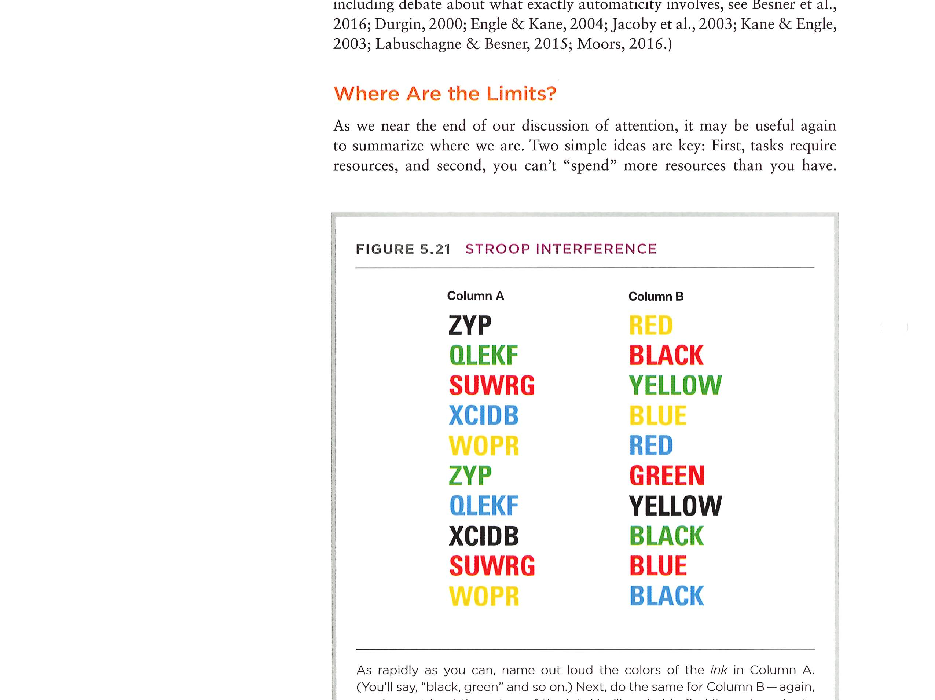
What is the Stroop task, and what does it demonstrate?
Naming ink color while ignoring the word (e.g., the word "red" in blue ink) — an automatic process (reading) interfering with a controlled one.
What are action slips?
Performing a familiar action when a different action was intended (e.g., driving to school when you meant to go to the store) — routines are efficient but inflexible.
What is Broadbent's (1958) filter model of attention?
A sentry-like filter blocks processing of unattended inputs and lets desired (attended) information through for further processing — an early-selection account.
Is the ability to inhibit distractors general or distractor-specific?
Distractor-specific: you develop the ability to inhibit a particular distractor, but it doesn't transfer to new distractors (Cunningham & Egeth, 2016; Frings & Wühr, 2014).
What did Mack & Rock (1998) find on inattentional blindness?
Participants fixated a dot while judging a "+" just off to the side; the dot briefly changed shape — 89% failed to detect the change, even though they were looking straight at it.
What are inattentional deafness and inattentional numbness?
Failing to hear a prominent stimulus (Dalton & Fraenkel, 2012) or feel an expected touch (Murphy & Dalton, 2016) when attention is elsewhere — inattention effects beyond vision.
Give a real-world example of inattentional blindness.
Experienced radiologists missed obvious anomalies in CT scans while looking right at them (Drew, Vo & Wolfe, 2013); drivers saying "I never saw the bicyclist" (Chabris & Simons, 2010).
What was the "Leon" door study (Levin & Simons, 1997)?
An experimenter asking pedestrians for directions was momentarily hidden by a door being carried past; roughly half failed to notice he'd been replaced by a different person — real-world change blindness.
What evidence supports late selection?
Moore & Egeth (1997): participants judged line length while background dots (unnoticed) formed a Müller-Lyer configuration — they showed the usual illusion, so the "unseen" background was perceived enough to bias judgment.
What neural evidence supports early selection?
The N1 effect (Hillyard, Vogel & Luck, 1998): brain electrical activity differs for attended vs. unattended inputs ~80 ms after stimulus arrival — before early sensory processing finishes. Attention also modulates LGN activity (Kastner, Schneider & Wunderlich, 2006).
Distinguish repetition priming from expectation priming.
Repetition (stimulus-driven) priming: mere prior exposure warms up detectors; no effort, no cost. Expectation priming: deliberately preparing for an anticipated input; improves performance but carries a cost when misled.
What did Posner & Snyder (1975) find about priming costs and benefits?
Primed detectors responded ~30 ms faster (benefit). In the low-validity condition, misleading primes cost nothing (detectors are independent). In the high-validity condition, being misled slowed responses — priming the "wrong" detector takes resources from the right one, revealing a limited-capacity system.
What brain evidence distinguishes the two types of priming?
Different sites: expectation-based ("goal-directed") vs. stimulus-driven attention involve distinct brain regions (Figure 5.8; Corbetta & Shulman, 2002).
Describe Posner, Snyder & Davidson's (1980) spatial cueing study.
Arrow cues (80% valid) preceded a letter left or right of fixation. Valid cues → faster detection; misled (invalid) trials → ~12% slower than neutral — devoting attention to one location means devoting less to others.
What is the spotlight metaphor of spatial attention, and what is its key caveat?
Attention is like a beam that can widen, narrow, and move (e.g., All is Vanity: narrow beam for details, wide beam for the whole scene) — but it refers to movements of attention, NOT the eyes: benefits appear within 150 ms, before eye movements (180–200 ms) could occur.
What three systems control attention (Posner & Rothbart, 2007)?
Orienting: disengage, shift, and engage attention. Alerting: maintain an alert state. Executive: voluntary control of actions and thoughts.
What does Figure 5.12 show about attention and the visual cortex?
Intending to attend left activates right visual cortex and vice versa — the control sites are separate from the analysis sites, and attention amplifies processing contralaterally via top-down signals.
What did Yarbus (1967) show about eye movements?
The pattern of eye movements while inspecting a picture depends on the viewer's task/goal — what you're trying to learn determines where you look.
What is the ultra-rare item effect?
People often overlook targets that appear very rarely — a problem for airport security screeners, who see threatening items so rarely they miss them (Mitroff & Biggs, 2014; Evans, Birdwell & Wolfe, 2013).
Distinguish endogenous from exogenous control of attention.
Endogenous: you choose what to attend to. Exogenous: a stimulus "seizes" your attention whether you like it or not (e.g., ambulance sirens, warning signals).
What did the barbell study (Behrmann & Tipper, 1999) show about object- vs. space-based attention?
Neglect patients tracked the red circle of a barbell even as it rotated into their "neglected" left side — once attention locks onto an object, the focus moves with it: evidence for object-based attention alongside the spatial bias.
What does it mean to say attention is an "achievement" rather than a process?
Paying attention involves many mechanisms (priming, inhibition, orienting); "attention" names the outcome — successfully focusing on what you want while avoiding distraction — not a single brain mechanism (Krauzlis, Bollimunta, Arcizet & Wang, 2014).
What did Allport, Antonis & Reynolds (1972) find on divided attention?
Shadowing spoken words while memorizing: most errors for heard words, fewer for seen words, fewest for pictures — the more similar the tasks, the harder to combine.
How does cell phone use affect driving (Strayer & Johnston, 2001)?
Drivers on phones miss more red lights and react slower — comparable to drunk driving risk; hands-free doesn't help.
Why is talking to a passenger less disruptive than a phone call (Drews, Pasupathi & Strayer, 2008)?
Passengers adjust their conversation to driving demands (e.g., pausing during tricky maneuvers); phone callers can't see the road.
What was the unicycling clown study (Hyman et al., 2010)?
Pedestrians crossing a square: 71% of those walking with a friend noticed a unicycling clown, vs. 25% of those on a cell phone — inattentional blindness from divided attention.
What is a perseveration error, and what causes it?
Repeating a response when the task requires a change (e.g., frontal-lobe patients keep sorting cards by color after the rule switches to shape) — failure of executive control (Goldman-Rakic, 1998).
What is goal neglect?
Failing to organize behavior toward one's goals despite understanding them — e.g., frontal patients copying a drawing piecemeal with no overall plan (Figure 5.20).
What is ADHD, and what brain proposal does Reisberg describe?
Attention-deficit/hyperactivity disorder: impulsivity, fidgeting, difficulty sustaining attention. Swanson et al. (2000) link symptoms to the alerting (right frontal, parietal, locus coeruleus), orienting (parietal, superior colliculus, thalamus), and executive (anterior cingulate, lateral frontal, basal ganglia) systems.
Why is Ritalin (a stimulant) used to treat ADHD?
It activates inhibitory circuits in the brain, helping guard against wayward impulses — ADHD may involve less effective inhibitory control.
Mack & Rock (1998) — 89% of participants failed to detect a shape change they were looking straight at (inattentional blindness)

N1 effect (Hillyard, Vogel & Luck, 1998) — attended vs unattended inputs differ ~80 ms after stimulus arrival; neural evidence for early selection

Posner & Snyder (1975) — primed detectors respond ~30 ms faster; misleading primes cost nothing at low validity but slow responses at high validity

Posner, Snyder & Davidson (1980) — valid spatial cues speed detection; invalid cues slow it ~12% vs neutral

Spotlight metaphor — attention as a beam that widens, narrows, and moves (independent of eye movements)

Brain sites for attention — alerting, orienting, and executive control systems

Unilateral neglect — clock drawing with the left side ignored

Behrmann & Tipper (1999) barbell — neglect patients track the red circle as it rotates; evidence for object-based attention

Strayer & Johnston (2001) — drivers on phones miss more red lights and react slower; hands-free doesn't help

Goal neglect — frontal patients copy drawings piecemeal with no overall plan

Stroop task — naming ink color while ignoring the word; automatic reading interferes with controlled color naming
Allport, Antonis & Reynolds (1972) — the more similar two simultaneous tasks, the more errors (divided attention)
