CH 9
 Call Kai
 Learn
Learn Practice Test
 Spaced Repetition
 Match
Match Flashcards
 Knowt Play
1/37

There's no tags or description
Looks like no tags are added yet.
Name | Mastery | Learn | Test | Matching | Spaced | Call with Kai | Chat |
|---|
No analytics yet
Send a link to your students to track their progress
38 Terms
Silent point mutation
(seCreT)
T to C

Missense point mutation
(Miss my TA)
T to A

Nonsense point mutation
(Carpenter Girl)
C to G

Insertion frameshift
(AT&T)
AT after T
Inserts AT after the T of the TCC serine codon

Deletion frameshift
Removes 4 nucleotides

Inversion
Invert/Flip something

Duplication
DNA sequence is copied
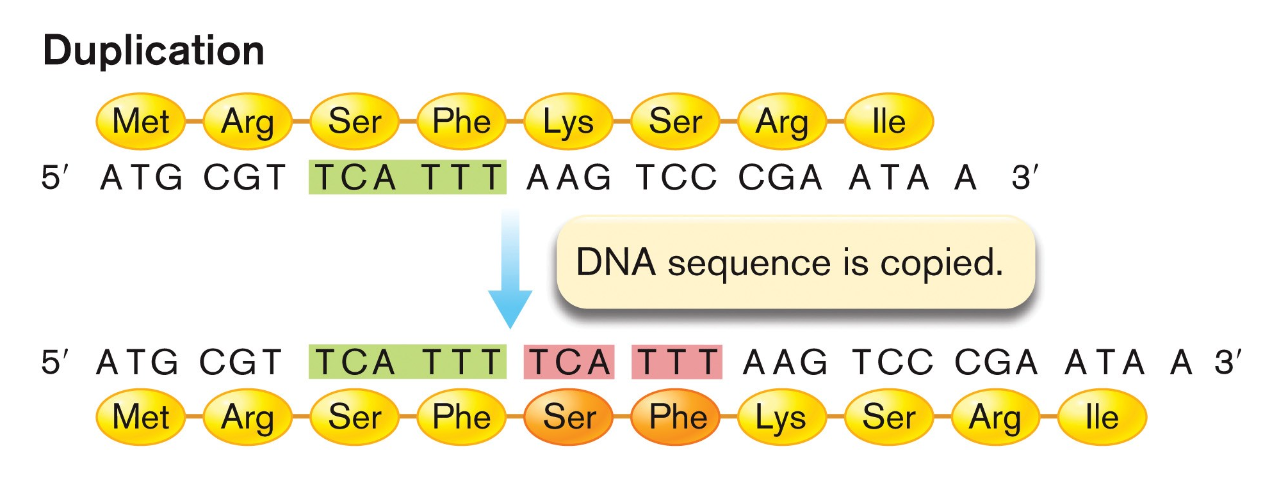
What causes mutations
Mistakes during replication
Point Mutations
Change in one base pair
Transition mutation
Base replaced by another base of the same class
Ex:
Adenine (A) -> Guanine (G)
Cytosine (C) -> Thymine (T)
Larger mutations (IID)
(Dinner In Italy)
Insertion of a section of DNA into
chromosome
Deletion of a portion of the chromosome
Inversion: flipping a portion of chromosome
Mutagens that cause mutations
Electromagnetic radiation -
UV light
x-rays
gamma rays
Chemicals -
Base analogs
Base-modifying chemicals
Intercalators
Base analogs
(Ana - con artist)
Chemical impostors that trick a cell into using them instead of normal DNA building blocks
Base-modifying chemicals
Substances that alter the chemical structure of normal DNA or RNA nucleotide bases
Intercalators
(In escalators)
Molecular wedge that slips between the rungs of a DNA ladder.
(causes frameshift mutations)

How do mutations affect phenotype ?
(No effect)
Most have no effect on the organism
How do mutations affect genotype
Permanent change in an organism's DNA sequence
How is mutagenicity accessed
(How do we know if this chemical damages DNA?)
Ames test
Ames test
Uses auxotrophic bacteria for histidine because they have hisG gene mutation (cant grown without histidine)
Chemical added, if causes reversion bacteria grow = mutagenicity
Most mutagens are carcinogens (cause cancer)
Mismatch repair
Cuts out mispaired base and puts correct one
BER (Base Excision Repair)
Replaced by DNA Polymerase I

Recombinational repair
Copies undamaged strand to replace damaged one after
rep
catalyzed by RecA recombinase
SOS repair
(Error prone)
Extensive DNA damage, turns off LexA, last resort
How do microbial genomes evolve
(Gain or loss of genetic material)
Gain or loss of genetic material
Small changes in a gene sequence cause…
Small changes = Slow changes
(no new func)
Slow changes in protein usually no new func
Large chromosome changes are
(ID)
Insertion of new material
Duplication of genes

Duplication of genes causes…
New functions for the cell (only if copied gene keeps doing its og func)
Base-modifying chemicals
CHANGE the base
Mutagens
CAUSE mutations
How do microbes exchange genetic material ?
Horizontal Gene Transfer
HGT: Transformation, Conjugation, and Transduction
What is Horizontal Gene Transfer (HGT)
Movement of genes between cells (besides cell division)
Plasmids
Carry genes between cells without having to become part of the chromosome
What is a plasmid ?
Extra piece of DNA outside chromosome
What is a secondary genome linked to ?
Plasmid acquisition or integration of an essential gene.
How can a secondary genome form ?
Through plasmid acquisition or integration of an essential gene.
What is one example of bacteria with two chromosomes ?
Vibrio cholerae.
What process can help bacteria acquire plasmids ?
Horizontal gene transfer.