Week 9c — Concepts & Categories Part 2
 Call Kai
 Learn
 Practice Test
 Spaced Repetition
 Match
 Flashcards
 Knowt Play
1/29

There's no tags or description
Looks like no tags are added yet.
30 Terms
How can a knowledge network represent relationships among concepts, and what does inheritance mean?
Concepts are nodes linked by meaningful relationships, and properties stored at a higher level are inherited below — so a canary inherits 'can fly' from bird and 'eats/breathes/has skin' from animal without restating them.

What is the semantic network's prediction about verification time? [Figure: hierarchy-inheritance.png]
More links to traverse → longer verification time: "Bird can fly" is 1 link, but "Bird eats" is 2 links (bird → animal → eats), so "bird eats" should take longer to verify than "bird can fly."
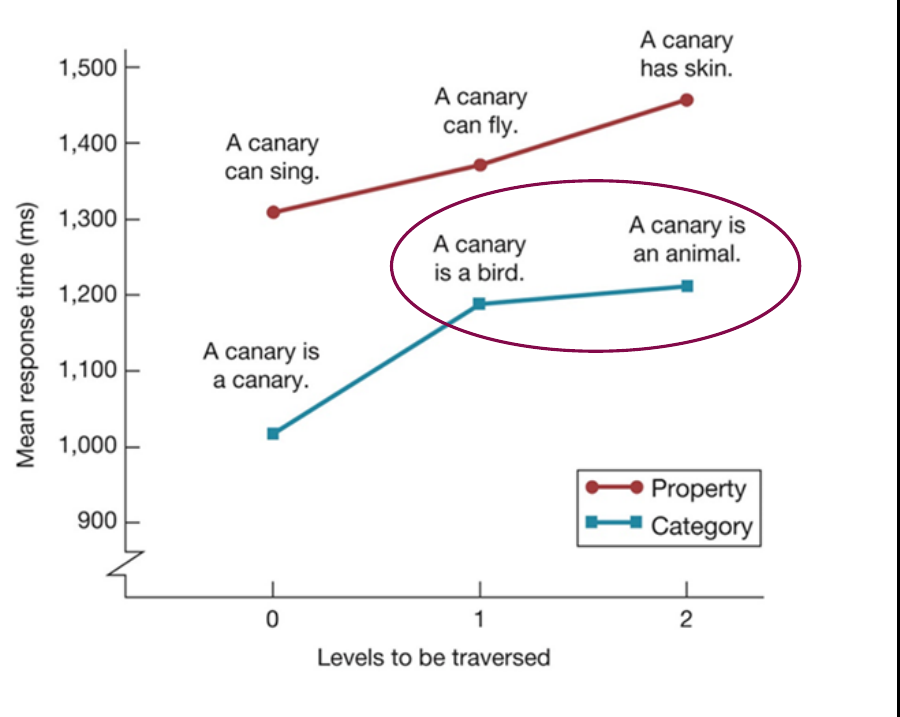
What did the reaction-time data show for property verification? [Figure: retrieval-time-graph.png]
It fit the prediction — response time rose with links traversed: 'canary can sing' (0 links) < 'canary can fly' (1 link) < 'canary has skin' (2 links), from about 1,300 to 1,460 ms.
Where did the data break the link-counting prediction for category statements?
Category verification flattened: 'canary is a canary' (0 links) took ~1,010 ms, but 'canary is a bird' (1 link) and 'canary is an animal' (2 links) both took ~1,200 ms — no further increase with distance.

Why don't false statements slow down the way the hierarchy predicts? [Figure: hierarchy-false-statements.png]
False statements are rejected immediately instead of slowing with network distance — and 'cat is not a stone' is verified faster than 'cat is not a bird,' so similarity, not distance, drives rejection time.
What is the verdict on the definition and hierarchical-structure approaches?
Both failed in their simplest forms: definitions can't capture everyday categories (counterexamples everywhere), and the hierarchy's link-counting doesn't match the reaction-time data (category verification flattens; false statements aren't slowed). Each captures something useful, but neither explains every aspect of categorization.

What is family resemblance, and what do graded and probabilistic membership mean? [Figure: family-resemblance-faces.png]
Family resemblance means members share overlapping features with no single feature in all of them (like brothers); membership is GRADED (some members are more typical) and PROBABILISTIC (boundaries are fuzzy and context can shift them for borderline members).
What is the difference between typicality and membership?
They dissociate: a robin is a highly typical bird and a penguin is highly atypical, but both are unambiguously birds. Typicality is how good an exemplar is; membership is whether it belongs at all.
Why did the lecturer open with a photo of a Komondor, a dog that looks like a mop?
It is a deliberately atypical dog: despite looking like a mop, it is unambiguously a dog — typicality varies even when membership is clear.
In the fruit-listing demo, what did people write first and last, and what does that show?
In 20 seconds, people listed typical fruits first (orange, banana, strawberry) and atypical ones last (dragon fruit, pumpkin, papaya) — what comes to mind first reflects typicality.

What were the typicality ratings for fruit and birds? [Figure: typicality-ratings.png]
On a 1 (least) to 7 (most typical) scale, apple 6.25 and robin 6.89 were most typical, olive 2.25 and bat 1.53 least typical, with a smooth gradient in between — the birdiness diagram puts the robin at the center and the ostrich at the edge.
Why use different methods to study typicality?
For converging evidence — free listing, typicality judgments, and goodness-of-member ratings all give the same pattern, showing the effect is real rather than an artifact of one method.
How does typicality influence how quickly we identify objects?
American subjects are quicker to identify pictures of German shepherds or collies as dogs than pictures of Chihuahuas or dachshunds. Typicality affects identification speed — but a less typical instance is no less clearly a member of the category.

Where does a cup become a bowl? Describe the continuum. [Figure: cup-bowl-continuum.png]
Across shapes 1–7 (growing wider, with and without handles), there is no abrupt switch: labeling changes gradually from "cup" to "bowl" as width increases, showing graded membership.

What did the cup–bowl graph show in the neutral context? [Figure: cup-bowl-graph.png]
With a handle, an object is called a 'cup' 100% of the time, but as width increases 'cup' falls and 'bowl' rises, crossing over around width 2.0 — so the same object can be labeled either way in the middle.

How did the mashed-potatoes context shift the category boundary? [Figure: context-shifts-boundary.png]
Imagined filled with mashed potatoes, the 'cup' curve dropped faster and 'bowl' rose sooner, shifting the crossover to a narrower width — so the same object was called a 'bowl' sooner, though object 1 stayed 'cup' regardless of context.

In the cups/bowls/vases study, how did context change identification of the same figure? [Figure: cups-bowls-vases.png]
Of 19 numbered figures, object 1 was always a 'cup,' but object 4 was called a 'cup' in someone's hands and a 'bowl' on a table filled with mashed potatoes.

What is the prototype account, and what is a prototype? [Figure: prototype-vs-exemplar.png]
People judge membership by comparing a new instance to the prototype — an abstracted summary of the category's characteristic features, the 'most typical' member, which need not match any object actually encountered (e.g., a robin as the prototype of bird).
What is the exemplar account?
People judge membership by comparing a new instance with stored memories of other instances — remembered exemplars, typical and atypical — so the representation is fuzzy, with no single summary, and your exemplars depend on your own experience.
What does each account preserve, and what is each account's main challenge?
Prototype: representation = abstracted summary; useful information = common structure; main challenge = capturing exceptions and subgroups. Exemplar: representation = remembered instances; useful information = specific details and variability; main challenge = explaining which instances are stored and retrieved.

Why is a prototype an incomplete picture of a category? [Figure: average-does-not-capture.png]
A prototype is an average (central tendency, location P) discarding information, hiding variability, and missing fine details — while exemplar theory keeps that variability, classifying new items by similarity to stored exemplars, with the most similar one influencing classification most.

How did Festa's lab study category learning with novel animals? [Figure: learning-exemplar-to-prototype.png]
People classified novel cartoon animals (varying in leg number/length and stripes) into two made-up categories with yes/no feedback — early on they compared new items to remembered exemplars, but over time they relied more on the abstracted prototype.

How do children move from exemplars to prototypes when learning a category? [Figure: familiar-exemplar-to-prototype.png]
A child starts with a familiar instance (the family dog) as the standard and may overgeneralize (calling a lamb a 'dog'), but with varied exemplars they extract shared features and form an abstracted summary — the category's 'center of mass.'

How do prototype and exemplar processes work together? [Figure: combined-prototype-exemplar.png]
Both contribute as experience accumulates: summary information supports generalization, while specific memories preserve details and exceptions.
Why is similarity alone not enough to determine category membership?
A crushed orange looks nothing like an orange but is still one, while a convincing counterfeit $100 bill looks exactly like money but isn't — features can change drastically while membership stays, or match perfectly while membership fails.
What background knowledge guides categorization, beyond similarity?
Origins (where did it come from?), causal structure (what makes it have these properties?), function (what is it for?), and rules/conventions (what makes it count as a genuine instance?). Features are interpreted through background knowledge.
How does background knowledge decide the counterfeit-bill and crushed-orange cases?
For the crushed orange, origin beats appearance — it's still an orange because of where it came from — while for the counterfeit bill, institutional rules decide authenticity, not appearance, and for artifacts generally intended function is especially informative.
For the novel musical instrument, what do you need to know before deciding how to play it?
Similarity (which familiar objects does it resemble?), experience (which instruments have you encountered?), and knowledge (what do strings, a resonating body, and tuning pegs suggest?) — you combine several sources to categorize it and predict how to play it.
Summarize the four accounts of conceptual knowledge.
Semantic network: concepts are linked through meaningful relationships. Prototype: categorization draws on an abstracted summary. Exemplar: categorization draws on remembered instances. Knowledge-based: background knowledge guides how features are interpreted.
How are typicality, membership, and context related?
They are related but distinct: typicality (how good an exemplar is) varies independently of membership (whether it belongs), and context can shift boundaries for ambiguous or borderline cases without changing membership of clear cases.