Lab 9 (TSIA)
 Call Kai
 Learn
Learn Practice Test
 Spaced Repetition
 Match
Match Flashcards
 Knowt Play
1/27

There's no tags or description
Looks like no tags are added yet.
Name | Mastery | Learn | Test | Matching | Spaced | Call with Kai | Chat |
|---|
No analytics yet
Send a link to your students to track their progress
28 Terms
What is a selective media biochemical test?
Selective media designed to enhance isolation by inhibiting growth of some organisms while encouraging growth of others
What is a differential media biochemical test?
Differential media is many types of media that may also contain indicators to expose differences between organisms
What are coliforms?
Subgroup of Enterobacteriaceae that produce acid and gas from lactose fermentation.
What is the most prominent member of coliforms?
E.coli
Where do coliforms usually live?
Most coliforms are normal inhabitants of the human intestinal tract
What does the presence of coliforms possibly indicate?
fecal contamination
What do the nutritional components in biochemical tests do?
Typically selected to obtain optimal growth
What do inhibitors do in biochemical tests?
Make the medium selective. Designed to prevent growth of specific growth of microorganisms while allowing other organisms to grow
What do substrates do in biochemical tests?
Almost always what makes the medium differential. Differing abilities to preform a specific chemical reaction differentiates organisms?
What do indicators do in biochemical tests?
Make expected reaction visible
Frequently a dye that changes color as pH changes
Also can be chemicals that react with products of a reaction and produce a color change
What is the preferred source of metabolic activity?
Fermentation
What is the process of fermentation in biochemical test?
Process of extracting energy from the oxidation of organic compounds such as carbohydrates (glucose, sucrose, lactose)
T/F Organisms capable of fermenting glucose will exhaust glucose supply before utilizing sucrose or lactose
True
What products does fermentation produce?
Fermentation produces acid byproducts, lowering the pH
Many types also produce hydrogen gas
What do microbes utilize and produce when carbohydrates are depleted or when they’re incapable of carbohydrate fermentation?
Microbes utilize peptones or amino acids
Produce NH3, raising the pH
What are the categories of microbe fermentation? (what they’re capable of)
Only capable of fermenting glucose
Capable of fermenting glucose and sucrose and/or lactose
Incapable of carbohydrate fermentation
On what basis does TSIA differentiate bacteria?
Sugar fermentation
Glucose
Sucrose/ Lactose
Sulfur reduction
Gas production
Why does a TSIA slant have a shallow agar slant with a deep butt?
Provides aerobic and anaerobic growth environments
How do you inoculate a TSIA slant?
Inoculated by a stab in the butt followed by fishtail streak of the slant
What does a TSIA slant contain?
3 carbohydrates (glucose, sucrose, and lactose)
ferrous sulfate and sodium thiosulfate as sources of oxidized sulfur
What are the indicators in TSIA?
For fermentation:
pH indicator: phenol red
For sulfur reduction:
Ferrous sulfate
What results do you see when TSIA is inoculated with a glucose ONLY fermenter?
Fermentation of glucose produces acid, which lowers pH and turns medium yellow throughout
Glucose concentration is very low (0.1%) and so it is depleted very quickly
As glucose diminishes, organisms in the aerobic region (slant) begin to break down available amino acids, producing NH3 and raising the pH turning the pH pink
Only occurs in the slant because of the anaerobic conditions in the butt
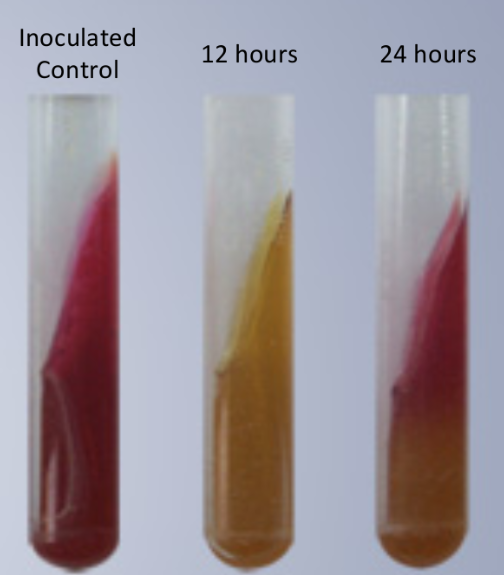
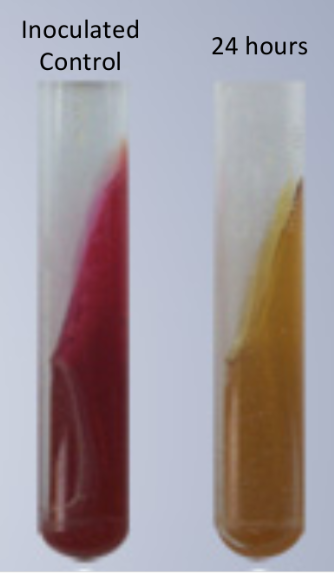
What results do you see when TSIA is inoculated with a organisms capable of fermenting glucose and lactose and/or sucrose?
Fermentation of glucose also lowers pH and turns the medium yellow throughout
Because lactose and sucrose concentration are 10x higher than glucose, greater acid production keeps both the slant and butt yellow
What results do you see in TSIA when inoculated with an organism incapable of carbohydrate fermentation?
Utilizes peptone and amino acids, alkalinizes the medium and turns it red (will look almost like an uninoculated tube)
How is gas production observed in TSIA slants? How is it produced?
Produced by fermentation of the carbohydrates
Appears as fissures in the medium or will lift the agar off the bottom of the tube
How is hydrogen sulfide production produced in TSIA slants?
May be produced by the reduction of thiosulfate in the medium or by the breakdown of cysteine in the peptone
Indicator (ferrous sulfate) reacts with the hydrogen sulfide to form a black precipitate
What conditions need to be present for thiosulfate reduction? What does this indicate?
Acidic conditions
Black precipitate indicates BOTH sulfur reduction and fermentation
If the black precipitate obscured the color of the butt, it MUST be yellow
How do we record results for TSIA?
Slant/ butt/ gas/ H2S
Yellow = acidic (A)
Pink/red = alkaline (K)
Using + or - to indicate result for gas and H2S production