Lab Concepts 2: Gait Patterns, Assistive Devices
 Call Kai
 Learn
 Practice Test
 Spaced Repetition
 Match
 Flashcards
 Knowt Play
1/25

There's no tags or description
Looks like no tags are added yet.
26 Terms
list common assistive devices + PT role
• 2-Wheeled Walker (2WW) • 4-Wheeled Walker (4WW) • Hemiwalker (HW) • Single Point Cane (SPC) • Large-Base Quad Cane • Small-Base Quad Cane • Crutches
-PT role: pick device they should use, and how they should use it
2-Wheeled Walker (2WW)
stability : mobilitiy
-Most common assistive device utilized in hospitals
-Provides a good combination of mobility efficiency (wheels on front) with stability (wide 4 bases of support)
-Requires good grip strength bilaterally, and good leg strenght
-Fit

4-Wheeled Walker (4WW)
lower stability: higher mobility
-4-wheels (pivoting), seat, storage area, brakes (*but can’t use seat if bad coordination)
-Designed for most efficient mobility while providing mild support for balance
-NOT typically used immediately after injury/surgery in hospital setting…WHY???=need more stability
-Fit
*easier to push so can do work longer (if pt has okay strenght but not good endurance)

Hemiwalker (HW)
higher stability: lower mobility
-One-sided device, largest base of support
-Commonly used with post-CVA patients
-Not an efficient device for mobility (designed for stability) (*good acutely)
-Fit
*good gait training tool; not for community use

Single Point Cane (SPC)
lower stability:higher mobility
-Small point of contact for balance only (not designed for weight-bearing)
-Held in opposite arm of affected lower extremity
-Slightly different styles
-Fit
*good for everyday (in home, community, etc.)
*opposite arm and opposite leg (mimick normal gait pattern); ex=if L knee injured put cane on R side

what side should a cane go?
want opposite side!
-ex=if L knee injured put cane on R side

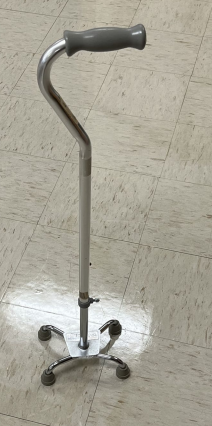
Small-Base Quad Cane (SBQC)
stability:mobility
-Larger points of contact for some weightbearing/offloading of affected lower extremity
-All 4 points must be in contact with ground (*press down on all 4 at same time)
-“K” facing away from the patient
-Fit: straight side against pt
*not used often, for specific pts (ex: storke and past HW but still need more stability)
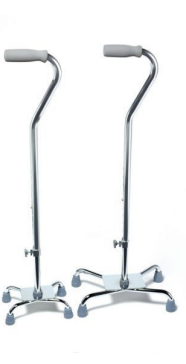
Large-Base Quad Cane (LBQC)
*pretty much like small, but more stability and better if larger pt
-Wider BOS than SBQC
-Larger points of contact for some weightbearing/offloading of affected lower extremity
-All 4 points must be in contact with ground
-“K” facing away from the patient
-Fit
Crutches (axillary)
lower stability:higher mobility
-Requires good balance, coordination and cognition from patient (*not age necessarily)
-Can be used unilaterally or bilaterally
-More common with orthopedic diagnoses
-Fit: on opposite side of surgical leg

Gait Patterns
Four-Point (two canes or crutches, two lower extremities)
-1) Device -> 2) Affected Leg -> 3) Device -> 4)Unaffected Leg
*for specific pts (ex=CP)
[two and three point most common; cane or crutches…]
Three-Point
-1) Device -> 2) Affected Leg -> 3) Unaffected Leg
*if need extra stability than two point
Two-Point
-1) Device and Affected Leg – 2) Unaffected Leg
*preferred, normal walking pattern; walkers
PT guarding patient during gait
-Stand on the weak side
-Position yourself slightly posterior and lateral to the patient
-Hip-to-hip
-One hand on gait belt, other hand positioned where needed
-Guarding will slightly vary depending on the device, diagnosis and patient presentation

exception to pt guarding on side
-if using HW and need to knee block, you stand on side more

PT cues to patient during gait
-pick 1-2 things to focus on
-Internal vs External cues

list common adaptive equipment
-Leg Lifter, Long-handled shoehorn, Sock Aide, Grabber/Reacher, Dressing Stick
leg lifter
-Helps the patient utilize their arms to lift their affected lower extremity
-Most common after THA/TKA

long-handled shoehorn
-Assists patient to put on shoes when unable to bend forwards
-Common after posterior hip replacements, lumbar surgeries

sock aide
-Assists patient to put on socks when unable to bend forwards
-Common after posterior hip replacements, lumbar surgeries

grabber/reacher
-Assists patient to access small/light items on the floor when they are unable to bend forwards
-Common after hip replacements, lumber surgeries, balance issues/concerns (*bad shoulder)

dressing stick
-Used to assist in lower extremity dressing
-Common after lower extremity or spine surgeries, balance issues/concerns

list common braces/external supports + how Rx them
-surgeon/doctor gives Rx/says when wear, will give it to them
-PT 1) educate them 2) helps transition them out of these

walking boot
-Commonly utilized following ankle/foot injuries and surgeries
-Typically ordered by MD
-Could be WB or NWB in the boot
-Prevents ankle movement
-Mobility considerations?: ~90DF; can take on/off to check incision and do PT

straight leg brace
-Commonly utilized after patellar/quad tendon repairs, tibial plateau fractures
-Prevents flexion of the knee
-Mobility considerations?: not meant to bend knee at all; in most of the time but can take off at therapy

hinged knee brace
-Allows increased support of the knee joint
-Can be locked in any variation of knee flexion/extension
-Common after ACL and meniscal repairs/reconstructions (*decreased quad strenght)
-Mobility considerations?: dial starts at zero and then hinge and lock at specific degree, doctor decides frequency and we help transition them

Lumbosacral Orthosis (LSO)
-Utilized to prevent excessive movement at the lumbar spine
-Common after lumbar fusions or other lumbar surgeries
-Mobility considerations?: how get on/off and how use it
*in hospital; cause weak core

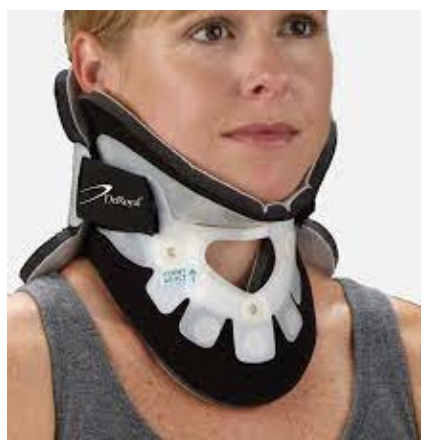
cervical spine collar
-Utilized to prevent excessive movement at the cervical spine
-Common after cervical surgeries
-Mobility considerations?: protective, but muscles weak in brace
shoulder sling
-Utilized to prevent shoulder movement
-Common after rotator cuff operations, shoulder replacements, sometimes after CVA’s (*labral tear)
-Mobility considerations?: removable to can work on shoulder at PT; little shoulder flexion
