Analytical Chemistry
 Call Kai
 Learn
 Practice Test
 Spaced Repetition
 Match
 Flashcards
 Knowt Play
1/30

There's no tags or description
Looks like no tags are added yet.
31 Terms
Qualitative vs Quantitative
qualitative analysis - what components are present in your sample
Techniques - NMR, Mass spectrometry, Microanalysis, Infrared spectroscopy
used to determine if biomarker is present eg: pregnancy test
Quantitative Analysis - how much of each component is in your sample
Techniques - Titrations, Electroanalytical methods, optical methods
Used for determining concentration of substances in the body eg: measuring ions in blood
Accuracy vs Precision
Accuracy - Refers to how close a measurement is to the true or accepted value
Precision - Refers to how close a series of measurements are to each other

Repeatability vs Reproducibility
Repeatability - refers to consistency of results obtained when the same person uses the same instrument under the same conditions. Over a short period. This leads to increased precision.
Reproducibility - Refers to the consistency of results obtained when different people use different instruments in different laboratories. A method is useless without reproducibility
what is the british Pharmacopoeia (BP)
legally recognised collection of standards for medicines
provides pharmacopoeial standards for human and animal medicines. It ensures quality of pharmaceutical substnaces
contains 3000 micrographs
BP drug monograph strcuture
A typical drug monograph in the BP includes:
Name: The official name of the drug.
General Notices (Ph. Eur. Number): References to European Pharmacopoeia standards.
Action and Use: A brief description of the drug's therapeutic purpose.
Definition: Specifies the chemical identity and often includes the chemical formula.
Content: Defines the acceptable range for the amount of the active ingredient (e.g., 95%-105% of the stated dose).
Identification: Tests to confirm the identity of the substance. Common methods include:
IR Spectrophotometry.
Melting point determination.
Test: Specific analytical procedures to assess the quality of the substance. This often includes:
Related Substances: Typically uses chromatography (e.g., liquid chromatography) to detect and quantify impurities. The monograph will detail chromatographic conditions, mobile phases, and system suitability requirements.
Assay: A quantitative method to determine the exact amount of the active ingredient present. This also often uses chromatography and specifies the conditions for measurement.
Impurities: Sections detailing specific impurities that need to be controlled.
Pharmaceutical analysis techniques
Chromatography: Used to separate mixtures of compounds and determine if a sample is one compound or many.
UV/Vis Spectroscopy: Used to determine the color of a sample.
Mass Spectrometry (MS): Used to determine the mass of molecules.
IR Spectroscopy: Used to identify functional groups present in molecules.
X-ray Analysis: Used to determine how molecules fit together in the solid state (crystal structure).
Nuclear Magnetic Resonance (NMR) Spectroscopy: Used to determine the number of protons and carbon atoms, and their chemical environments within a molecule.
uv and visible light wavelength and energy ranges
ultraviolet - 100nm to 400nm
visible light 400nm to 700nm
UV/Vis spectroscopy: Instrumentation
uv/light spectrophotometer has:
light source - Deuterium lamp used for uv region 190 - 350nm
Tungsten lamp - used for visible region 350 - 900nm
Monochromator - This devices disperses the light from lamp into wavelengths,
sample holder cuvette - typically 1cm cuvette made of quartz or glass
detector - measures the intensity of the light that has passed through the sample
output - instrument records intensity of transmitted light as a function of wavelength producing a spectrum

two main types of instrument
single beam - sample and reference must be analysed separately
Dual beam - sample and blank are analysed simultaneously providing more stable readings
what is a chromophore
functional group within a molecule that absorbs UV or visible light
absorption occurs when electromagnetic radiation has sufficient energy to promote electron from a lower energy to higher energy orbital
The molecules absorb the light causing electron to move from lower energy level HOMO to higher energy level LUMO
eg; alkenes, alkynes, aromatic rings, c=o and atoms like oxygen nitrogen and sulfur with lone pairs
Drugs contain these groups so UV/Vis is used to study them
The wavelength at which maximum absorption occurs is denoted as
λmax. (lambda max)
what is conjugation and increasing it does what?
conjugation - (alternating single and double bonds in a molecule)
lowers HOMO-LUMO gap. This means longer wavelengths of light (lower energy) are absorbed causing λmax.to shift to higher wavelengths
what is the beer - lambert law and the equation
describes the relationship between absorbance of a solution and its concentration
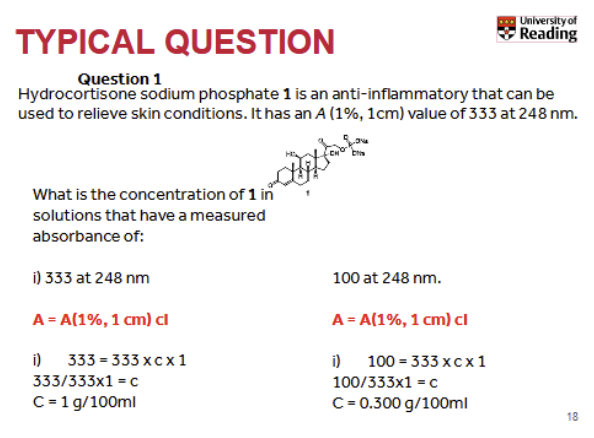
A=A(1%,1 cm)cl
A= Absorbance
A(1%,1 cm = absorbance of a solution with 1% w/v concentration of a substance in a 1cm pathlength cuvette units = dL⋅cm−1⋅g−1
C = concentration of the sample in grams per 100ml
l = pathlength of the cuvette, which is almost always 1cm
what are auxochromes
groups attached to the chromophore that modify the ability of the chromophore to absorb light. Without contributing to absorption themselves
usually heteroatoms (eg;O,N) with lone pairs of electrosn
pKa determination
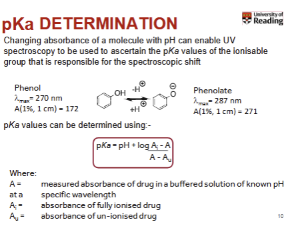
Uv spectroscopy can be used to help determine pKa values of ionisable groups in a molecule
when a molecule ionises eg: changes pH its chromophore can be altered leading to a change in
λmax and/or absorbance intensity.
equation to work out pKa
pka= pH + log (A_i-A / A−A_u)
A = measured absorbance of drug in buffered solution of known pH
Ai = absorbance of fully ionised drug
Au = absorbance of unionised drug
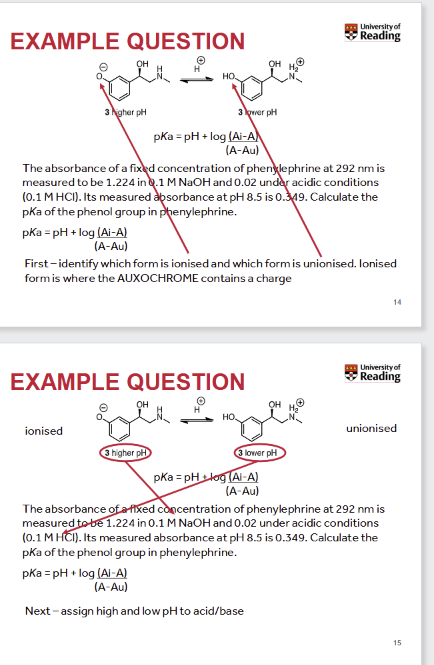
pka example question
First to find what is being ionised and unionised look at the chromophore, in this case it is the benzene ring

why is there bp calibration in UV Spectroscopy
it ensures that each uv spectrometer is giving the same answers as another uv spectrometer for the same sample
application of UV/Vis spectroscopy in pharmaceuticals
Quantitative Analysis - determination of drug concentrations #
pka determination
identity check
Advantage + Disadvantage of UV/vis Spectroscopy
ad:
relatively cheap
can be used with separation techniques
doesnt require extensive training
provides good precison
dis:
analysis of complex mixtures can be challenging
limited selectively due to potential for multiple chromophores
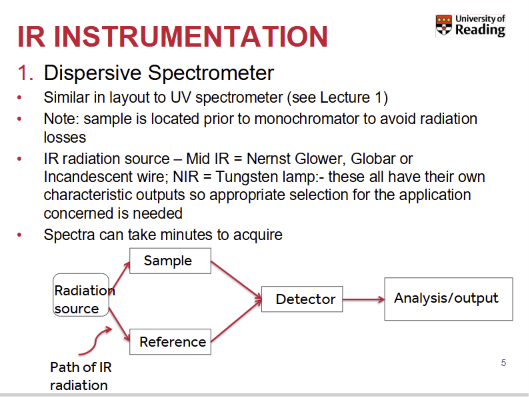
IR instrumentation
features of IR Spectrum
starts at 4000 and moves to right
increasing wavelength to right
high frequency of vibration on the left
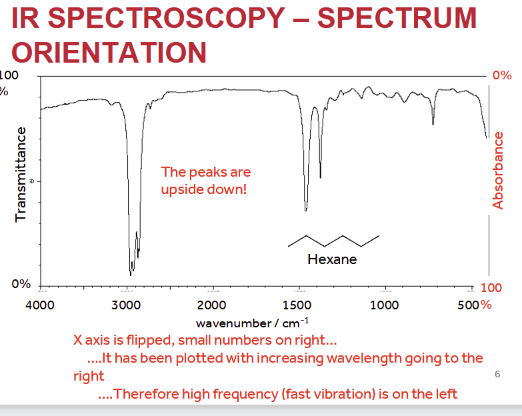
what groups can you find in 3000-3600
what groups can you find in 2000-2400
what groups can you find in 1550-1750
what groups can you find in <1500
OH,NH,NH2
Triple bonds alkyne nitrile
C=O, N=O, Ester, Ketone, Aldehyde, Acid, Amide, Nitro
Fingerprint region
frequency of vibrations are determined by what?
bond strength - stronger bonds (double and triple vibrate at higher frequencies than weaker bonds. This allows faster vibrations
Mass of an atom - bonds involving lighter atoms vibrate at higher frequencies than bonds involving heavier atoms
how is intensity of absorption determined
IR absorption depends on how much the dipole moment changes during a vibration.
A large change in dipole moment = strong absorption.
A small change = weak absorption.
No change = no IR absorption (IR inactive).
eg:C=O (ketone): Large change in dipole moment → strong absorption.
C=C (symmetrical alkene): Small change in dipole moment → weak or no absorption.
O₂ and N₂: No change in dipole moment → IR inactive (no absorption).
how are samples prepared
Sample Preparation
The preparation depends on whether the sample is a liquid, solid or gas:
Liquids: Placed between two special salt plates or mixed with a suitable solvent.
Solids: Mixed with oil (mull) or KBr powder and pressed into a thin disc (pellet).
Gases: Placed in a special gas cell for analysis.
why is calibration important
Reproducibility: Ensuring that spectra obtained at different times or on different instruments can be reliably compared.
Reliable Identification: Accurate peak positions are essential for confirming the identity of a compound.
Applications of IR spectroscopy
qualitative analysis of drugs -
identity testing
synthesis monitoring
ad + dis of IR
ad:
relatively cheap
versatile
dis
limited structural data
complex mixtures
sensitivity