heme II: hemorrhagic disorders
 Call Kai
 Learn
 Practice Test
 Spaced Repetition
 Match
 Flashcards
 Knowt Play
1/85

There's no tags or description
Looks like no tags are added yet.
86 Terms
what kind of hemorrhage is being described: bleeding from a single location, commonly indicates injury infection or a tumor
localized
what type of hemorrhage is being described: bleeding from multiple sites, spontaneous and recurring bleeds
generalized
what kind of hemorrhage requires physical intervention and transfusions
generalized
if you see petechiae, purpura, and echymoses, what can be infered
a patient has mucocutaneous bleeding
which assay is prolonged in deficiencies of factors II, V, VIII, or X
PT
which assay is prolonged in deficiencies of all factors except VII and XIII
PTT
which assay is prolonged by unfractionated heparin therapy, dysfibrinogenemia, hypofibrinogenemia, and afibrinogenemia, is a qualitative issue
TT
which assay is reduced in dysfibrinogenemia, hypofibrinogenemia, and afibrinogenemia, and is a quantitative issue
FG
if a patient’s bleeding episodes begin after childhood, it is considered
acquired
which acquired hemorrhage accounts for most fatal hemorrhages
ACOTS
what does cryoprecipitate contain
fibrinogen, factor VIII
what does FFP contain
all coagulation factors
how does liver disease lead to hemorrhage
it alters the production of vitamin K dependent factors
what are the vitamin K dependent factors
II (prothrombin), VII, IX, and X, Protein C/S/Z
what is a complication of liver disease caused by lower vitamin K production
DIC
an elevated thrombin time indicates
decreased fibrinogen levels
fibrinogen is ___ in moderate to severe liver disease
decreased (<200 mg/dl)
thrombin time is ___ in liver disease
prolonged
PT is ___ in mild liver disease
prolonged
PTT is ___ in severe liver disease due to DIC
mildly prolonged
platelet count is ___ in liver disease
decreased
D dimer is ___ in liver disease
elevated
what is the most crucial step that vitamin K facilitates
gamma carboxylation
what does gamma carboxylation do to the coagulation factors
it enables them to bind to calcium ions
how is calcium important for coagulation factors
it enables them to anchor themselves to the surface of activated platelets, forming a stable fibrin clot
vitamin K deficiency leads to all of the following except
excessive clotting
if a patient has vitamin K deficiency, what are the mixing study results
PT and PTT yield a corrected result after pooled with normal plasma
bleeding into joints is specific for which congenital bleeding disorder
hemophilia
what is the most common bleeding disorder
VWD
who is more likely to be diagnosed with VWD
women
which type of VWD is the most common form
type 1
which type of VWD is a quantitative defect in VWF
type 1
which type of VWD is a qualitative defect in VWF
type 2
which type of VWD is a near absence of VWF and very low FVIII
type 3
which type of VWD has a proportionate decrease in VWF:Ag and VWF activity
type 1
which type of VWD has normal or near-normal levels of VWF, but a functionally abnormal protein
type 2
which subclass of type 2 VWD has a decreased platelet adhesion due to loss of high molecular weight multimers
type 2A
which type 2 VWD has an increased affinity of VWF for platelet GPIb
type 2B
which type 2 VWD is caused by defective multimer assembly or increased proteolysis by ADATS13
type 2A
which type 2 VWD leads to spontaneous platelet aggregation and thrombocytopenia
type 2B
which type of VWD has both mucocutaneous and deep tissue bleeding
type 3
which type of VWD has an undetectable VWF:Ag and VWF activity
type 3
which test panel measures the total amount of VWF protein is present regardless of function
VWF:Ag assay
which test panel measures the functional activity of VWF, specifically its ability to bind to GPIb
VWF activity test: ristocetin cofactor assay (VWF:RCo)
a low VWF:Ag with proportionate decrease in activity is indicative of
type 1 (quantitative)
a normal VWF:Ag with disproportionately low activity indicates
type 2 (qualitative)
a VWF:RCo/VWF:Ag ratio >0.7 is indicative of
type 1 VWD
a VWF:RCo/VWF:Ag ratio <0.7 is indicative of
type 2 VWD
in type 1 or type 2 VWD, factor VIII levels are
mild to moderately low
in type 3 VWD, factor VIII activity is
markedly low
which test helps distinguish between type 2 variants
VWF multimer analysis
a loss of HMW is seen in what types of VWD
type 2A and 2B
a normal distribution of VWF multimers with decreased function indicates
type 2M
a complete absence of VWF multimers indicates
type 3 VWD
in what type of VWD can there be platelet aggregation at low doses of ristocetin
type 2B
a platelet aggregation study showing normal aggregation with all aggregators EXCEPT ristocetin is indicative of
VWD/bernard soulier
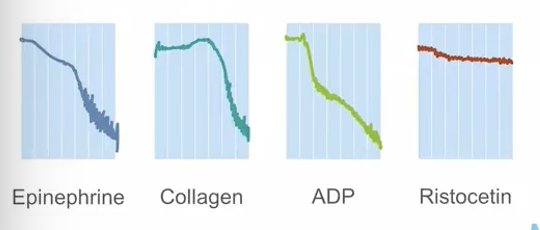
which disease correlates with this platelet aggregation study
VWD/bernard soulier
which type of VWD mimics hemophilia A
type 2N
what does desmopressin therapy do
it increases plasma levels of VWF and factor VIII
which type of VWD is contraindicated by DDAVP therapy
type 2B
hemophilia A is a deficiency in
factor VIII
hemophilia B is a deficiency in factor
IX
hemophilia primarily affects
men
what is the most common type of hemophilia
hemophilia A
<1% FVIII activity indicates what level of hemophilia A
severe
1-5% FVIII activity indicates what level of hemophilia A
moderate
5-40% FVIII activity indicates what level of hemophilia A
mild
severe hemophilia A has how much FVIII activity
<1%
moderate hemophilia A has how much FVIII activity
1-5%
severe hemophilia A has
spontaneous bleeding
in hemophilia A, PT and TT are
normal
in hemophilia A, PTT is
prolonged
what is the platelet count for patients with hemophilia A
normal
if plasma FVIII activity fails to rise to expected levels after concentrate administration, what is suspected
an inhibitor
what is used to quantify the inhibitor if indicated (confirmatory)
a bethesda assay
what disorder is also called christmas disease
hemophilia B
in hemophilia B, PTT is
prolonged
in hemophilia B, PT is
normal
hemophilia C is a deficiency in
factor XI
which deficiency reduces thrombin production
factor IX
in FXIII deficiency, PT, PTT, and TT are all
normal
the urea solubility test is used to screen for
factor XIII deficiency
factor V deficiency leads to
bleeding
factor V leiden leads to
clotting
in factor V deficiency, PT and PTT are
prolonged