PHRM 4060 Exam 3: Corticosteroids I
 Call Kai
 Learn
 Practice Test
 Spaced Repetition
 Match
 Flashcards
 Knowt Play
1/63

There's no tags or description
Looks like no tags are added yet.
64 Terms
What is/are the main hormone(s) and functions of glucocorticoids?
Main Hormone: Cortisol
Function: Sugar, stress, anti-inflammatory
What is/are the main hormone(s) and functions of mineralocorticoids?
Main Hormone: aldosterone
Function: salt and water balance
What is/are the main hormone(s) and functions of androgens?
Main Hormones: Testosterone, DHT
Function: sex
What is/are the main hormone(s) and functions of estrogens?
Main Hormone: Estradiol
Function: Sex
What is/are the main hormone(s) and functions of progestogens?
Main Hormone: Progesterone
Function: Reproduction
Examples of Neurosteroids
allopregnanolone, zuranolone
How are steroids made?
Cholesterol (C27) → Pregnane (C21) → Androstane (C19) → Estrane (C18)
Characteristics of Cholestane Skeleton
C27
Cholesterol
Characteristics of Pregnane Skeleton
C21
Corticoids, progestogens
Characteristics of Androstane Skeleton
C19
Androgens
Characteristics of Estrane Skeleton
C18
Estrogens
Structure of Steroids
Skeleton:
17-carbon gonane core (rings A–C 6-membered, ring D 5-membered),
angular methyls at C10 and C13,
C17 side chain.
3D Conformation:
Mostly trans B/C and C/D junctions form a flat, rigid plank;
β is above the plane, α is below;
5α-H keeps ring A flat (DHT), whereas 5β-H bends it (bile acids).
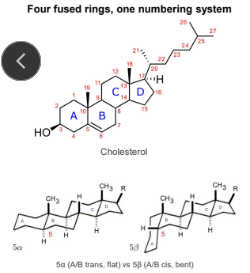
Exception in 3D steroid structure
digoxin, A/B and C/D both cis, a bent steroid
Why is the skeleton and 3D shape of steroids important?
Their positions are key in polar groups (C3, C17, C11, C21) doing receptor binding
Minor structural modifications drastically alter activity (e.g., adding 9α-F9α-F to cortisol yields fludrocortisone, increasing glucocorticoid potency ∼10-fold and mineralocorticoid potency ∼125-fold).
Glucocorticoids Structure
Δ4-3-one (ketone)
11β-OH
17α-OH
20-ketone
21-OH
Mnemonic: Cortisol = 11,17, 20, 21

What is the main hormone of glucocorticoids?
cortisol
Mineralocorticoids Structure
Δ4-3-one
11β-OH
18-CHO (aldehyde)
21-OH
No 17α-OH
Aldosterone = Aldehyde = Salt

What is the main hormone of mineralocorticoids?
aldosterone
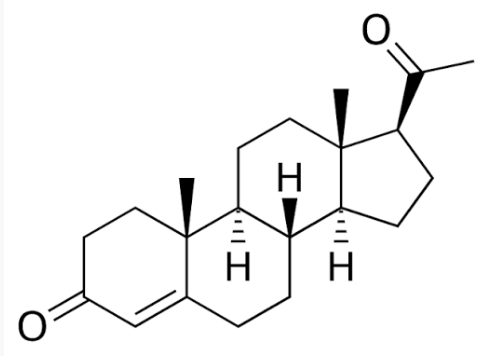
Progestogens Structure
Δ4-3-one
20-one
no 11-, 17- or 21-OH
Androgens Structure
17β-OH (or 17-one)
no side chain

Estrogens Structure
Aromatic ring A
Phenolic 3-OH
no C19

-ol / -one
OH / C=O, with position and α/β
example: 17β-hydroxy...-3-one
-ene, Δ
C=C starting at that carbon
example: Δ4 = C4=C5; pregna-1,4-diene
nor-
1 carbon removed
example: 19-nortestosterone (nandrolone)
seco-
A ring bond broken
example: 9,10-secosteroid (vitamin D)
Stereo
α (below), β (above)
example: 11β-OH, 17α-OH, 5α-H
HPA Axis
Hypothalamus releases CRH upon stress
CRH stimulates anterior pituitary
Anterior Pituitary releases ACTH
ACTH stimulates adrenal gland
Adrenal gland releases Cortisol
Cortisol leads to negative feedback loop back to CRH and ACTH
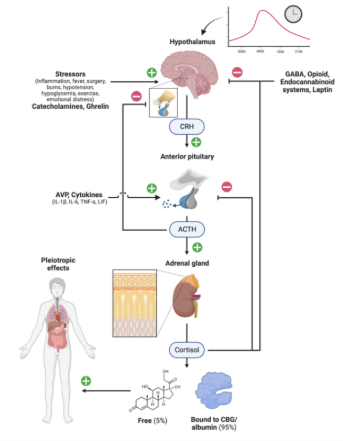
What stimulates cortisol release?
Stress
Infection
Surgery
Pain
Fear
Low blood glucose
Circadian rhythm and cortisol levels
Highest: early morning
Lowest: midnight
What are the adrenal cortex zones?
GFR = Salt, Sugar, Sex
glomerulosa, fasciulata, reticularis
Glomerulosa
Produces: Aldosterone
Controlled by:
Angiotensin II
Potassium
Enzyme:
CYP11B2
Fasciculata
Produces: Cortisol, gluconeogenesis, break down protein and fat (sugar)
Controlled by: ACTH
Enzyme: CYP11B1
Reticularis: What is produced and what type of activity does it contain?
Produces: Androgens (DHEA)
Contains:17,20-lyase activity
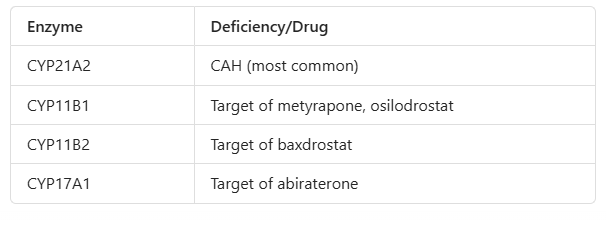
CYP21A2 loss leads to
CAH (most common) = congenital adrenal hyperplasia

CYP11B1 leads to
Cushing’s
CYP11B1 inhibited by
osilodrostat, metyrapone
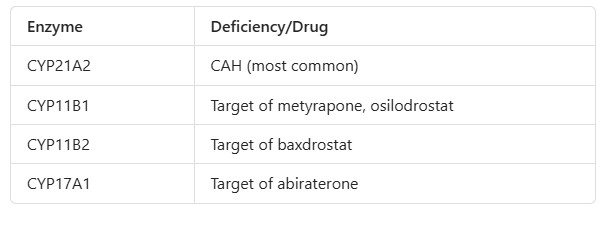
CYP11B2 leads to
hypertension
CYP11B2 inhibited by
baxdrostat

CYP17A1 leads to
prostate cancer
CYP17A1 is inhibited by
abiraterone
11β-HSD Enzymes Location and Function
Location: Liver, Fat
Function: Activates prodrugs
Cortisone → Cortisol
Prednisone → Prednisolone
Which 11β-HSD enzyme drug is preferred in severe liver disease?
Severe liver disease:
✅ Use prednisolone
❌ Avoid prednisone
11β-HSD2 Location, Function and Purpose
Located in: kidney, colon, placenta
Function: inactivates cortisol (Cortisol → Cortisone)
Purpose: Protect MR (mineralocorticoid receptor) from cortisol
Licorice Toxicity
Licorice inhibits 11β-HSD2
Cortisol activates MR
HTN, hypokalemia, salt retention occurs
Which drugs are used to mature fetal lungs before preterm birth?
Dexamethasone and betamethasone
They are poor 11β-HSD2 substrates because they are fluorinated and can cross into the fetus
Steps of GR activation
transactivation
transrepression
Steps of transactivation
Turns on anti-inflammatory genes: GILZ, MKP-1, IκBα, annexin
A1/lipocortin → phospholipase A2 inhibition leading to less prostaglandins and leukotrienes
Turns on metabolic genes: PEPCK, G6Pase → gluconeogenesis, protein breakdown → Many side effects
Steps of transrepression
Turns OFF inflammatory transcription factors NF-κB and AP-1
Leads to inhibition of IL-1, IL-6, TNF-α, COX-2, iNOS, adhesion molecules
Less swelling, redness, pain
Cell Effects of GR Activation
Fewer lymphocytes, eosinophils, monocytes in blood;
neutrophils go UP due to detachment (demargination) from vessel walls
Do not mistake steroid neutrophilia for infection
Ranking of Anti-Inflammatory Potency
Dexamethasone is ~25-30× stronger than hydrocortisone

Addison’s Disease
Too little cortisol + aldosterone
Symptoms: Fatigue, Weight loss, Hypoglycemia, Hypotension, Hyperkalemia, Hyponatremia, Hyperpigmentation
Treatment: Hydrocortisone, Fludrocortisone
CAH (21-Hydroxylase Deficiency)
Cannot make cortisol
↓
ACTH increases
↓
Androgens increase
↓
Virilization
Cushing Syndrome
Too much glucocorticoid caused most commonly by exogenous glucocorticoid therapy
Symptoms:
Moon face
Buffalo hump
Diabetes
Thin skin
Striae
HTN
Muscle wasting
Conn Syndrome
Too much aldosterone
Leads to HTN, hypokalemia, metabolic alkalosis
Side effects of Glucocorticoids
Hyperglycemia
Osteoporosis
Infection risk
HPA suppression
Muscle wasting
Psychiatric changes
Cataracts/glaucoma
CYP3A4 Inhibitors
Ritonavir
Cobicistat
Clarithromycin
Itraconazole
Risk of CYP3A4 inhibitors and steroids
↑ steroid levels
↑ Cushing syndrome risk
Especially inhaled fluticasone
CYP3A4 Inducers
Rifampin
Phenytoin
Carbamazepine
What are the effects of CYP3A4 inducers?
Increased steroid efficacy
Aldosterone
Act upon MR
Increase: ENaC, Na+/K+-ATPase, ROMK
Leads to: Na+ retention, water retention, K+ loss, H+ loss
Fludrocortisone
9α-F cortisol
MC potency ↑ 125×
Use: Addison’s disease, Adrenal insufficiency
Spironolactone
MR antagonist
Also blocks AR
Uses:
HF
Resistant HTN
PCOS
Acne
Hirsutism
Side effect:
✅ Gynecomastia
✅ Hyperkalemia
Eplerenone
More MR selective
Less gynecomastia
Still causes hyperkalemia
Finerenone
Nonsteroidal
No AR/PR activity
No sexual adverse effects
Key toxicity:
Hyperkalemia