CHEE 380 FINAL
 Call Kai
 Learn
 Practice Test
 Spaced Repetition
 Match
 Flashcards
 Knowt Play
1/34

There's no tags or description
Looks like no tags are added yet.
35 Terms
Polymer
—Long molecule unit built from many copies of a repeat unit
Addition polymerization
—Chain reaction carried by a radical (one unpaired electron)
——→Radical turns monomer into radical which turns into another monomer into a radical and they bond, this repeats
Condensation polymers
—Two molecules join and release water
Molecular weight
—Depends on chain length (longer chain = higher MW)
Number average (% of chain) and weight average (% of mass)
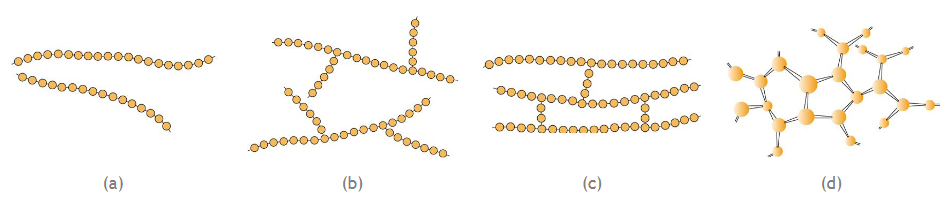
Molecular structure
—Decide whether a polymer melts, stretches or stays rigid
a) Linear
b) Branched
c) Cross-linked
d) Network
Copolymers
—Two repeat units in one chain
—Altered properties like a composite, very tunable (can get the exact properties you want)
a) Random
b) Alternating
c) Block
d) Graft

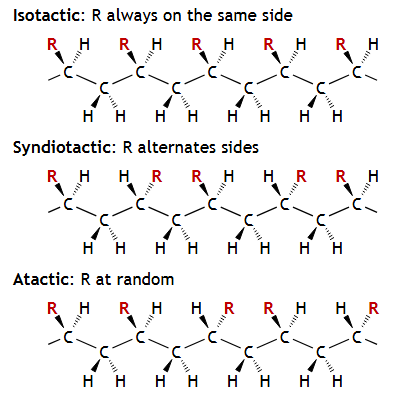
Isomerism
—Where side group R sits
Isotactic: R always on the same side (crystalize easily)
Syndiotactic: R alternates sides (crystalize easily)
Atactic: Random
Polymer crystallinity
—Chains pack into a crystal by folding back and forth into a thin plate
—Usually a mix of amorphous and crystaline
—Polymer crystals grow out of nuclei as spherulites
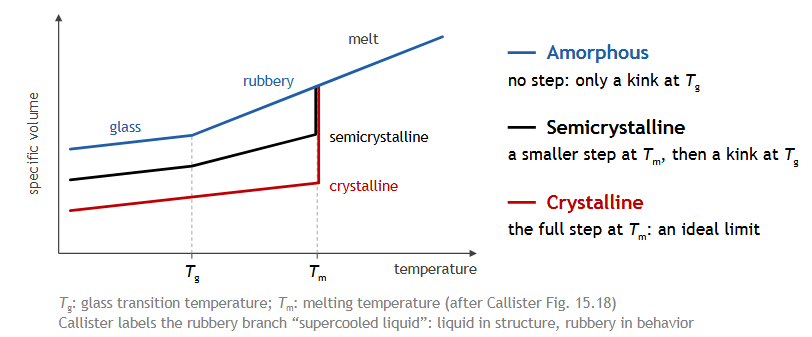
Glass transition
—Crystalline, shrinks suddenly at Tm
—Amorphous, changes slope at Tg
——→ < Tg: rigid glass
——→ Tg to Tm: Rubbery or tough solid
——→ > Tg: viscous liquid
Thermoplastic
—Soften when heated, harden on cooling
—Recyclable
—Can be reshaped
EX:
→PET
→PP
→PVac
→PVC

Thermosets
—Cured once into a network
—They char instead of melting
—Can’t be reshaped
EX:
—Epoxy resins
—Polyester resins
—Urea-formaldehyde

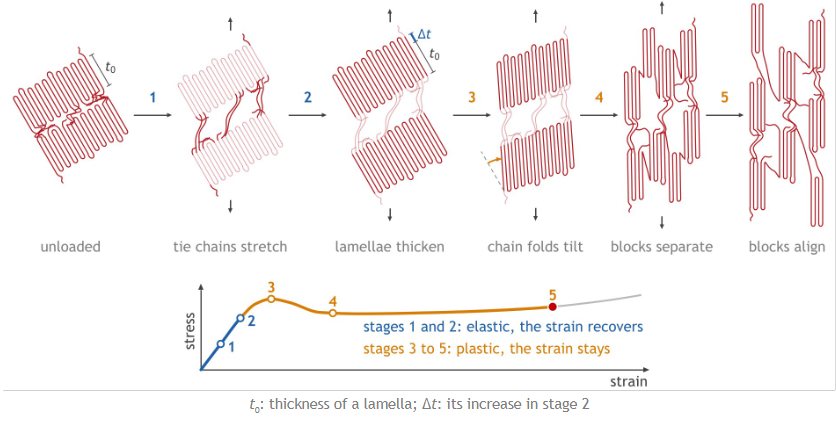
Necking and cold drawing
—Necking spreads out through the bar of polymer
——→Chains in the neck align and strain-harden

Semicyrtsalline polymer deformation
—Amorphous layer stretch first
—Then lamellae tilt towards tensile axis, break into blocks and align (neck hardens)
Viscoelasticity
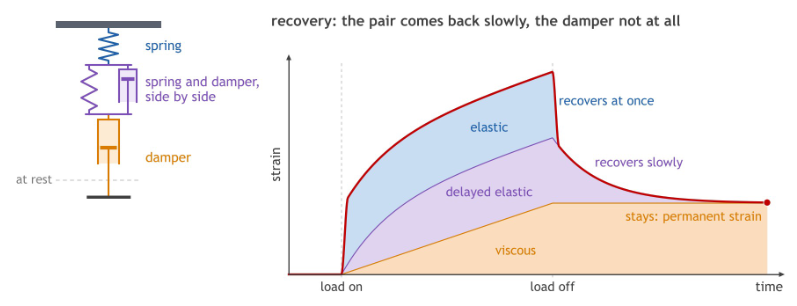
—Under a constant load, a polymer stretches at once and keeps creeping (deforming)
Elastic: Once load off, all recovers at once
Viscous (dashpot): Remains deformed
Viscoelastic: Combination effect (partial recovery)

Creep and recovery
—Under constant load, strain jumps, then creeps (slowly increases)
—When unloaded, it recovers only in part
——→Elastic recovers at once
——→Delayed elastic (spring-dashpot pair) recovers slowly
——→Dashpot does not recover
Stress Relaxation
At a fixed strain (elongation):
Chains uncoil right after stretching (high stress)
Chains slip past each other and recoil (stress falls), stops slip

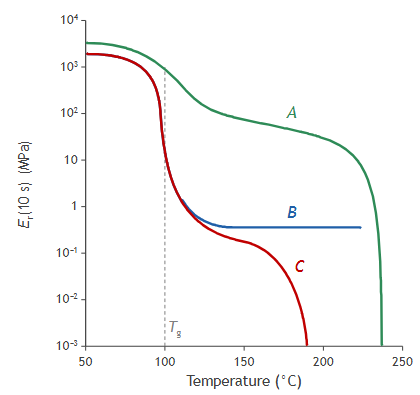
Relaxation modulus (Er)
—Viscoelastic polymer: depends on how long load lasts
—Falls with time and temperature
—Flow means cufrve is completely vertical
EX:
a) Fully crystalline, stiff to ~240 C
b) lightly cross-linked, plateau → never flows
c) amorphous, flows soon after Tg
Ceramic stress-strain
—High stress fracture
—No yield, no neck, just a straight line
—Brittle in tension, stiff and strong in compression
—Crystalline ceramics hardly slip
—Hot glass flow like viscous liquids

Porosity
—Pores lower stiffness and strength
—Pores can’t carry load an concentrate stress (strength falls the fastest)

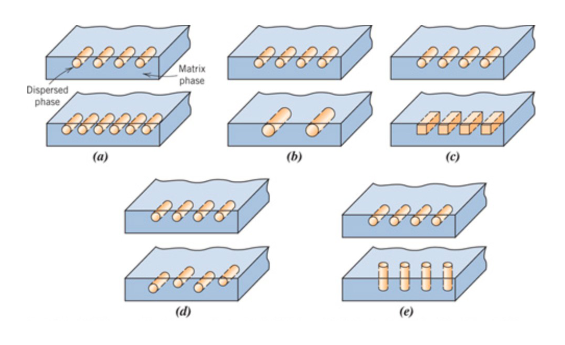
Dispersed phase
—Particles, fibers, or layers held by the matrix (continuous phase)
—Geometry decides the properties
—Composites are designed by choosing and arranging the dispersed phase
Critical fiber length
—Matrix passes load to fiber by shear at the interface
—Length of fiber should at least reach critical length, so the fiber tensile strength can be reached
——→If not, fiber never reaches the tensile strength, and the matrix will break before fiber (not ideal)

Fiber composite stress strain
—Brittle, stiff fibers in a ductile matrix (fibers carry most load)
1) Both matrix and fiber are elastic
2) Matrix yields, fiber carry most load
3) fibers break, matrix may still hold

Ductile and brittle fracture
—Differ in how much plastic deformation occurs first
Ductile: necking and plastic flow (always preferrable), slow unless load increases
Brittle: fast crack, no plastic flow

Cup-and-cone fracture
—Ductile fracture
—Voids open in neck, joins into a crack, outer rim shears off

Brittle fracture surfaces
—Leaves markings that point back to where the fracture started
Transgranular: along the boundaries
Intergranular: through the grains

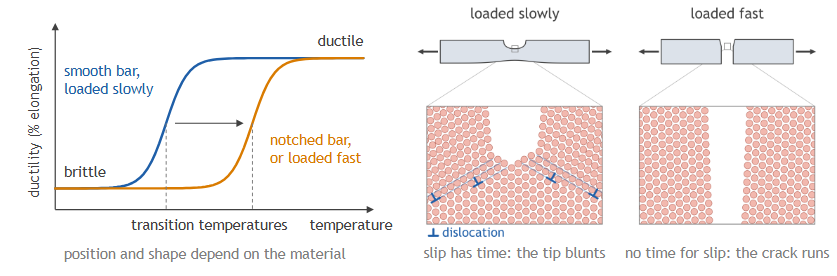
Ductile to brittle transition
—Same material can break in a ductile or brittle way, depends on conditions
Ductile: slow loading, high temp, smooth shape (few stress raisers?)
Brittle: fast loading, low temp, sharp notches
——→Sharp corners and notches raise local stress
Griffith’s theory
—A crack grows when energy released by its growth is enough to make new cracks
——→Energy cost: Breaking new atomic bonds need energy (surface energy)
——→Energy gain: Material that cracks releases their elastic energy
GRAPH:
—Blue line: energy needed as crack grows
—Red line: energy released as crack grows
—Black line: surface energy + elastic energy
Below ac (critical length): crack doesn’t grow spontaneously because black line slope is +
Above ac: spontaneous crack growth because black line slope is -

Fracture toughness
—Resistance to crack propagation (crack runs when it reaches Kc)
—Geometry factor (Y): depends on crack length relative to width of specimen (a/W)
——→Read off graph
NOTE: yield strength is resistance to permanent deformation, this is resistance to crack propagation. Something can have high Y.S. but low Kc

Impact testing
—Pendulum breaks a bar, the energy it loses (decreased height) is the impact energy
—Tough bar: absrobs more energy, bends (ductile)
—Brittle bar: absorbs less, breaks

Temperature and strain rate
—Colder temp: yield strength and tensile strength increases, but ductility falls
—Faster loading rate: same yield stength and TS, ductility falls
—Because dislocations need time and heat to pass obstacles, if they cant pass, they break (like polymer chain that rearranges itself for further plastic deformation before breaking)

σy and σc
—σc: critical applied stress that causes fracture
—Whichever one is reached first decides how the material fails
(higher T, σy reached first, more ductile as it moves to plastic deformation)

Material class transitions
—FCC metals: stay ductile, σy always below σc
—BCC metals (< 912 C) and polymers: brittle when cold, ductile when warm
—High strength materials (σy > E/150): stay brittle σc always below σy

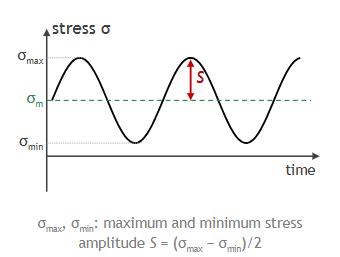
Fatigue
—Failure due to repeated loading (even if stress stays below TS and σy)
Graph: S → stress amplitude, sigma m → mean stress
1) Something slips and an intrusion forms at surface
2) Intrusion grows more with each load
3) Stress intensity reaches toughness Kc, the rest breaks
S-N Curves and fatigue limits
—Stress amplitude until fatigue (Sfat)
—Below Sfat, steel lasts indefinitely (lasts a lot of loadings); unsafe above Sfat
—Aluminum does not have Sfat, therefore it will fail at some point at any stress after enough loadings, unsafe

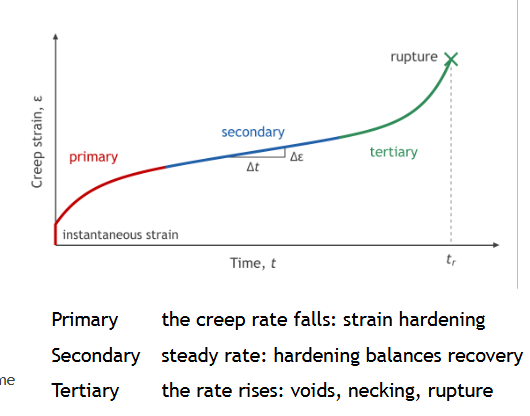
Creep
—At high temps, constant stress keeps straining (permanent deformation) a material until it ruptures
—Creep is important for metals above 0.4Tm
—Creep rate: how fast a material deforms over time under constant stress (slope on graph)