Pracrical - bone tissue
 Call Kai
 Learn
Learn Practice Test
 Spaced Repetition
 Match
Match Flashcards
 Knowt Play
1/57

There's no tags or description
Looks like no tags are added yet.
Name | Mastery | Learn | Test | Matching | Spaced | Call with Kai | Chat |
|---|
No analytics yet
Send a link to your students to track their progress
58 Terms
Lamellae (concentric lamellae) - Rings of
very thin layers of bone; Collagen fibers of adjacent lamellae run in opposite directions which resists twisting and bending force
each circular section within the osteon like the ring of a tree
1

Central (Haversian) canal - Contains blood
vessels and nerves; Lined by endosteum
2

Lacunae - Small cavities between lamellae
filled with E C F
3

Canaliculi - Tiny canals that connect lacunae; Filled with thin cytoplasmic extensions of osteocytes that contact each other through gap junctions
4

Interstitial lamellae - Compact bone is composed of multiple osteons
connected by Interstitial Lamellae internally, and Circumferential Lamellae in the inner and outer rings that strengthen bone
5

Circumferential lamellae - Compact bone is composed of multiple osteons
connected by Interstitial Lamellae internally, and Circumferential Lamellae in the inner and outer rings that strengthen bone
6

Perforating (Volkmann) canal - connect central canals of neighboring osteons and carry blood vessels from the periosteum to the central canals
7

Trabeculae
Branching structures in spongy bone that provide support.
Spongy Bone
Inner, honeycomb-like structure of bone that resists forces.
Appositional Growth
Growth in width of bones, occurring through the activity of osteoblasts. (caused by repeated pressure like running)
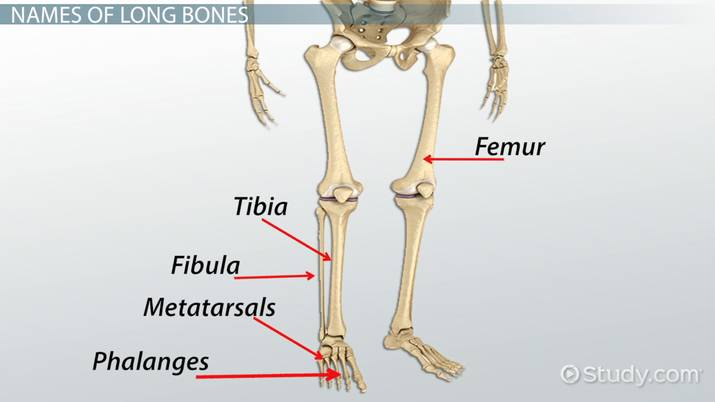
LO 2 - Bone types - Long Bones
Longer then wide, Ex bones of limbs, femur
LO 2 - Bone types - short bones
about as long as wide, roughly cube shaped exmples include ankles and wrist bones

LO 2 - Bone types - Flat bones
Thin and broad ex, skull and bones of pelvis

LO 2 - Bone types - Irregular bones
Irregular shapes; Examples
include the vertebrae

LO 2 - Bone types - Sesamoid Bones
Small, flat, oval-shaped bones
located within tendons; An example is the kneecap

LO 3 - Periosteum - Outer dense irregular connective
tissue membrane with blood vessels and nerves
1

LO 3 -Perforating Fibers - Collagen anchors that
penetrate into bone matrix to attach the
periosteum
2

LO 3 -Diaphysis - Shaft of the bone with a Medullary
(Marrow) Cavity lined by the Endosteum and
filled with marrow
3

LO 3 - Epiphyses—Ends of a long bone (filled with Red
Marrow) covered with Articular Cartilage, which
is composed of hyaline cartilage
4

LO 3 - Compact Bone—Hard, dense outer bone that
resists linear compression and twisting forces
7

LO 3 - Spongy (Cancellous) Bone—Inner, honeycomb-
like bone framework that resists forces in many
directions and provides a place for bone marrow to
reside
8

LO 3 - Ends of a long bone (filled with Red
Marrow) covered with Articular Cartilage, which
is composed of hyaline cartilage
5

LO 3 - Shaft of the bone with a Medullary
(Marrow) Cavity lined by the Endosteum and
filled with marrow
6

LO 3 - Shaft of the bone with a Medullary
(Marrow) Cavity lined by the Endosteum
filled with marrow
9

Diploë
in flat bones, the spongy bone is called

Osseous tissue
-a hard, mineralized connective tissue that forms the structural framework of the skeletal system.
-It provides strength, support, and protection for the body,
-composed of cells (osteoblasts, osteocytes, osteoclasts) embedded in a matrix of collagen and minerals like calcium phosphate.
Axial skeleton
Longitiudal axis of body structured for protectin
includes skull, verebral column and thoracic cage

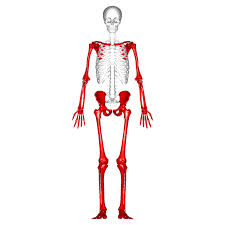
Appendicular skeleton
allow for movement, includes the girdles and limbs
Vertebral column
33 vertebrae; top 24 surround spinal cord, last two coccyx and sacrum are made of fused vertebrae and function for support
thoracic cage
12 pairs of ribs, the sternum, part of vertebral column; protect the structures in thoracic cavity
pectoral girdle
includes clavicle and scapula; supports Upper Limb and anchors it to the trunk
Upper Limb - the arm
includes the humerus;
The forearm includes the radius and ulna;
The wrist includes the carpals;
The hand and fingers include
the metacarpals and phalanges
Forearm
part of upper limb / arm
includes the radius and ulna
Wrist
part of upper limb / arm
includes the carpals;
hand
part of upper limb / arm
The hand and fingers include the metacarpals and phalanges
Pelvic Girdle
Includes 2 pelvic bones and the
sacrum;
Each pelvic bone is composed of an ilium,
ischium, and pubis;
Supports the lower limb and anchors it to the trunk
Lower Limb
The thigh includes the femur
The leg includes the tibia and fibula
The ankle includes the tarsals;
The foot includes the metatarsals and
phalanges
Thigh
includes the femur
Leg
includes the tibia and fibula
Ankle
includes the tarsals
foot
includes the metatarsals and
phalanges
the Skull - Cranial Bones (Cranium)
*8 of them
Single Bones—Frontal, Occipital, Ethmoid, Sphenoid
Paired Bones—Temporal, Parietal
the Skull - sutures
All skull bones are united in adults by
immoveable joints called Sutures, except the mandible (lower jaw bone)
the Skull - Facial Bones
14 total
Single Bones—Mandible, Vomer
Paired Bones—Maxilla, Zygomatic, Nasal, Lacrimal,
Palatine, Inferior Nasal Concha
the Skull - Cranial Cavity
Surrounds the brain with a
superior Cranial Vault (Calvaria) and an inferior Cranial Base
the Skull - Cranial Vault (Calvaria)
the cranial cavity Surrounds the brain with a superior Cranial Vault (Calvaria) and an inferior Cranial Base
the Skull -Cranial Base
contains Anterior, Middle, and Posterior Cranial Fossae (indentations) to support the brain
the cranial cavity Surrounds the brain with a superior Cranial Vault (Calvaria) and an inferior Cranial Base
the Skull - Orbits
Contain the eyeballs
the Skull - Nasal Cavity
Houses the sensory receptors for
smell
the Skull - Nasal Septum
Divides the two sides of the nasal
cavity, called the nasal fossae;
Anteriorly, composed of hyaline cartilage; Posteriorly, the perpendicular plate of the ethmoid and vomer
the Skull - Paranasal Sinuses
Found within the frontal, sphenoid, ethmoid, and maxillary bones
• Lined with mucous membranes and connect to the nasal cavity
• Lighten the skull and enhance voice resonance
the Skull - Oral Cavity
Houses the teeth, the tongue, and
some salivary glands; First part of the gastrointestinal tract of the digestive system
includes, roof, anterior and lateral walls and floor and posteriot wall
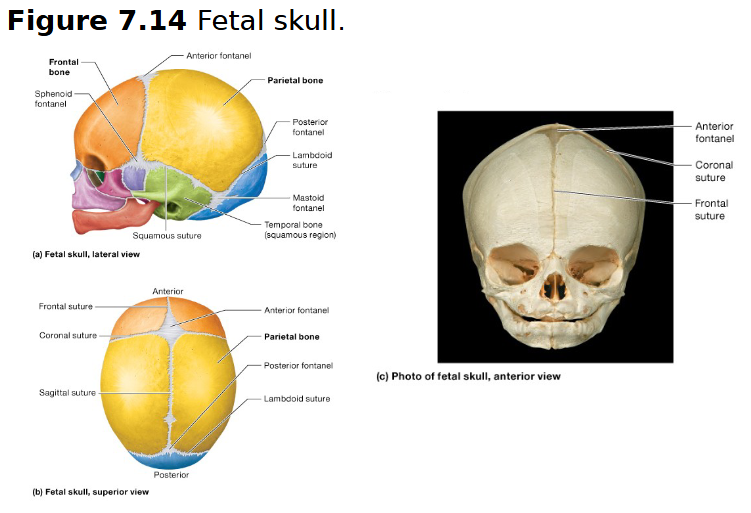
the Skull - Frontanels
Fetal Skull—Include membranous areas where ossification is not complete called soft spots or Fontanels
includes anterior, posterior, sphenoid, and mastoid fontanels
the Skull -Anterior Fontanel
only in fetal skulls
Between developing frontal and parietal bones where coronal and sagittal sutures meet

the Skull -Posterior Fontanel
only in fetal skulls
Between developing parietal and occipital bones at the apex of the lambdoid suture
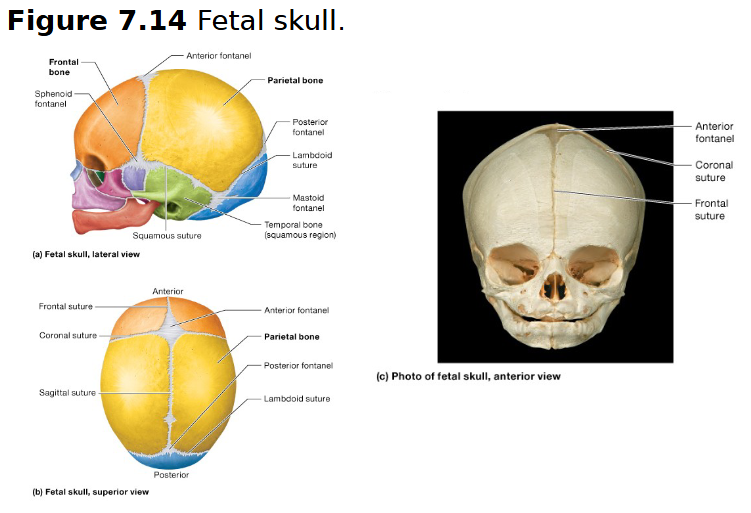
the Skull - Sphenoid Fontanels
only in fetal skulls
In each temple on the right and left sides where the sphenoid bone meets other cranial bones

the Skull - Mastoid Fontanels
only in fetal skulls
At the junction of the lambdoid and squamous sutures where the developing parietal, temporal, and occipital bones meet
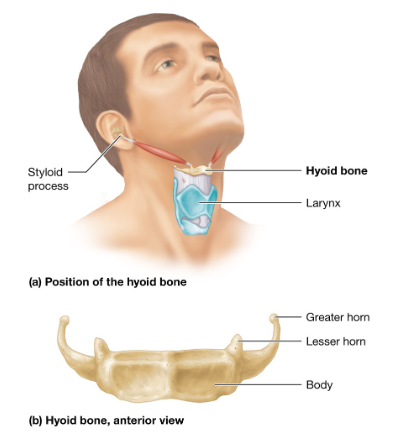
Hyoid bone
Only bone in bod not attached to another bone
Small, C- shaped bone suspended in the superior neck by muscles and ligaments
• Attach to the styloid processes of the temporal bone and to the larynx
• Attachment point for muscles involved in swallowing and speech