Flashcards MGMT 1000 - Midterm 2
 Call Kai
 Learn
 Practice Test
 Spaced Repetition
 Match
 Flashcards
 Knowt Play
1/221

There's no tags or description
Looks like no tags are added yet.
222 Terms
What is Human Resources management?
the process of hiring, developing, motivating, and evaluating employees to achieve organizational goals.
HR management process (7 activities)
1) Job analysis and design
2) Human resource planning and forecasting
3) Employee recruitment
4) Employee selection
5) Training and development
6) Performance planning and evaluation
7) Compensation and benefits
Job Analysis and Design
what skills different jobs require: essential skills, knowledge, and abilities required
HR Planning and Forecasting (2 forecasts)
1) Determining the number of people needed by some point in time
2) Estimating the number of people currently employed by the organization who will be available to fill various jobs at some future time; internal supply forecast.
Internal Labour Market
Internal recruitment:
1) Promotions
2) Job transfers
Define: Recruitment
the process of attracting qualified people to form an applicant pool
Methods to attract applicants
Print, Radio, Web, and TV advertising
Employee Selection (6 Steps)
1) Initial Screening
2) Employee Testing
3) Selection Interview
4) Background and Reference Check
5) Physical Exams and Drug Testing
6) Decision to Hire
Initial Screening
an applicant completes an applicaition and has a brief interview about educational background and work experience
Employee Testing
following the initial screening, the applicant may take tests that test cognitive ability, motivation, and knowledge/skills
Selection Interview
an in-depth discussion of an applicant's work experience, skills and abilities, education, and career interests.
Decision to Hire
if an applicant progressses satisfactorily through all the selection steps, a decison to hire is made.
Performance Appraisal
a comparison of actual performance with expected performance to determine an employee's contributions to the organization and to make decisions about training, compensation, promotions, and other job changes.
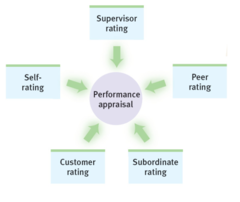
360 Degree Feedback
Feedback from:
1) Supervisor
2) Co-workers
3) Subordinates
Compensation
Pay and Benefits
Pay structure and internal influences
Wages, salaries, and benefits are based on skills, experience, and the level of the job
Pay level and external influences
Salaries must be competitive with other firms, or else you won't be able to higher skilled people
Direct compensation
the wage or salary received by the employee
Indirect compensation
employee benefits and services (health insurance, vacation time, etc.)
Labour union functions (3)
1. Collective bargaining
2. Worker relations and membership services
3. Community and political activities
The scope of human resource management includes:
a) Hiring
b) Development
c) Evaluation
d) A&C
e) All of the above
e)
Fred is looking to hire a manager in the finance department at Green Plant Company. He posts the job to the company's internal job board. He is hiring from...
a) The internal labour market
b) The external labour market
c) A job fair
d) His personal network
A)
Meghan is rading a job posting to be a financial intern. The section she is reading describes the task and the responsibilities mandatory for the role. She is reading the ______ section of the job posting.
a) Job specification
b) Job qualification
c) Job description
d) Job salary and benefits
c)
What company's hiring process exhibits how they want their employees to treat their customers?
Ritz-Carlton
It is ______ for employers to interfere with employees forming/joining a union.
illegal
Benefits....
can be mixed and matched, dependent on the firm, to allow for customizable coverage.
Off-the-job training can be...
a) done in a class room and can consist of cases, role-play exercises, films, videos, and lectures
b) taught through e-learning platforms
c) done using simulations
d) all of the above
e) none of the above
d)
A job analysis is a study of the ______ required to do a job well. This information is used to specify the _______ required for the job
tasks;
essential skills, knowledge, and abilities
Compensation is closely connected to...
performance appraisals
Monika was reviewing a job offer she got for Sapphire Engineering. The details included a $70,000 base salary as well as health insurance and 14-days of vacation time. The $70,000 base salary is an example of:
Direct pay
Union memership has ________ over the past three decades
Decreased (quite a lot)
Ryan works construction and is part of a union. He has a complaint about the health and safety at one of his job sites. Ryan wants to reach out to his union to let them know about the issue. He should reach out to:
a) his boss
b) the head of the union
c) a shop steward
d) any other union member
c)
Billy works in a car manufacturing plant. The employees have decided they want to unionize and currently have a union representative who is collectively bargaining with their employer. They are in what phase of union-manaegement relations?
a) Union organizing
b) Negotiating a labour agreement
c) Administering the agreement
d) Forming the union
b)
Martino applied for a job at a large accounting firm. He has currently filled out an application, submitted his resume, and has a phone call with a member of their HR team. He is currently in which part of the recruitment process?
Initial screening
The main steps of the Human Resource Management process are:
Hiring, Developing, and Evaluating
Define: Operations Management
Technological advances, ongoing competition, and consumer expectations force companies to rethink where, when, and how they will produce products or services.
Consumer Expectations/Demands
1) High quality at reasonable prices.
2) Manufacturers to deliver products in a timely manner.
How do manufacturers compete?
sreamlining hwo they make their products -- by automating their factories, developing new production processes, forcusing on quality-control, and improving supplier relations.
Purpose of Operations Management
to find the most efficient and effective methods of producing the goods and services a company sells to its customers.
Four Types of Utility Customers can Benefit From
1. Time
2. Place
3. Ownership
4. Form
Time
making sure the product or service is available to the customer when they require it
Place
operations managers must consider the placement of their product/service to deliver a convenient option to their customers
Ownership
customers benefit from owning the products and services operation managers are able to deliver. This is called "Ownership/Possession Utility"
Form
"Form utility" benefits the consumer since operations have transformed a product from a raw material to a finished good.
Manufacturing Process
To compete with other organizations, a company must convert resources (materials, labour, money, information, etc.) into goods and services as efficiently as possible.
Why is due diligence important?
to ensure that all potential risks and errors are mitigated entirely.
Define: Operations Managers
Operations managers manage the process that transfroms inputs into outputs
About ____% of Canadian workers are employed in ____________, in contrast to 30% in 1950.
10%, manufacturing
80% of Canadian jobs are held in this sector:
Service sector
Manufacturers vs Service Providers: Intangibility
manufacturers produce tangible products, while service companies produce intagible products, such as branking and education.
Manufacturers vs Service Providers: Customization
most manufactured goods are standardized, while services are often customized to meet the specific needs of customers.
Manufacturers vs Service Providers: Customer contact
You receive satisfaction when you come in contact with the consumer: manufactuers do not receive as much satisfaction as service workers.
Forms of Production Processes (4)
1. Make-to-order
2. Mass production (make-to-stock)
3. Mass customization
4. Just-in-time production
Make-To-Order
-products are customized to meet the needs of the buyers who ordered them
-longer production and delivery cycle
-low-volume, high-variety goods according ot customer specifications
Mass Production
-producing high volume of identical goods at a cost low enough to price them for large number of customers
-goods are made in anticipation for future demand and kept in inventory for future sale
-standardized goods
-shorter cycle time than make-to-order
-takes advancatage of economies of scale
Define: Economies of Scale
refers to the reduced costs per unit that are realized from an increase total number of units produced.
Mass Customization
-combines the advantages of customized products with those of mass production
-mass-produce a product up to a certain cut-off point and then customize it to satisfy different customers
Just-in-Time Production
-the manufacturer arranges for materials to arrive at production facilities just in time to enter the manufacturing process.
-the suppleir has to commit to supplying the right materials, of the right quality and quantity, at the exact right time
Types of Processes (2)
1. Analytic
2. Synthetic
Analytic Process
-resouces are broken down in the production process (extracting minerals from ore)
Synthetic Process
-resources are combined in the production process (paint production)
Gantt Chart
helps operations managers determine the status of projects

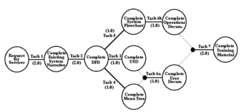
PERT Chart
Program Evaluation, Review Technique: used for planning and controlling more complex activities
Total Quality Managment (TQM)
-AKA quality assurance.
-the steps a company takes to ensure that its goods or services are sufficiently high quality to meet customers' needs.
TQM Tasks (3)
1. Customer satisfaction
2. Employee Involvement
3. Continuous Improvement
Elizabeth works in production. Her company finds out exactly what a customer wants and then manufactures the good using efficient production methods to hold down costs. This is an example of what production process?
Mass Customization
Lyndsay works in production. Her company mass-produces a product to a certain point and the customizes it to satisfy different customers. This is an example of what production process?
Mass Customization
Two critical tasks for controlling production and operations efficiency are:
a) Routing and scheduling
b) Production planning and production location
c) Employ quality management and lean manufacturing techniques
d) Routing and production planning
e) Scheduling and production location
a) Routing and scheduling
Noor is doing operations planning and control for her company. She is currently looking to see if there are other manufacturers in her industry in the area. She is checking what?
a) The availablity of production inputs
b) Marketing factors
c) The manufacturing environment
d) Local incentives
e) None of the above
c) the manufacturing environment
Burger King redesigned their facilities to accommodate the needs of their customers while keeping costs low by...
wrapping their Whoppers in paper instead of the cardboard boxes that took up more space.
Education is moving towards which production process?
Just-in-time production
Nearly every type of business organization needs to find the most ___________ and ___________ methods of producing the goods or services it sells to its customers.
efficient; effective
Total Quality Management (TQM) us also known as:
Quality Assurance
The four main types of utility are:
1. Time
2. Ownership
3. Form
4. Place
Molly's business is committed to Total Quality Management (TQM). They let their customers define quality by identifying desirable product features and then offering them. This is a part of what task of TQM?
Customer Satisfaction
The Canadian economy has changed from a goods producer to a service producer over the last _______ years. (From the time of the textbook)
60
Emily is an operations manager. She is currently focused on picking a location for her service in order to deliver a convenient option to her customers. She is focused on the utility of:
Place
Define: Accounting
Accounting is the process of measuring and summarizing business activities, interpreting financial information, and communicating the results to management and other decision-makers.
Accounting is often called:
"the language of business"
Why?
Because it communicates so much of the information that owners, managers, and investors need to evaluate a company's financial performance.
Key Purpose of Accounting
A key purpose of accounting is to help stakeholders make better business decisions by providing them with financial information.
Fields of Accounting (2)
1. Management Accounting
2. Financial Accounting
Managment Accounting
-provide information and analysis to decision-markers inside the organization to help them run it.
-internal and private
-flexible formatting because it is used by people of a wide variety of jobs
Financial Accounting
-responsible for preparing the organizations financial statements that summarize a company's past performance and evaluate its current financial position
-focus on external parties, public
-must follow IFRS
Who Uses Accounting Information?
Managerial -- a firm's managers.
Financial -- shareholders, potential investors, etc.
Ontario Securities Commission (OSC)
a federal agency that regulates stock trades and is charged with ensuring that companies tell the truth with respect to their financial information.
Income Statement
-shows sales, expenses, and whether or not a profit was made
-shows how much incoem you earned over a period of time
Balance Sheet
-shows assets and liabilites, the amount invested in the business
-shows the current financial position of the company
Statement of Cash Flows
-shows how much cash is coming in and going out
-provides info about a conpany's expenses and receipts + insight into its future income needs to meet future obligations (expenses and receipts)
Statement of Cash Flows Reports Cash from 3 Areas of Business:
1) Cash from Operations
2) Cash from Investing
3) Cash from Financing
Cost of Goods Sold (COGS) is:
the total cost of the goods that you've sold
Operating Expenses are:
the costs of operating your business ecept for the COGS
Gross Profit is:
the difference between sales and COGS is gross profit, also known as the gross margin
Net Income (Loss) is:
the difference between gross profit and operating expenses is your net income or profit (loss)
What do Profitability Ratios tell you?
tell you how much profit is made relative to the amount invested (return on investment) or the amount sold (return on sales)
What do Liquidity Ratios tell you?
tell you how well-positioned a comapny is to pay its bills in the near future. Liquidity refers to how quickly an asset can be turned into cash.
What do Debt Ratios tell you?
these look at how much borrowing a company has done to finance the operations of the business. The more borrowing, the more risk/debt a company has taken on, and the less likely it would be for new lenders to lend.
What do Efficiency Ratios tell you?
tell you how well your assets are being managed.
Profitability Ratios (3)
1) Earnings Per Share (EPS)
2) Return on Investment
3) Return on Sales
What is the Current Ratio?
-a type of liquidity ratio
-examines the relationship between a company's current assets and its current liabilities
The Debt-to-Equity Ratio:
-tells us how well the company is financed.
-calculates the relationship between funds acquired from creditors (debt) and funds invested by owners/shareholders (equity).