attachment - overview
 Call Kai
 Learn
Learn Practice Test
 Spaced Repetition
 Match
Match Flashcards
 Knowt Play
1/45

There's no tags or description
Looks like no tags are added yet.
Name | Mastery | Learn | Test | Matching | Spaced | Call with Kai | Chat |
|---|
No analytics yet
Send a link to your students to track their progress
46 Terms
reciprocity
turn taking. when each person responds to another and elicits a response from them.
e.g. smiling back and forth.
interactional synchronicity
when interacting, ‘mirror’ what the other is doing (facial and body movements) - includes emotions. two or more things move in the same way
meltzoff and Moore - research support
aim: to investigate the age at which interactional synchrony occurs between mother and child.
procedure: videotaped 12-21 day-old babies as they watched an adult experimenter perform different facial expressions. An adult displayed one of three facial expressions or one of three distinctive gestures.
findings: an association was found between the expression of gesture the adult had displayed and the action of the baby.
filmed observation - evaluation
strength of the research is that the caregiver-infant interactions are usually filmed in a laboratory.
this means that other activity that might distract a baby, can be controlled
Also, using films means that observations can be recorded and analysed later
therefore it is unlikely that researchers will miss seeing key behaviours.
having filmed interactions means that more than one observer can record data and establish the inter-rater reliability of observations.
babies don’t know they are being observed, so their behaviour does not change in response to observation.
difficulty observing babies - evaluation
one limitation of research into caregiver-infant interaction is that it is hard to interpret a baby’s behaviour.
you g babies lack co-ordination and much of their bodies are almost immobile.
the movements bring observed are just small hand movements or subtle changes in expression.
it is difficult to be sure, for example, whether a baby is smiling or just passing wind.
it is also difficult to determine what is taking place from the baby’s perspective.
we cannot know whether a movement such as a hand twitch is random or triggered by something the caregiver has done.
this means we cannot be certain that the behaviours seen in caregiver-infant interactions have a special meaning.
Russell Isabella et al
observed 30 mothers and babies together and assessed the degree of synchrony
they found high levels of synchronicity was correlated (not causal - still could be other factors) with better quality mother-baby attachment (emotional intensity of relationship - personality?)
Isabella et al
claims early interaction between infant and caregiver (mother) is important for development of attachment.
others argue the socially sensitive nature of the research can be damaging to women who want to go back to work and reinforces gender stereotypes that women should stay home with their children.
Schaffer and Emerson - mother and father attachment figures.
Schaffer and Emerson found that the majority of babies first became attached to their mother at around 7 months.
In their research it showed that only 3% of cases the father was the first sole object of attachment.
In 27% of cases the father was the joint first object of attachment along with the mother.
However when later in the child's lift the fathers become important attachment figures, 75% of babies formed an attachment with their father at 18 months.
This was shown when the baby would fuss when the father left them - a sign of attachment.
Tiffany Field
Filmed 4 month old babies face-to-face interaction with primary caregiver mothers, the secondary caregiver fathers and primary caregiver fathers.
Primary caregiver fathers spent more time smiling, imitating and holding babies than the secondary caregiver fathers.
Smiling, imitating and holding babies are all part of reciprocity and interactional synchrony which are part of the process of attachment formation.
Fathers have the potential to be the more emotion-focused primary attachment figure, but maybe only express this when they are given the role of primary caregiver.
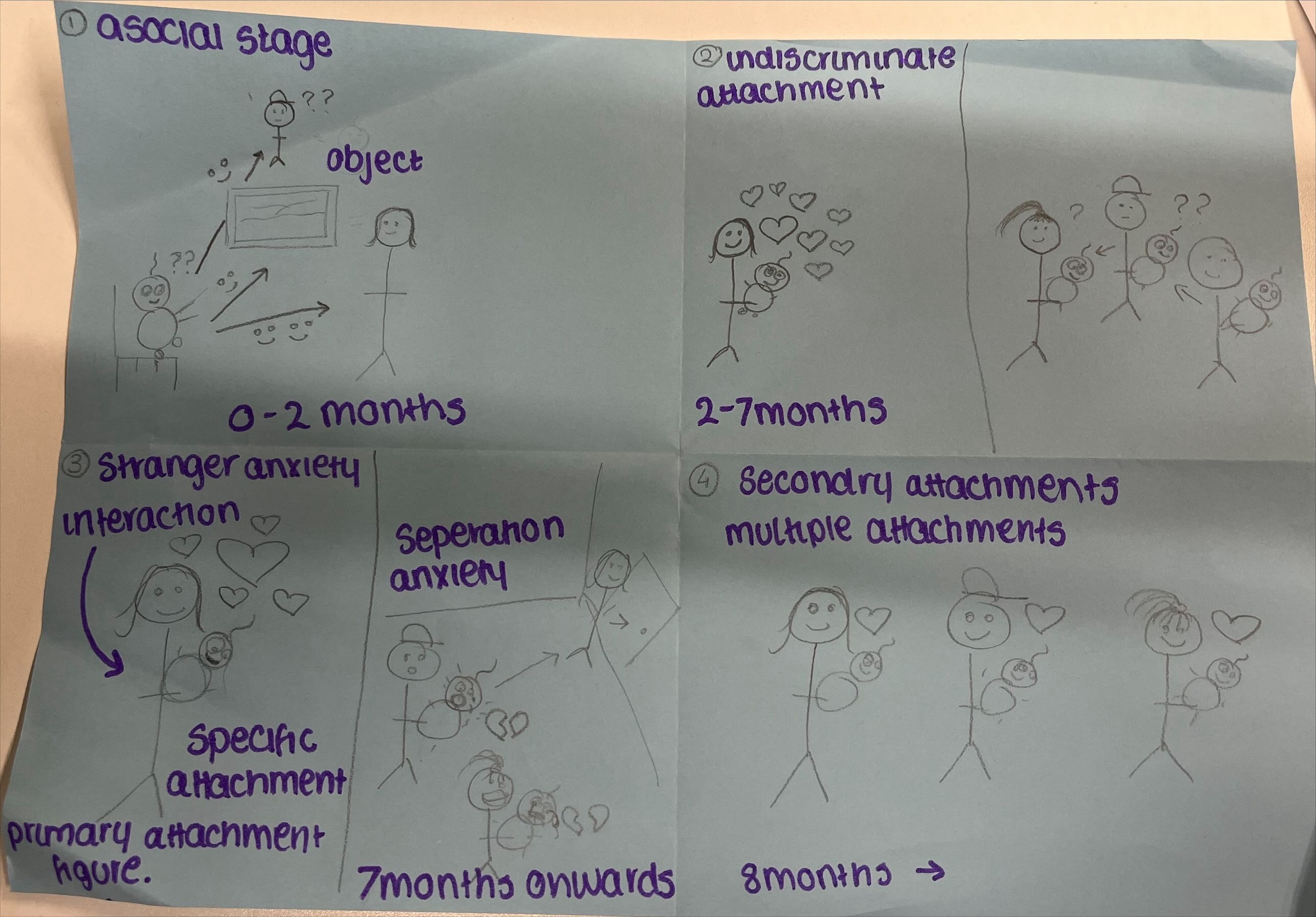
stages of attachment - Shaffer and Emerson
Aim = investigated the formation of early attachments and the age they are formed
Procedure = observed 60 families, Galwegians babies for 18 months, mostly skilled working class families.
Visited babies at home, every month for first year and again at 18 months.
Asked mothers about babies' reaction when caregiver left the room and stranger anxiety.
Findings = data was used to develop 4 stages of attachment based on when babies specific attachments, attachment to mother and stranger anxiety
stages of attachment
Stage 1: Asocial stage 0-6 weeks. Babies display innate behaviours that ensure proximity to any potential caregiver. anyone can comfort them.
Stage 2: Indiscriminate attachment, 6 weeks - 7 months. infants develop the ability to tell the difference between familiar and unfamiliar individuals.
Stage 3: specific attachment 7-9 months, babies form a strong attachment to a primary caregiver, most often their mother. (develop separation anxiety and stranger anxiety)
stage 4: multiple attachment, 9/10 months, the infant starts to form attachments with other regular caregivers.
Schaffer and Emerson (1964)
conducted a longitudinal observation of 60 working class babies from Glasgow.
found that separation anxiety occurred in most babies by 25-32 weeks, with stranger anxiety starting one month later. in the 18-month follow up, 87% had developed multiple attachments.
the strongest attachment was to those other with consistent caregiver-infant interactions. results suggest development occurs in the stages outlined by Schaffer and the quality of caregiver- infant interaction influences the strength of attachment between infants and their mothers.
Strength - as infants and their families were observed in their own homes, the study had high level of mundane realism, the experience of strangers visiting the family home or mothers leaving the room was normal for the infants.
weakness - the sample in Shaffer’s study may not be generalisable or have temporal validity as it only included a group of working-class mothers in 1960s Glasgow.
learning theory - explanations of attachments
classical conditioning = learnt through association - Pavlov’s dog. Where an unconditioned stimulus is paired with a conditioned stimulus repeatedly to create
Operant conditioning = learnt through reinforcement, Skinners box, positive reinforcement (rewarding a behaviour) negative reinforcement (taking away a negative stimulus as a reward) and punishment (adding a negative stimulus in relation to a behaviour)
learning theory
According to learning theory, the baby has to learn to form an attachment with their mother.
By the process of classical conditioning, the baby forms an association between the mother (a neutral stimulus) and the feeling of pleasure that comes from being fed (an innate, unconditioned response).
At first, the baby simply feels comforted by food However each time they are fed, the
Mother is there too. They quickly associate the mother with the pleasure of being fed.
Before long, the mother stimulates a feeling of pleasure on her own, even without food.
This means the baby feels happier when the mother is nearby. It is the beginning of attachment.
operant conditioning - attachment
In terms of operant conditioning, if a behaviour results in agreeable consequences it is likely to be repeated and if it results in disagreeable consequences it is likely to avoided.
If crying results in feeding, then the consequences are pleasant and crying is reinforced. Escaping from an unpleasant stimulus is also agreeable so it is a reinforcer.
Most carers dislike hearing a baby cry so the cessation of crying is a negative reinforcer encouraging the carer to behave in such a way that the child stops crying. Smiling by the child is very rewarding and is therefore a positive reinforcement so the carer behaves in such a way as to evoke smiling. In these ways, an attachment bond is formed between carer and child.
Dollard and miller
explain operant conditioning in terms of attachment and 'drive' reduction theory.
A 'drive' is something that motivates behaviour.
Discomfort = a drive to reduce discomfort
Hungary infant = a drive to reduce hunger.
Attachment happens behaviours the child seeks out the person who supplies the reward or reinforcement.
attachment as secondary drive
Hunger is a primary drive as it is innate and natural.
Food is a primary reinforcer.
The mother (or comfort) is the secondary reinforcer.
Infant seeks food to remove feeling of hunger (negative reinforcement)
Behaviour that led to the food is learned because it is negatively reinforced.
Sears et al - as the caregiver provide food to relieve hunger, this feeling of satisfaction of hunger is generalised to them.
Attachment is therefore a secondary drive learned by an association between a caregiver and the satisfaction of hunger (a primary drive).
Bowlby’s monotropic theory
Bowlby came up with a theory of attachment which was based on evolution.
He observed and interviewed children and their families who were separated in the aftermath of WW2.
These studies were often conducted in hospitals and institutions.
babies instinctively use signals called social releasers that attract the caregiver’s attention; mothers are biologically programmed to initiatively find these behaviours cute or destressing.
infants should use their mothers as a safe base to explore their environment and show stranger anxiety.
Bowlby suggests as strong monotropic attachment must form in the first 30 months after birth (critical period) and a ack of monotropy results in permanent negative social, intellectual and emotional consequences for the infant.
innate
Attachment is innate.
Behaviours have evolved through natural selection.
All infants are born with a drive to attach. Pre-programmed to do so as it keeps them safe.
monotropy
Tendency for a child to form a single attachment to one person who is most important.
The quality of the time - who is most sensitive with the baby's needs.
Law of continuity - child's care is constant then the quality of attachment is superior.
Law of accumulated separation - the effects of separation add up.
social releasers
Infants are born with certain innate characteristics or behaviours which encourage care giving.
e.g. smiling, laughing
They activate the adult attachment system. Make them feel love towards an infant.
internal working model
An infants mental representation (schema) of their attachment to their primary caregiver.
The continuity hypothesis - becomes a template for future relationships.
A loving reliable caregiver - loving reliable future relationships.
Poor attachment - poor future relationships, difficult to make attachments.
Influence the type of parent you become.
critical period
The most sensitive to forming attachments.
Bowlby saw mothering is useless for ALL children if delayed after 2.5 years (30 months)
Critical period - up to 6 months
sensitive period
Sensitive period of up to 2.5 years.
The maximum time in which people can form attachments.
After this it is hard for any meaningful and proper attachments to be formed.
Hazan and Shaver love quiz
extended Bowlby’s idea that later romantic relationships should be predictable from knowledge of an individual’s early attachment style.
They used the ‘Love Quiz’ to measure this and found a strong relationship between childhood attachment type and later adult relationships.
More specifically, people with secure attachments in childhood were more likely to have happy relationships where they were trusting of their partners. They did not fear intimacy and believed in lasting love.
People who were insecurely attached in childhood felt more jealous, possessive and were afraid of abandonment in later relationships.
securely attached adults
had certain beliefs (love is enduring)
reported certain experiences (e.g. mutual trust)
were less likely to have been divorced.
insecurely attached adults
felt true love was rare; fell in and out of love easily
found relationships less easy
were more likely to be divorced.
different types of attachments
Secure
Resistant
Avoidant
Mary Ainsworth - strange situation
aim: to look at the relationship between an infant and caregiver to identify the different types of attachment that children could have with their parents/carers.
procedure: structured observations of infant and mother pairs in a lab setting. the eight stages included the mother leaving the room and the stranger entering. behaviours that indicated attachment strength were recorded.
findings: provided evidence for three distinct attachment types that seemed to correlate with the level of sensitive responsiveness shown by the mother.
66% of infants were secure, 34% insecure, including 22% insecure-avoidant and 12% insecure resistant.
Study lasted about 21 minutes and used 56 white middle class, American, 18-21 month year olds
5 categories used to judge attachment quality
– proximity to caregiver
Exploration and secure base behaviour- are they able to explore if they have secure base or do they not have a secure base or will they not leave their secure base
Stranger anxiety
Separation anxiety- from caregiver
Reunion behaviour- when caregiver comes back into the room
culture
The traditions, behaviours, beliefs and religions, relationships in the countries or areas of the world. Attitudes, customs, values, food, language and environment.
the role of the father - Schaffer
found at 18 months, 75% of infants had informed an attachment with their father, showing separation anxiety, suggesting fathers play an important role in their infant’s lives.
Active play: fathers are seen to engage babies in active play activities more consistently than mothers, this stimulation is thought to encourage risk-taking behaviours.
primary caregiver: if men take on the role of primary caregiver, their interactional style changes to be more like mothers, increasing their capacity for sensitive responsiveness.
role of the father - evaluation
strength - Field - found that fathers in general focused ore on game-playing and less on holding, additionally primary caretake fathers showed more sensitively responsive behaviour, similar to mothers.
strength - verissimo - found a strong attachment to the father was the best predictor of the ability to make friends in school, suggesting an important role for fathers in socialisation.
weakness - social sensitivity - theories that argue the role of the mother cannot be replaces by the father, may lead to father-led single families and families with two fathers feeling they cannot fully provide for the needs of infants.
economic implications - research could lead to legislation that ensures equal paternity and maternity leave. this may reduce the number of males in the workforce, reduce economic activity, but also help to address the gender pay gap.
animal studies of attachment - Lorenz
tested imprinting. birds forming a strong bond with and following their mother shortly after hatching.
procedure: Goose eggs were randomly divided; half were taken to be hatched by Lorenz and the other half were hatched by the biological mother. in later studies, he varied the time between hatching and when the gosling first observed a moving object.
found that the goslings he hatched imprinted on him. he placed them in a box and when the goslings were released they continued to follow Lorenz.
Lorenz found that goslings have a critical period of 32 hours; if a gosling did not see a large moving object to imprint on in these first few hours, it lost the ability to imprint.
research suggests imprinting is a strong evolutionary/ biological feature of attachment in certain birds.
animal studies of attachment - Harlow
tested for ‘cupboard love’ theory that babies love mothers because they feed them.
procedure: infant monkeys were placed in cages with two surrogate mothers, one that provided milk but not comfort as its body was constructed of exposed wire; the other surrogate mother provided comfort as teh wire was covered with a cloth; but not food. time spent with each mother was recorded as well as the infant ran to when scared.
found: that infant monkeys spend most of their time with the comfort-providing ‘cloth mother’ only visiting the food mother when they needed to eat. they returned to the cloth mother when frightened.
animal studies of attachment - evaluation.
weakness - the generalisation of animal behaviour to human psychology is problematic. humans and animals have very different biology , and humans have various social and cultural experiences that inform their behaviour.
weakness - Harlow is criticised on ethical groups for the harm caused to many intentionally orphaned primate infants and for causing high stress levels, and public knowledge of these studies has harmed psychology’s reputation.
strength - Harlow’s findings on contact comfort have been highly influential; Bowlby argued similar to monkeys, infants crave comfort from their mothers, attempting to form a monotropic relationship.
strength - Lorenz’s findings on the critical period in geese have bene highly influential; Bowlby argued that there is a similar critical period for humans. 6-30 months.
strength - there is practical application of Harlow and Lorenz’s work. knowledge initially gained from these studies and later developed by Bowlby has been applied to early childcare. for example, immediate physical contact after birth.
bowlby’s monotropic theory - evaluation
strength - Bowlby’s ideas have been developed and applied to early childcare. for example, immediate physical contact between the mother and their babies in the first few hours after birth is encouraged.
limitation - Bowlby’s work is based on Lorenz’s findings. research on orphans suggests unlike geese, early childhood is ‘sensitive’ not critical, important but suitable care can lead to recovery, counter to Bowlby’s claim of permanent damage.
limitation - the internal working model is highly deterministic, people like to think that they have complete conscious control over their relationships, including responsibility for the success of relationships, not that this is set in infancy.
Bowlby argued the father’s role is to provide resources for the family while the mother’s monotropic role is crucial. this is likely a reflection of a 1940s worldview that was likely correct in its time but not lacks temporal validity.
Ainsworth’s types of attachment
Ainsworth identified behaviours that indicated attachment strength. proximity to the mother, exploration/safe base behaviour, stranger anxiety, separation anxiety, reunion response and sensitive responsiveness.
Ainsworth categorised infants into one of three attachment types.
insecure avoidant - infants explore freely, not using their mother as a secure base. has low stranger anxiety and separation anxiety: mothers show low sensitive responsiveness.
secure - infants use their mother as a safe base. they have a moderate level of stranger anxiety and show separation anxiety; caregivers show sensitive responsiveness.
insecure resistant infants are clingy and have high stranger and separation anxiety; when their mothers return, the infants appear ambivalent, with mixed emotions, seeming to both crave and reject her attention. mothers and inconsistent with sensitive responsiveness.
Ainsworths strange situation
procedure:
structured observations of infant and mother pairs in a lab setting. the eight stages included the mother leaving the room and the stranger entering. behaviours that indicated attachment strength were recorded.
findings:
provided evidence for three distinct attachment types that seemed to correlate with the level of sensitive responsiveness shown by the mother.
the research suggests that a secure attachment develops due to the attention of a consistently sensitively responsive mother.
66% of infants - secure
34% insecure
22% insecure-avoidant
12% insecure-resistant
Van Ijzendoorn - cultural variations in attachment
procedure: conducted a large scale meta analysis of 2000 infants in 32 studies from 8 countries; each study classified the attachment types of infants and mothers using the ‘strange situation’
findings: secure attachment was the most common type in all countries. insecure resistant was the least common type. avoidant was more common in individualistic western cultures and resistant in collectivist cultures. Individual Germany had the most insecure-avoidant infants. Japan had the most insecure resistant.
suggests: as secure attachment is the most common type, there is a globally preferred attachment style which potentially has a biological basis.
cultural variations in attachment - evaluation
positive - Ainsworth and Van Ijzendoorn’s findings may lack temporal validity.
positive - as the dominant attachment style was ‘secure’ for all countries studied, this may be evidence for Bowlby’s theory that there is a biological, instinctive drive to parent in a way that produces secure attachments.
negative - many of the countries represented only had one study included; such a small sample is not representative of the countries population.
positive - this meta-analysis included a very large sample; a strength of this is any poorly conducted study or unusual results only have a small effect on the overall results, increasing confidence in the validity of the findings.
negative - using the strange situation to assess attachments in non-western countries may be an example of ethnocentrism. it may suffer from cultural bias as secure styles of attachment are more common in western culture.
Romanian orphan studies
as institutions are unable to provide the same level of physical and emotional care to young children as families, institutionalisation is thought to influence childhood development negatively.
deprivation is not recieving suitable emotional care from a primary attachment figure due to frequent or extended absences of the primary caregiver.
privation is the total lack of care so there is no ability to form an attachment bond.
Romanian orphans studies
Rutter ERA - conducted a longitudinal study of 165 Romanian orphans who lacked physical and emotional care from staff; many were malnourished and abused. they were then adopted into British families.
rutter procedure: children were adopted while under six months, between 6 months and two years, and older than two years. each group were assessed at the age of 4,6,11 and 15.
rutter main findings:
age 6 - overly friendly behaviour to strange adults (disinhibited attachment) was more common in infants adopted after two years.
age 11: children adopted after 6 months showed delayed physical, emotional and intellectual development. children adopted after 24 months had an average IQ of 77. intellectual problems continued at the 15 year follow up. in a small number of cases, quasi-autism tendencies were identified.
Romanian orphan studies - evaluation
strength - practical application Romanian orphans research has changed policies around adoption and care in orphanages.
strength - hodges and tizard found children adopted into caring families coped better on measured of behavioural and peer relationships then children returned to abusive families.
weakness - the children in Rutter’s study were not randomly assigned for adoption but were selected by the new parents in Romania, it is possible this results in a bias, with the more sociable children picked for adoption at a younger age.
strength - Bowlby argues that if children miss a window for development, the harm is permanent. However, Orphan studies that show recovery suggest a sensitive period; the damage caused, while severe can be addressed with later care.
influences of early attachment
internal working model - infants develop a schema based on their attachment to their primary caregiver, this schema acts as a template for how relationships work.
the continuity hypothesis suggests an individual’s future relationships will follow a pattern based on their IWM.
hazan and shaver argue an adult’s relationship type is a continuation of their infant attachment style.
bowlby’s maternal deprivation theory suggests children with a disrupted attachment with their primary caregiver in the critical period have problems with social, emotional and intellectual development, affecting adult relationships.
Influence of early attachment - evaluation
positive - hazan and shaver’s love quiz assessed childhood attachment type and participant’s adult relationship styles. there was a correlation between adult and child attachment types - 56% secure looked for a balance of closeness and independence, 25% avoidant avoided intimacy and 19% anxious couldn’t cope with independence.
positive - McCarthy studied women assessed using the strange situation as infants. found adults with long-lasting and secure adult friendships and romantic relationships were securely attached in infancy.
negative - Kagan’s temperament hypothesis suggests infant and adult relationships are due to inherited temperament. high-reactivity babies grow into inhibited and anxious adults, and low reactive infants grow into outgoing adults.
negative - early attachment research is correlational. so it is impossible to establish a cause-and- effect relationship between early childhood attachment and later adult relationship styles; there may be another variable, such as poverty.