Chapter 10: Density, Layering, and Lake Mixing
 Call Kai
 Learn
Learn Practice Test
 Spaced Repetition
 Match
Match Flashcards
 Knowt Play
1/32

There's no tags or description
Looks like no tags are added yet.
Name | Mastery | Learn | Test | Matching | Spaced | Call with Kai | Chat |
|---|
No analytics yet
Send a link to your students to track their progress
33 Terms
At what temperatre is water most dense at?
4 degrees celsius
What is an isothermal/homiothermal body of water?
A body of water that has a uniform temperature
How does wind mix water and distribute heat?
Wind mixes the upper water layers and distributes the heat downwards

What can you deduce from the following graph?
What is shown is a vertical daylight curve
Lake B is warm at the surface and gradually gets colder as it increases in depth
Amount of light piercing the lake decreases with depth as well

what the fuck kind of graph is this
this is a vertical temperature profile showing lake stratification.
the thermocline is when temp changes in such a short amount of depth
At the hypolimnion, water becomes more dense and colder
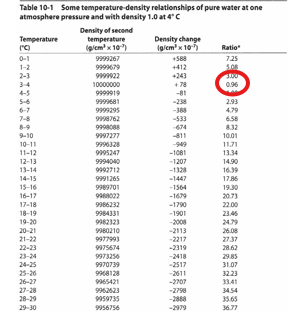
What is the relationship between pressure, temeprature, and maximum density?
pressure lowers the temperature of maximum density.
A low ratio with tempeature, desnity, and density change means that there was a lot density change, meaning it can take on a gaseous form
What does a high solute concentration do to density?
Temperature of greatest density is depressed
salt lowers the freezing point of ice
think of salting roads when there’s ice, it melts the ice faster
can cause inverse stratification
salt
biocarbonate
calcium

what the fuck kind of graph is this
This is an inverse temperature stratification graph in a saline desert pool
The solid colored line is temperature, where it is cold at the surface then gets warmer as depth increases
The broken up light colored line is the density of distilled water, would be the “norm”
What even is stratification?
Lake stratification is when lakes “divide” into different layers (strata) of water with different temperatures
What is the lake stratification during the summer and fall?
During the summer
Epilimnion
Metalimnion (thermocline)
Hypolimnion
(Eat My Hair)
During fall
-Flips over
What is Stability (S)?
the amount of work required to mix a lake to uniform density without adding or subtracting heat.
Stable occurs bc water has a high heat capacity

What do the peaks of the graph mean? and where can u tell mixing occurred?
Peaks show how much energy transfer was there during the season
The biggest peaks show where mixing occurred, as seen with the arrows pointing
What is an Amixis lake?
Always usually permanently covered in ice
lake never mixes
high latitude
high elevation
must be cold all the time to survive
What is a Holomixis lake?
Wind circulation mixes entire lake
when it overturns, the entire water mass is involved
Has a lot of subclassifications
Oligomixis
Monomixis
Cold monomixis
Warm monomixis
Dimixis
Polymixis
What is an Oligomictic lake?
Circulation periods are unusual, irregular, and short in duration
There are two types
Equatorial lakes at low elevations
very little seasonal change
Cold mountain lakes that remain cold but not iced over
Lots of seasonal change, ice over in winter
What is a Monomictic lake?
Experience one regular period of mixing per year
Usually exist where seasonal changes are pronounced
What is a cold monomixis?
One mixing event
frozen in winter and shielded from wind
thaws in the summer
experiences mixing effects
common in warm nothern lakes such as in the United States
What is a warm monomixis?
Almost all North Texas lakes are like this
They circulate in winter and lack ice cover
located in mid latitude in temperate regions
exception: Lake Victoria
circulates bc density effects of rainy season
What are Dimictic lakes?
“Di” = two; two mixing periods
vernal (spring) and autumnal
stratification occur during warm periods/ turn over
What usually happens during cold dense water in a water mass?
it sinks to the bottom (usually)
What is a seiche?
rocking back and forth motion like wave
standing wave in an enclosed body of water

By looking at the graph, what months were there water inverse stratification? and what was the temperature at 20m like in July?
Inverse water stratification was seen from November through January, where warm waters were located at the bottom and cold water at the surface.
In july, the temperature at 15 meters was 6 degrees Celsius
What are polymictic lakes?
“poly” lots of mixing periods or continuously mixed
influenced through changing conditions thru out day instead of seasonally
common in shallow bodies of water
nocturnal cooling occur from evaporation
What are Meromixis lakes?
Lakes circulate at times, but incomplete
entire water mass DOES NOT participoate
ottoms remain stagnant and anaerobic
bottom layer: Monolimnion
upper layer: mixolimnion
middle layer: chemocline (rapid chemical change w depth)
What are Biogenic meromixis lakes?
Very odd and rare; must possess characteristics that prevent mixing and encourage anaerobic respiration
Topography and climatology
Bacterial growth in deep areas
Anaerobic oxygenation at bottom
What is the Langsee of Austria?
Shallow, surrounded by hills
goey dark sapropel
below sapropel, has organic sediments
cutting trees around the lake= importation of clay which led to meromixis forming 2,000 years ago


what the fuck kind of graph is this
This is dissolved oxygen curve
arrows points at dichothermic temp curve
Boxed area is where it is anaerobic
circled area is where oxygen is expected to be and where biogenic meromixis is at
What is an Ectogenic meromixis?
More common than biogenic meromixis bc no specific conditions
Almost always because of strong salinity differences
Usually in arid areas where water is concentrated by evaporation

what are Crenogenic meromixis lakes?
Happens because of salty inflow of springs from the bottom and surface inflow from streams, rivers, or rainfall.
What is a Dicothermy lake?
Odd temp curves notices that cna be due to
geothermal sources
heat produced by bacteria
ex) lake Mead and Lake Washington
What is a Mesothermy lake?
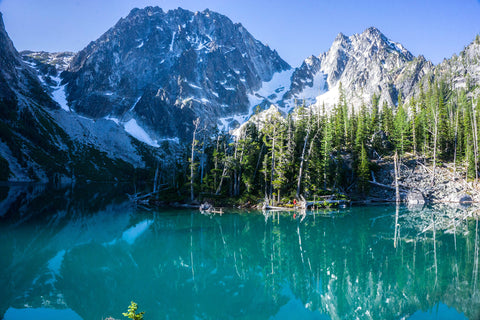
A warm stratum sandwiched between upper and lower colder layers
Transitory in areas without ice cover
Can be permanent in areas with ice cover
Sometimes caused by weird effects of solar heating through the ice
What is a Poikilothermy?
Complex temperature curves that have at least one low point and one high point
Very rare and transient
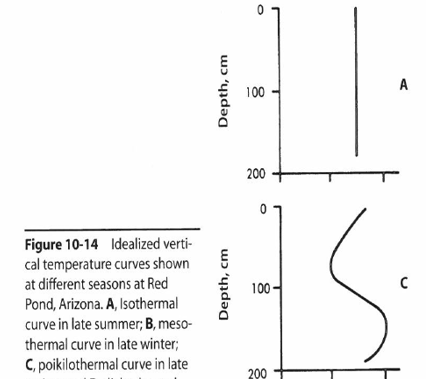
What the fuck kind of graph is this?
Graph A: shows an isothermal curve where is it around 5 ft deep
Graph B: Shows a middle-layer mesothermal lake
Graph C: Shows a poikilothermal curve with 2 diff curves
Graph D: Shows a Dichothermal curve with the first curve showing a warm top layer and the second curve showing an even hotter bottom layer of water mass