chapter 8 joints
 Call Kai
 Learn
Learn Practice Test
 Spaced Repetition
 Match
Match Flashcards
 Knowt Play
1/74

There's no tags or description
Looks like no tags are added yet.
Name | Mastery | Learn | Test | Matching | Spaced | Call with Kai | Chat |
|---|
No analytics yet
Send a link to your students to track their progress
75 Terms
bursae
fibrous sacs lined with synovial membrane and containing synovial fluid,
tendon shealth
cylindrical structures that surround muscle tendons-similar to bursae in synovial membrane and fluid content
bursae and tendon shealths both allow ______________.
adjacent structures to move over them

bursae
tendon sheath

3 factors influencing synovial joint stabilty
1.Articular surfaces
2. Ligaments
3.Muscle tone
3 Advantages of synovial joints
1.keep tendons taunt
2.acts as a stabilizing factor
3.important in reinforcing shoulder & knee joints and arches of the foot.
range of motion for synovial joint (4 movements)
1.gliding movement
2.Angular movement
3. Rotation
4. Special movements
Describe gliding movement
one bone surface moves over another similiar bone surface

Describe Angular movement
change in the angle b/w the two bones

Describe Flexion
bending movement that decreases the angle of the joint and brings the bones together

Describe extension
reverse of flexion!! bending movement the increases the angle of the joins and brings the bones farther apart

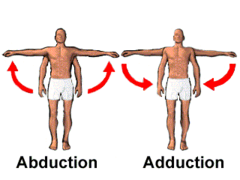
Describe abduction
movement of the bones away from the median plane of the body

Describe adduction
opposite of the abduction!! movement of the bones towards the median plane of the body
Describe rotation
turning of a bone around its own long axis

pronation
radius rotates over the ulna, palm down
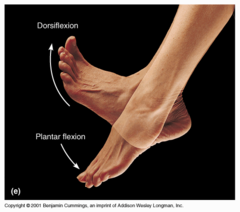
dorsiflexion and plantar flexion of the foot
up and down of foot at ankle
inversion and eversion of the sole of the foot
inwards and outwards

protraction and retraction of the mandible of the jaw
out and in

elevation and depression
lifting superiorly or inferiorly jaw or shoulders

opposition
thumb touches forefingers

What type of movement does plane joint do?
nonaxial, gliding

What type of movement does pivot joint do?
uniaxial, rotation

What type of movement does condylar joint do ?
biaxial movement, flexion + extension, adduction + abduction
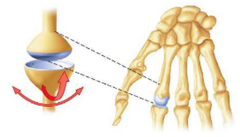
What type of movement does saddle joint do?
biaxial movement, adduction + abduction, flexion + extension

What type of movement does ball and socket joint do?
multiaxial movement, flexion + extension, adduction + abduction, rotation

shoulder-glenohumeral joint has a _____ range of movement.
wide

describe hip-coxal joint movement
-good-but movement is limited in range compared to shoulder
-limits set by strong ligaments and deep socket
-ligaments surround neck of the femur
-muscle tendons(hip and thigh) add to joint stability

three joints of knee joint
-Femoropatellar joint(intermedial)
- Tibiofemoral joint(lateral and medial)
-menisci
three joint ligaments of knee
1. Extracapsular fibular and tibial collateral ligaments
2.Oblique popliteal ligament
3.Arcuate popliteal ligament
intracapsular ligament
AKA cruciate ligament-forms X-cross over "cruci"-cross
What is the purpose of the knee?
acts as restrictive force to prevent displacement of the articular surfaces and secure articulating bones as we stand
sprain
joint ligaments torn or stretched
dislocation
bones forced out of alignment
cartilage tears
usually occurs when meniscus subject to compression and shear stress at the same time.
What is bursitis?
inflammation of a bursa,usually caused by a blow or friction
What is tendonitis?
inflammation of the tendon sheaths, usually due to overuse
osteoarthritis
disease of the joint cartilage, associated with secondary changes in the underlying bone.This leads to pain and impaired function of the bone.
Rheumatoid Arthritis
an Autoimmune disease causing inflammation of the synovial membrane. this leads to swelling and cartilage erosion. The end of this process is damage to joints and scar tissue formation, which may ossify and immobilize the joint

Lyme Disease
inflammatory disease caused by bacteria transmitted by a tick bite
arthrology
study of joints
arthroplasty
replacing a diseased joint with an artificial joint

rheumatism
a lay term referring to disease involving muscle or joint pain;may be used to apply to arthritis,bursitis, etc.
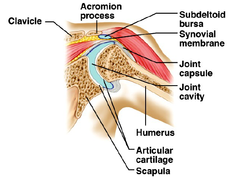
What type of joint is a shoulder joint?
is a ball and socket joint
What type of joint is the elbow joint?
a hinge joint

What type of joint is the hip joint?
is a ball and socket joint

what forms the temporomandibular joint
is formed by (1)the condylar process of the mandible and (2) the mandibular fossa and articular tubercle of the temporal bone

Articular surfaces determine…..
what movements are possible for a joint
What do ligaments limit?
stretch
What is the definition of muscle tone?
low level of contractile activity in relaxed muscles that keep muscles healthy and ready to react to stimulation
what is the purpose of the TMJ joint?
allows both a hingelike opening and closing of the mouth and an anterior gliding of the mandible
How does the TMJ joint dislocate?
It often dislocates anteriorly
What forms the hip joint?
formed by the acetabulum of the hip bone and the femoral head
What is the hip bone adapted for?
weight bearing— Its articular surfaces are deep and secure. Its capsule is heavy and strongly reinforced by ligaments.
What makes up the elbow joint?
ulna and radius articulate with the humerus
What forms the shoulder joint?
the glenoid cavity of the scapula and the humeral head
What is the most freely moveable joint of the human body?
shoulder
What helps to stabilize the shoulder?
The tendons of the biceps brachii and rotator cuff muscles help to stabilize it.
What is synarthroses?
immovable joint
What is amphiarthroses?
slightly moveable joints
What is diarthroses?
freely moveable joints
Are fibrous joints generally immovable or moveable?
immovable
Are synovial joints generally immovable or freely moveable?
freely moveable
What comprises fibrous joints?
collagen fibers of connective tissue
What are the three types of fibrous joints?
sutures, syndesmoses and gomphoses
What are suture joints?
seams between bones of a skull
What are syndesmosis joints?
joints held together by a ligament
What are gomphosis joints?
peg in socket (teeth)
How do cartilaginous joints work?
bones are united by cartilage
What are the two types of cartilaginous joints?
synchondroses and symphyses
How do synchondroses work?
a plate of hyaline cartilages unite the bones
How do symphyses work?
fibrocartilage units the bones
What are synovial joints?
joints in which the two articulating bones are separated by a fluid-containing joint cavity
name 4 important features of synovial joints
hyaline cartilage, joint cavity filled with synovial fluid, articular capsule surrounding the joint cavity, and reinforcing ligaments outside and inside the capsule
What are the two layers of joint capsule?
fibrous layer and dense irregular connective tissue