Chapter 9: Models of Chemical Bonding
 Call Kai
 Learn
 Practice Test
 Spaced Repetition
 Match
 Flashcards
 Knowt Play
1/35

36 Terms
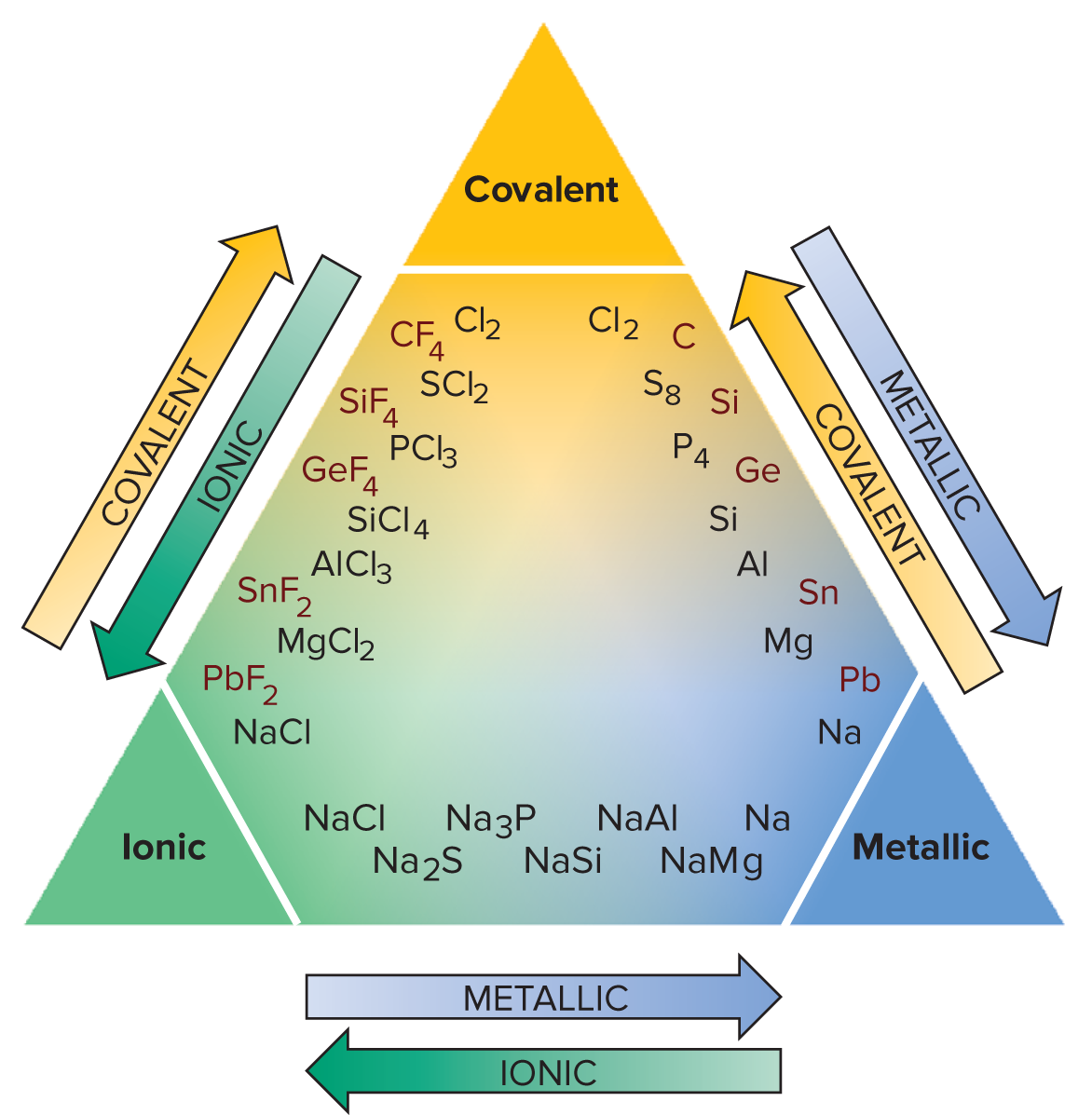
Bonding
This lowers the potential energy between positive and negative particles
Can be imperfectly modeled with classifications

Ionic bonding
This occurs between atoms with large differences in their tendencies to lose or gain electrons
Often occurs between reactive metals and nonmetals to form a noble gas configuration for a solid

Covalent bonding
This occurs between atoms with small differences in their tendencies to lose or gain electrons
Often occurs with electron-sharing nonmetals as separate molecules form

Metallic bonding
This occurs between metals when electrons are shared, with electrons being “pooled” (delocalized) due to low electron affinity that creates attractions between the positive nuclei
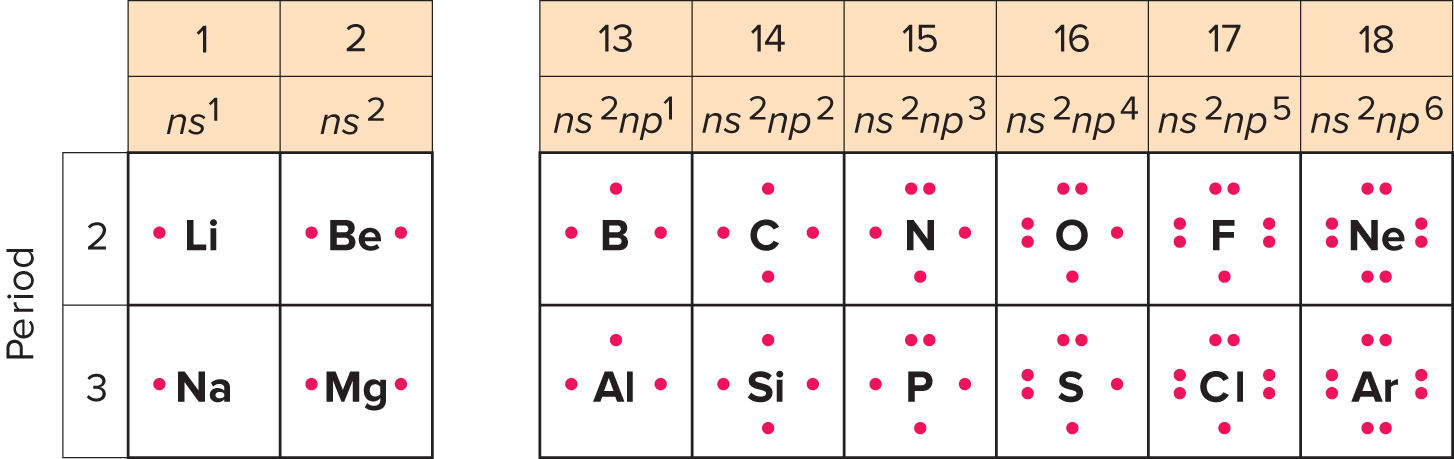
Lewis electron-dot symbol
A way of representing an atom through drawing a symbol that represents the nucleus and core electrons with dots representing the reactive valence electrons
Dots are drawn one at a time on each side until all valence electrons are represented, demonstrating a target towards the octet rule
Metals: Total number of dots is the number needed to form a cation
Nonmetals: Number of unpaired dots is the number needed to form an anion, or shared for covalent bonds
Octet rule
A generalization of atomic bonding that states that atoms lose, gain, or share electrons to attain a filled outer level of eight electrons

Energy absorption
This occurs during electron transfer, as energy is absorbed when breaking bonds and changing states, and emitted when forming bonds
Potential energy goes up due to excited states
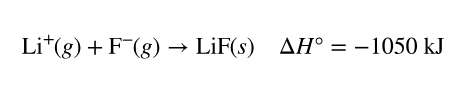
Energy release
This occurs when a compound forms from its elements in ionic bonding, typically producing heat and creating this overall
Mainly seen through the attraction between oppositely charged ions as bonds in the lattice are formed, also known as the lattice energy
Explained as potential energy decreasing
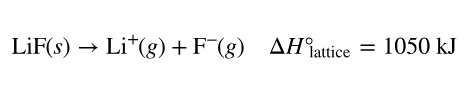
Lattice energy (ΔH°lattice)
The enthalpy change associated with one mol of ionic solid separating into gaseous ions
Equal to the opposite of the last step of ionic bond formation
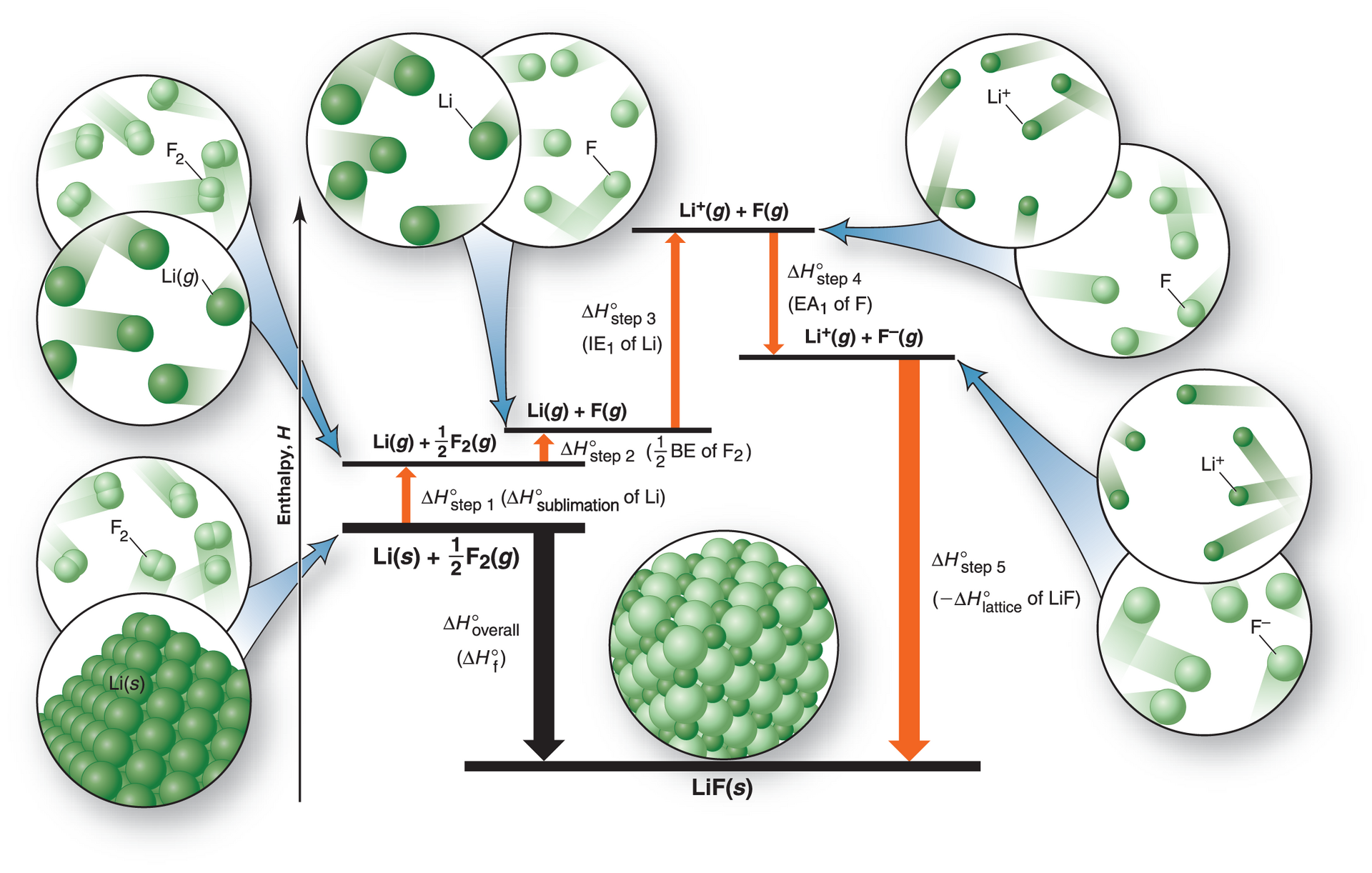
Born-Haber cycle
A series of steps and enthalpy changes that converts elements to an ionic compound, used to calculate the lattice energy from known enthalpies of formation
Based on Hess’s law, stating that ΔH°f = ΣΔH°steps
Requires adding individual ΔH values in order to form elements, then solving for the last step to obtain lattice energy
Demonstrates how energy is supplied by ion attractions to release heat overall
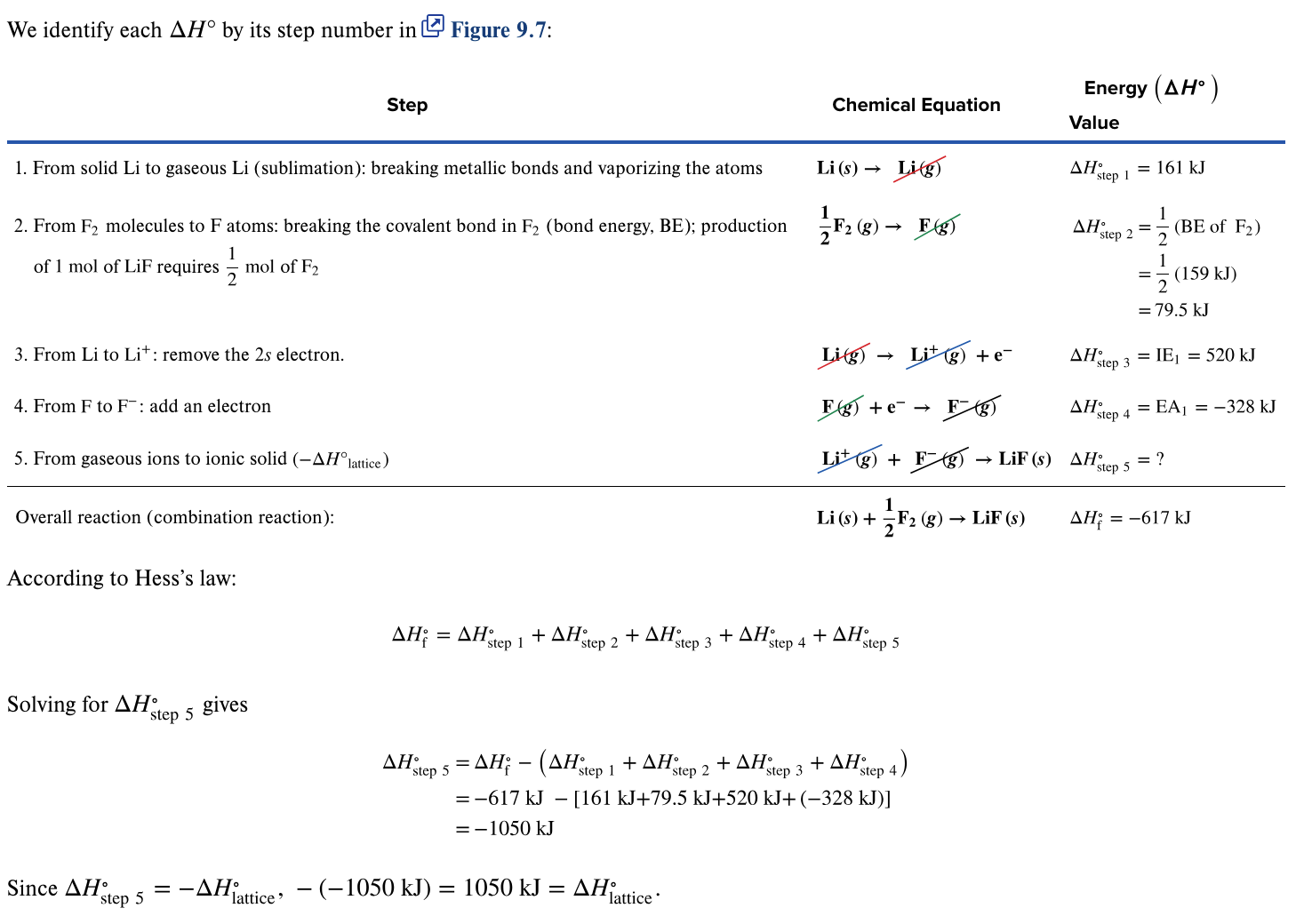
List out your given ΔH°f values.
Determine the order and sign of the individual steps to add.
Using Hess’s law, solve for -ΔH°lattice (the last step).
Take the opposite of the last step to find ΔH°lattice.
How do I solve for an equation using the Born-Haber cycle?

Coulomb’s law
States that the electrostatic energy between particles is directly proportional to the product of their charges and inversely proportional to the distance between them
Expressed as E = (Charge A ⋅ Charge B) / Distance
Greater charges, then smaller ion sizes, increase energy
Directly proportional to ΔH°lattice
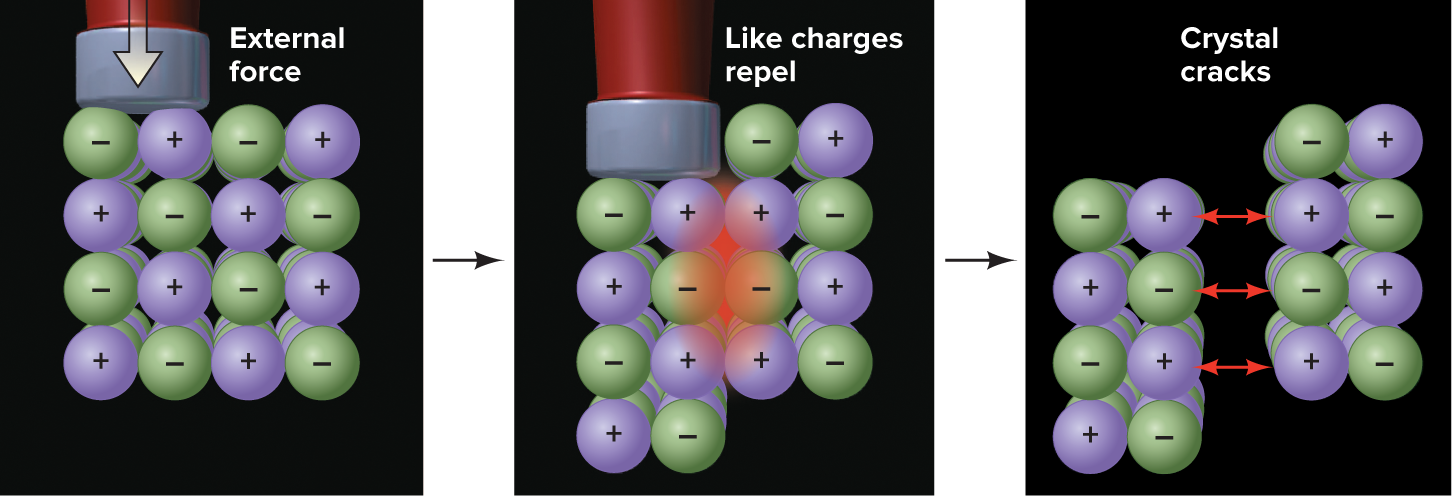
Ionic bonding model
This explains the properties of ionic solids, as:
Ions in specific positions make for a hard, brittle, and rigid solid
Ions dissolve and carry a current in water
Ions require large amounts of energy for separation due to high lattice energies, creating ion pairs in gaseous states instead of individual ions

Covalent bond
A bond where two atoms share electrons, arising from the balance between nuclei attracting electrons and electrons repelling
Results in greater electron density between nuclei
To form the bonds, energy from the atoms needs to be released, with some being released by heat through attraction.
Why does bond formation release energy?
To break the bonds, energy from the surroundings needs to be absorbed, enabling ionization.
Why does bond breakage absorb energy?

Bonding pair (shared pair)
The pair of electrons that is shared by the atoms in the bond
Represented by a pair of dots or a line
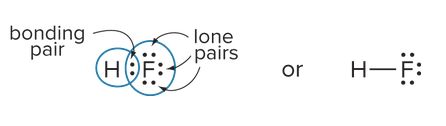
Lone pair (unshared pair)
A pair of outer-level electrons not involved in bonding
Generally shown as dots

Bond order
The number of electron pairs being shared by a given pair of atoms
Labeled as double, single, triple, or more
Higher numbers result in higher bond energy and lower bond length
Single bond
One bonding pair of electrons
Has a bond order of 1
The most common bonding pair of electrons

Double bond
Two bonding pairs of electrons with four electrons shared
Has a bond order of 2

Triple bond
Three bonding pairs of electrons with 6 shared electrons
Has a bond order of 3
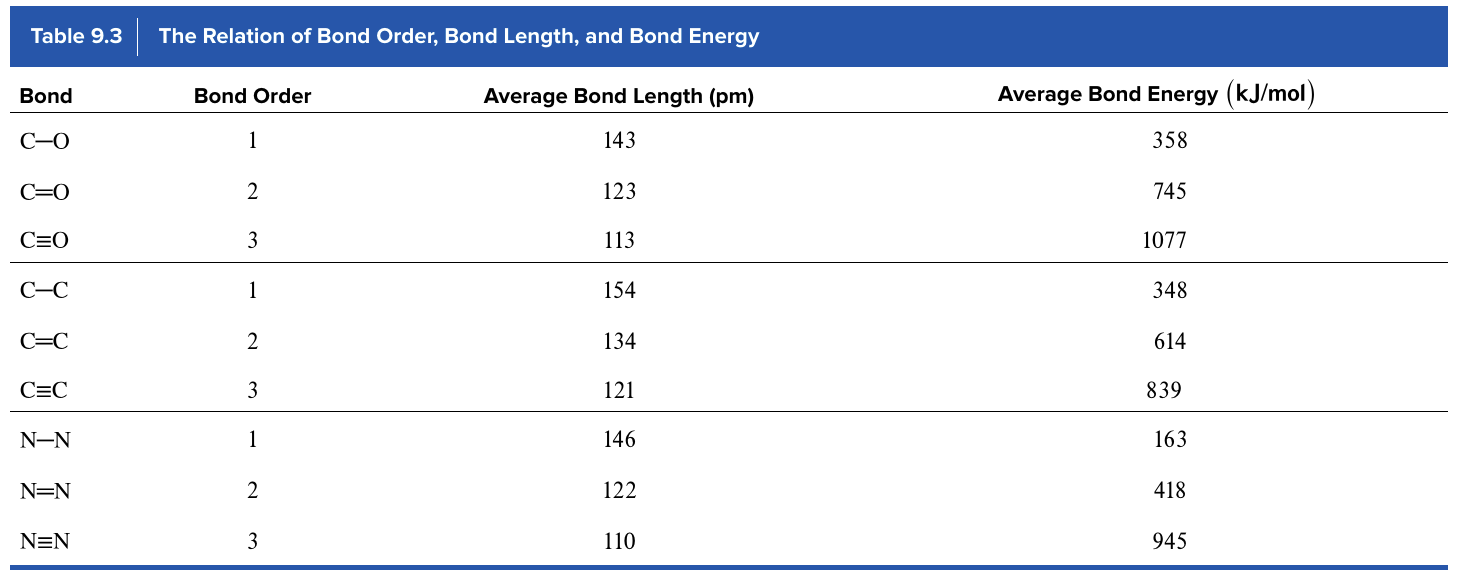
Bond energy
The standard enthalpy change (energy needed) to break apart the bond of 1 mol of a gaseous compound
Breakage is always positive (endothermic)
Equal to the energy difference between separated and bonded atoms, or the opposite of the difference in formation
Stronger bonds have larger levels of this due to lower energy; weaker bonds have smaller levels of this due to higher energy

Bond length
The distance between the nuclei of two bonded atoms
Defined as the distance at the point of minimum energy, denoted as an average
Equal to the sum of the radii and is used to calculate other atomic radii

Intermolecular forces
Unlike in ionic bonds, these are weak in covalent bonds, preserving the bonding forces within the molecule instead
Exceptions are made for covalent solids like quartz and diamond
Electrical conductivity
Unlike in ionic bonds, this is weak for covalent substances, due to localized electrons and a lack of ions

Infrared spectroscopy (IR spectroscopy)
The observation of IR wavelengths passing through molecules due to their tendency to absorb IR photons equal to their vibrational energy levels in bonds
Based on differing wavelengths and unique spectrums per compound
Enthalpy of reaction (ΔH°rxn)
This arises from the differences between reactant and product bond energies
Defined as ΣΔH°bonds broken + ΣΔH°bonds formed
Can also be defined as ΣBEbonds broken - ΣBEbonds formed (uses minus due to all positive bond energies)
Hess’s Law
States that the enthalpy of a reaction is equal to the sum of the enthalpies taken to get there, regardless of method
Enables the calculation of ΔH°rxn through the breakage of all reactant bonds and formation of all product bonds, using listed values for the reactants and products
Will not result in exact given values due to averaging

Fuel
Any material that reacts with O2 to release energy
Includes hydrocarbons and coal, requiring less energy needed to break the weaker bonds than needed to form to stronger bonds, creating an exothermic reaction
Has more C-C and C-H bonds compared to C-O and O-H bonds due to stronger O bonds
Weaker bonds release more energy as less input is needed
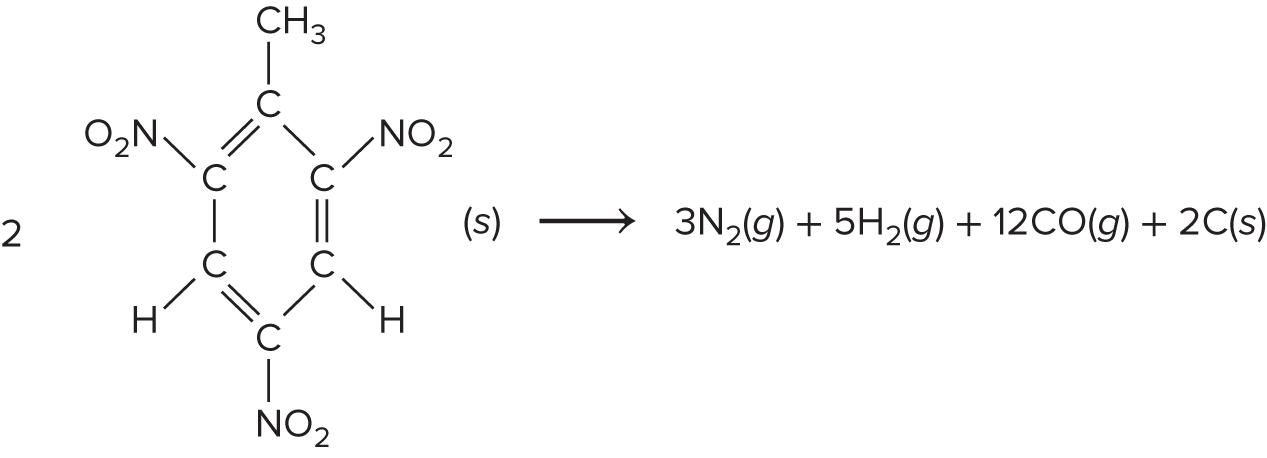
Explosives
Compounds that react very rapidly and release a large quantity of energy, producing a large quantity of gaseous products through formation that releases energy

Electronegativity (EN)
The relative ability of a bonded atom to attract shared electrons
Greater numbers equate to greater attraction to shared electrons in a bond
Generally inversely related to atomic size as electrons are attracted more strongly in smaller atoms (like F)

Polar covalent bond
The unequal sharing of electrons in a covalent bond due to large differences in electronegativity
Denoted by a polar arrow pointing towards the partially negative pole

Nonpolar covalent bond
The equal sharing of electrons in a covalent bond, typically seen with identical atoms
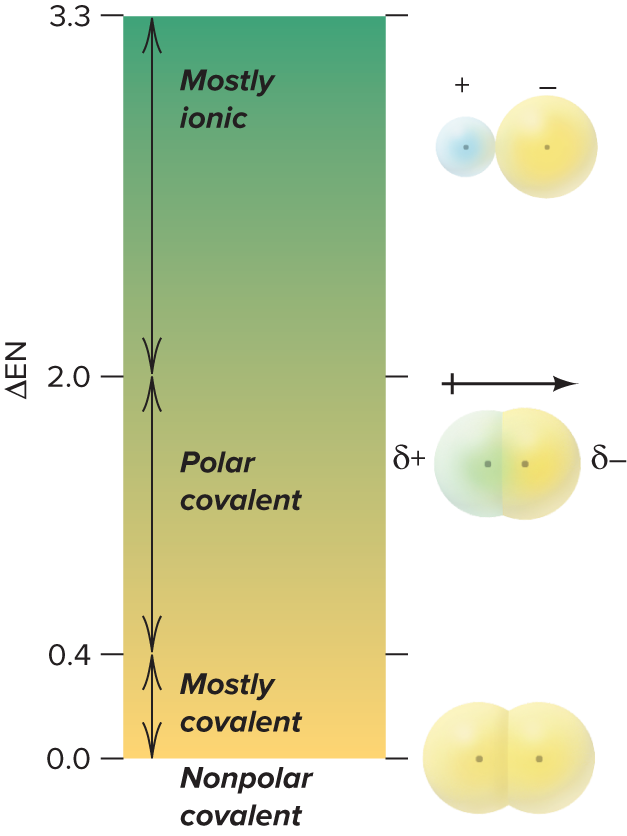
Electronegativity difference (ΔEN)
The difference between the EN values of the bonded atoms
Greater levels equate to a higher partial ionic character due to higher charge separation
Allows for the labelling of ranges defining mostly ionic, polar covalent, mostly covalent, or nonpolar covalent bonds

Percent ionic character
A number quantifying the level of sharing between atoms, increasing with electronegativity difference