Hippocampus & LTP
 Call Kai
 Learn
 Practice Test
 Spaced Repetition
 Match
 Flashcards
 Knowt Play
1/36

There's no tags or description
Looks like no tags are added yet.
37 Terms
What is the nernst of a receptor? What is it made of and what does it look like
Nernst of a receptor is POINT when receptor has EQUAL CURRENT FROM IONS
EX: glutamate receptor
point whne it has equal current from sodium and potassium
The nersnt for the receptor is the weighted average (GHK) of ENa and EK
What is is synaptic “strength”
measure of robustness of a connec’n b/n two neurons
INC strength → INC response to stimulus
What is synaptic plasticity
Ability of synaptic connections b/n neurons to CHANGE in strength
malleable and allows alter responses
Chemical synapses have MORe
what is short-term plasticity
short-duration changes in synaptic strength
facilitation, depression, etc
what is long-term plasticity
Long-lasting changes in synaptic strength
ex: Long-Term Potentiation (LTP)
^ the basis of learning and memory
What is the hippocampus. How doesit inatake info, and what type of things does it commit to long-term memory
Place where long-term memories can be made. Takes info from cortex → process → Sends back to cortex
For DECLARATIVE,Semantic info (names, places, ppl, etc)
what are the 3 sybapses for how info is processed in the hippocampus?
Preforant path → Dentae Gyrus
Mossy Fibers (MF) → CA3 (dendritic cells)
Schaffer collateral → CA1

What is the general path of AP/stimuli in the hippocampus?
cortical input signals from perforant path synapse at Dentae gyrus cells → Sends MF into CA3 (dendritic cells) → Sends their collaterals to CA1 → CA1 axons elave, make contact with cebiculum → Go back to the entorinal hippocampus (start area)

what does recording intracellular vs extracellular tell you

What induces LTP (LTP induction). How?
HIGH FREQUENCY STIMULATION (Tetanus) of the PRE-SYNAPSE
→ Causes much higher response and thus EPSP in post-synapse, which is how LTP is intially induced

what are the 3 phases of LTP. how long does each last and what happens there
LTP Induction (due to HFS, Tetanus)
LTP expression (early LTP)
lasts 3 hours
point of elevated post-synaptic response after HFS induced LTP induction
LTP Maintenance (“Late LTP)
Lasts 8 hours
Requires MULTIPLE trains of tetanus
Difference in depolarization and signal when recording intracellular vs extracellular?
Intra recording → Depolarization → Signal goes UP
Extra recording → Depol → Signal gpes DOWN (b/c seeing from outside)
what are the two main NT involved with LTP, what receptors do they bind to
Glutamate → Stimulatory, binds to NMDA and AMPA receptors
GABA → INHIBITORY, binfs to GABA A and GABA B receptors
what are the two main receptors that GABA binds to to inhibit LTP. What is the difference betwen them, and how do they inhibit?
GABA A
FAST IONOTROPIC, inhibitory receptors (like nicotnic)
via Cl- influx into cell
FAST IPSP
GABA B
SLOWER MUSCARINIC METABATROPIC inhibitory receptors
via OPENING of K+ channels (potassium eflux, hyperpolarizes cell)
→ SLOW IPSP
G -protein coupled
I nward
R ectifying
K+ channel
How is GABA A fast while GABA B is slow? Mnemonic for GABA B?
GABA A is a IONOTROPIC FAST channel. Chlorine ions just flow through after GABA binds
GABA B is a METABATROPIC receptor with GPCR (longer pathway). The SLOW opening of potassium channels causing eflux and hyperpolarization is why it is slow
What are the two receptors glutamate (excitatory) will bind to. what type of receptors are these
AMPA
NMDA
^^^ Ionotropic, cation NON-SELECTIVE receptors
what is the outcome of each of these receptors?
AMPA → Opens and activates NMDA receptors
NMDA → Influx of calcium for intracellular action and LTP triggering, strengthening synapse and getting INC LTP
What are AMPA channels permeable to, How do they function
Perm to ONLY Sodium and Potassium (depolarizes post-synapse)
Glutamate binds to AMPA → Opens → Sodium infllux and some potassium efflux (overall depol membrane) → Depolarizes membrane gets you EPSP → Removes magnesium block on NMDA via electrostatic attraction
What are NMDA channels permeable to, how do they function. Special term for NMDA?
Permeable to sodium potassium, AND CALCIUM
At rest, NMDA blocked with Magnesium → Depol of membrane from AMPA receptors opening repels the magnesium blocker out of place, is now unblocked → Influx of calcium in post-synapse → Intracellular action triggered → increases strength of synapse → increases LTP
NMDA gluatmate binding and magnesium unblocking MUST HAPPEN @ same TIME*
NMDA is COINCIDENCE DETECTOR (detect pre-synaptic glutamate binding and post-synaptic depol)
what does calcium influx from NMDA lead to? How is that relevant to LTP?
AMPAR insertion and phosphorylation, INC AMPAR conductance
LTP expressed by addition and phosphorylation of AMPA receptors at post-synapse
(more AMPA open, like positive feedbackloop)
How does correlated vs uncorrelated neuronal activity change synapse connections?
Correlated → STRENGTHENED synaptic connections
Uncorrelated → WEAKER connections
What are the 3 properties of LTP?, what are each of them generally?
Cooperativity
Minimum threshold number of pre-synaptic axons must be activated
Specificity
Only activated synapses show LTP
Associativity
Weakly-activated synapses CAN develop LTP in conjunction w/ strongly-activated synapses
what is cooperativity, and when is that reached for LTP?
→ Minimum threshold number of pre-synaptic axons that myst be activated to achieve HFS to induce LTP
More activated axons → more glutamate release → greater summation of EPSPs → greater postsynaptic depolarization.
Threshold is when NMDA magnesium blocker is removed and depolarization and calcium influx can happen.

What is specificity. why is it important?
Input specificity → only activated synapses are showing LTP, not the ones that were not activated
Only the part you specifically simulate will see an enhanced response after tetanus
Spatial specificity → synapse only at specific part is strengthened

What is associativity for LTP? What is it basically saying? What kind of timing is it?
When weakly-activaated synapses CAN develop LTP if their activation happens at same times as a strong activated synapse for LTP.
LTP can happen w/ weak stimuli when it is coupled with a strong one. Both get stronger as a result.
“Co-incidence timing”

What is Inhibitor Avoidance?
Behavioral test of learning and memory in which an animal learns the location of an unpleasant stimulus, and memory is measured by how long it takes to re-enter that place.
(higher latency to enter)
What is Mimickry in case of LTP
Two different different treatments get you the same result, their mecanisms of getting there are similar
Mimicry: Treatment A produces LTP, and Treatment B also produces LTP. Their effects are similar.
Occlusion: Treatment A produces LTP. Adding Treatment B produces little additional LTP because both treatments have already activated the same underlying mechanism.
The key difference: Mimicry is about producing a similar effect, while occlusion is about the lack of an additional effect when two mechanisms overlap.
Learning does something in neurons that LOOKS like LTP
What is Occlusion
Overlap of outputs due to having the SAME MECHANISM, and thus DO NOT have any additive effect.
working out + steroids
result from one manipulation or both look the same because of overlap in output DUE TO same mechanism.
Overlap of output due to having the same mechanism DO NOT have an additive effectbeing used for two diff things for achieving that output
two diff things with same mechanism
How does phosphorylation correlate with serine residuw associate with LTP?
Increase phosphorylation → enhances synaptic strength & INC LTP → Learning
How does CPP inhibition of NMDA affect LTP?
CPP inhibits NMDA receptors → DEC in phosphorylation → DEC in LTP and → DEC in learning
How does having more AMPA correlate with LTP?
more stimulation and stronger synaptic activity → more LTP and learning
What type of mimickry is it of phosphorylation and the AMPA receptor ratio?
BIOCHEMICAL mimicry
Different mechanisms are yielding the same result, that result in this case is happening biochemically.

with shocking training, what kind of mimicry is that?
Electrophysiologically mimicry
What is the difference between additive and occlusive?
two Different mechanisms, achieving a result that has been amplified or increased (instead of just one mechanism) → Additive
Two of the same mechanisms, achieving a result that is basically equally the same as the two mechanisms due to overlap of the output → Occlusive.
Example of Intervention A and Intervention B achieving the same result of occlusive or additive effect?

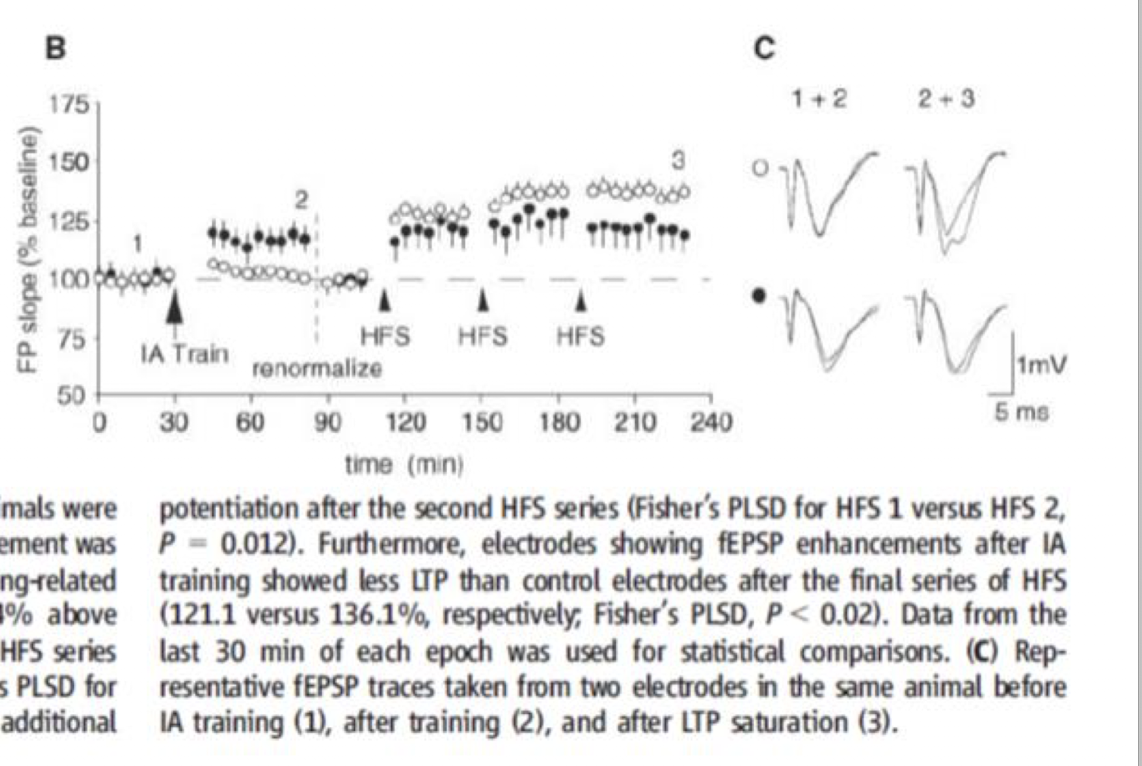
what is this graph saying?
image
