Textbook Module 2.1 - Mind Versus Body Problem
 Call Kai
 Learn
Learn Practice Test
 Spaced Repetition
 Match
Match Flashcards
 Knowt Play
1/27

There's no tags or description
Looks like no tags are added yet.
Name | Mastery | Learn | Test | Matching | Spaced | Call with Kai | Chat |
|---|
No analytics yet
Send a link to your students to track their progress
28 Terms
What is trephination?
Creating a surgical hole into a patients skull
Why did trephination occur?
To let in good or let out evil spirits from the body.
What were the symptoms that led to someone having a trephination?
Patients with epilepsy, headaches, psychosis, and other head/mental abnormalities
When did trephination begin?
6,000BCE
Were patients who received a trephination conscious or unconscious?
Conscious
How do we know patients lived from trephination?
Cave paintings depicting scar tissue at the forehead on the skull
What is the modern day version of trephination?
Craniotomy
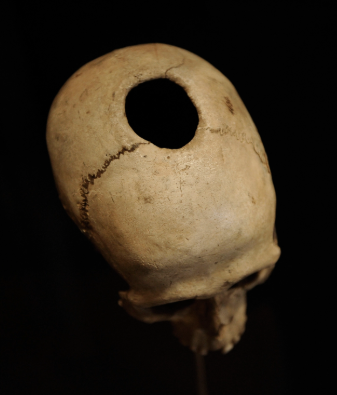
What does this image depict?
A neolithic skull with a trephination
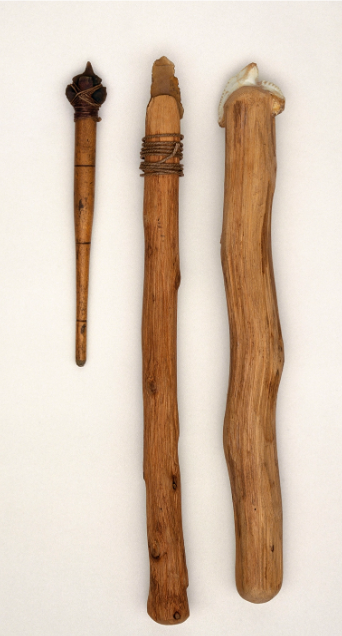
What does this image depict?
Tools used for trephination
Ancient Greek philosophers would argue whether….
the mind was separate from the physical body
Ancient Egyptian’s attributed abnormal behaviours and physical illness to…
supernatural origins
What did the Ancient Egyptians view as the centre of intelligence and reason?
The heart
What did Claudius Galen do?
Conducted dissections on animals, mainly apes, to develop an understanding of the brain and the body
What happened when Galen cut the medulla on an ape?
The ape immediately stopped respiration
What did Galen observe in some people who experienced strokes?
they lost a particular sense even though there was no apparent damage to the sensory organ
What did Galen deduce from his stroke findings?
The brain played a major role in sensation
Galen’s work contributed to the….
materialist approach
Thomas Willis developed the terms
hemisphere and lobe
Thomas Willis theorised that particular cortical structures had specialised functions. When he conducted a study what did he find?
Automatic processes, such as breathing, heart rate, and other motor functions are controlled by specific areas of the lower brain.
What is the “Circle of Willis”?
The four major arteries at the base of the brain
What did Franz Joseph Gall do in 1796?
Suggested that personality was directly linked to brain structure.
Franz Joseph Gall was a neuroanatomist and physiologist. He is noted for the development of….
phrenology
What is Franz Joseph Gall’s theory?
The shape of the skull reflects an individual’s personality and intelligence
Is phrenology pseudoscience?
Yes
What is the mind-versus-body problem?
A debate on whether the mind is a separate entity from the brain and body
Materialists approach the mind versus body problem is
the mind is the same as the brain and both the mind and body work together through complex physical interactions between neurons.
Dualists approach to the mind versus body problem is
the mind and body are separate from one another, the body is seen as physical and the mind is considered non-physical. It experiences the world as a non-physical entity and doesn’t die with the body.
Rene Descartes was a
dualist