Materials Finals
 Call Kai
 Learn
 Practice Test
 Spaced Repetition
 Match
 Flashcards
 Knowt Play
1/36

There's no tags or description
Looks like no tags are added yet.
37 Terms






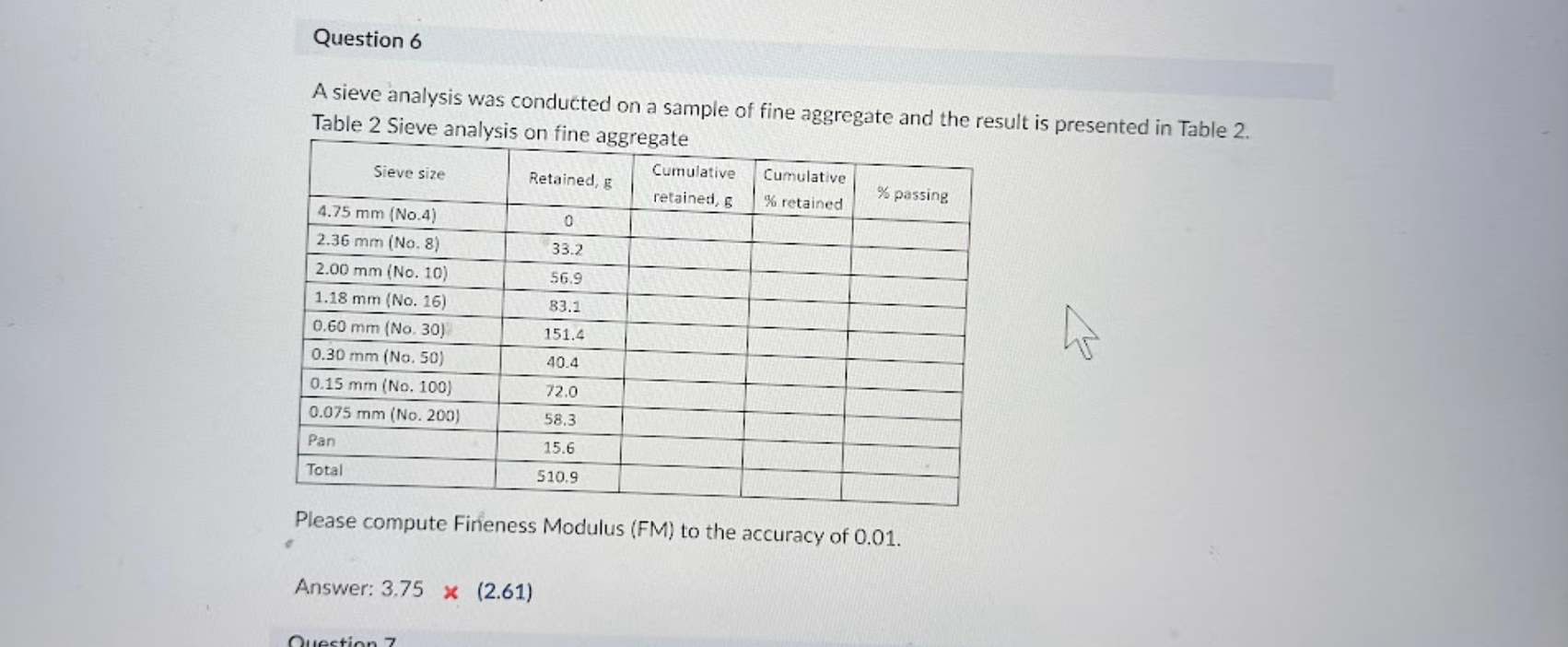
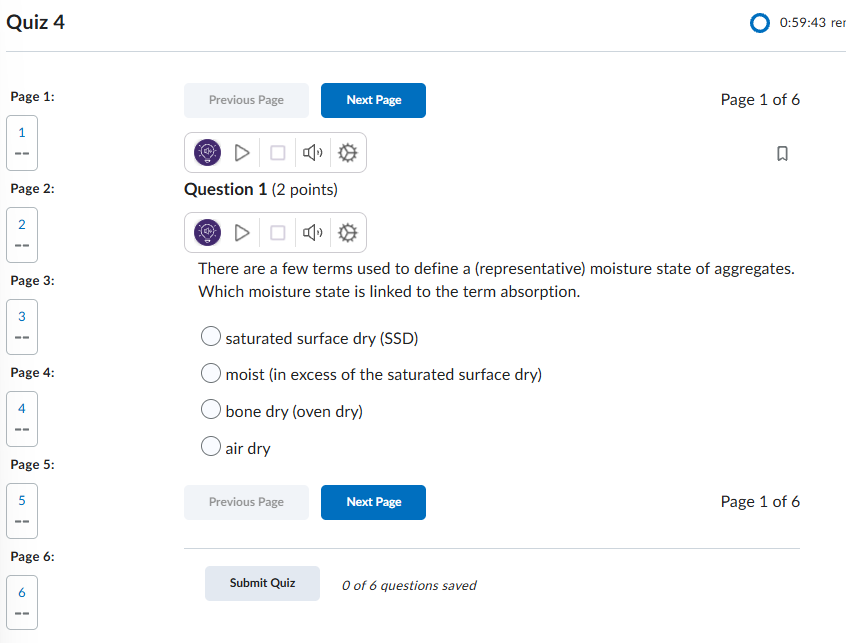
Saturated surface dry (SSD)

Topic 5- Main characteristics of asphalt binder
• Adheres well to most rock
• Waterproof
• Fairly durable
• Resistant to reaction with most acids, alkalis, and salts
• Temperature sensitive

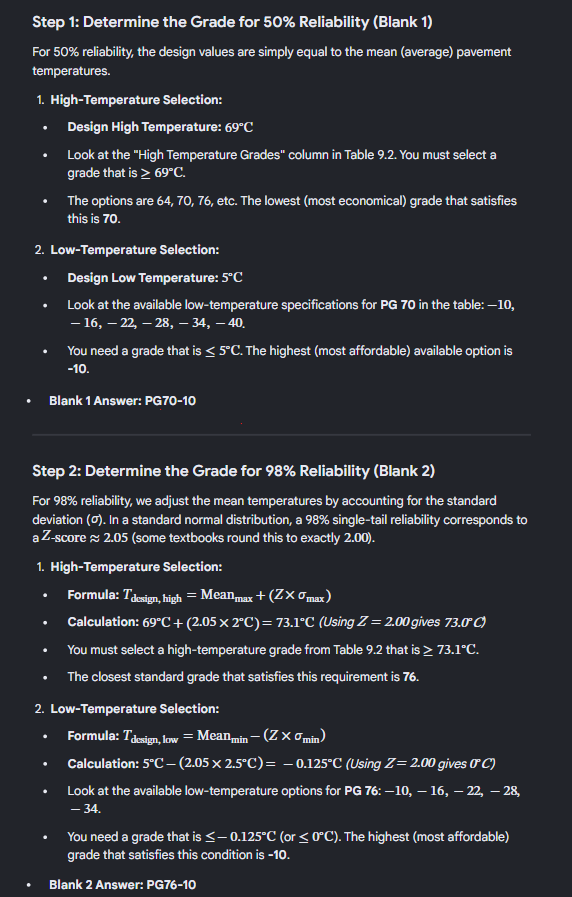
Answer for blank # 1: | PG70-10 | ||||||||||||||||
Answer for blank # 2: | PG76-10 | ||||||||||||||||
|
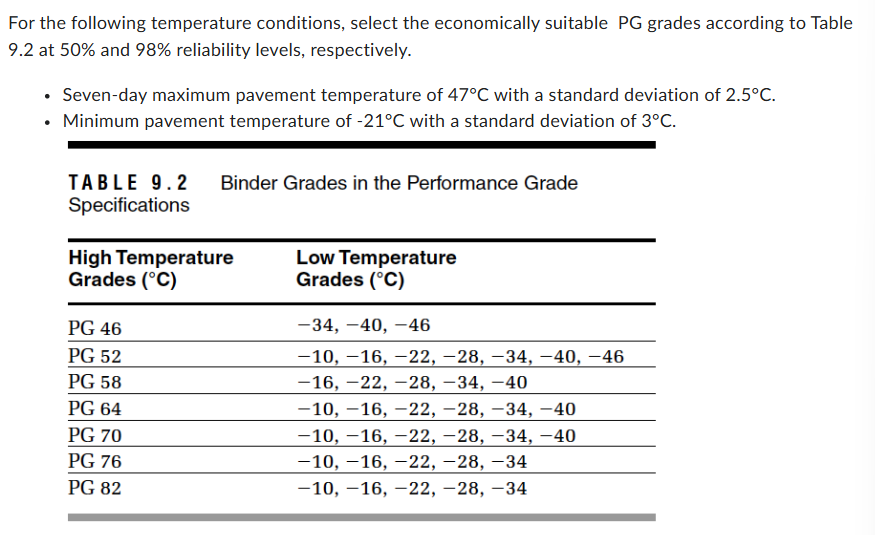
PG52-22 (50%) and PG52-28 (98%)

PG58-28
Which asphalt grading system can best offer a performance-based asphalt selection for asphalt pavements?
Penetration (Pen) grading | |
Superpave PG grading |
Superpave PG grading

PG52-16

Answer for blank # 1: | PG46-44 | |
Answer for blank # 2: | PG46-40 |
The following observations are made for asphalt products:
Asphalt is highly affected by temperature and its changes
As temperature increases, the viscosity of asphalt decreases
Soft asphalt is desirable for applications in cold regions
What is the phrase that best describes the above property?
Temperature sensitivity (susceptibility) |
Aging effect |
Time dependency |
Asphalt chemestry |
Temperature sensitivity (susceptibility)
After two years of traffic, cores were recovered from the roadway which has severe rutting and bleeding. The bulk specific gravity and the maximum theoretical specific gravity were measured on these cores and are as follows:
Bulk specific = 2.442
Maximum theoretical specific = 2.535
Choose the nearest air void in the asphalt concrete cores
3.7%
An asphalt concrete mixture sample (compacted) contains 5% asphalt binder (Gb = 1.013) by weight of the total mix, and aggregate (Gsb = 2.855). The bulk density of the sample is 2.531 g/cm3. Ignoring absorption, compute the percent voids in the total mix (%Va).
3.4%
An asphalt concrete specimen has the following properties:
Asphalt content = 5.5%
Bulk specific gravity of the mix = 2.324
Theoretical maximum specific gravity = 2.411
Bulk specific gravity of aggregate = 2.689
Ignoring absorption, calculate the percents VTM or %Va (in Blank 1), %VMA (Blank 2), and %VFA (Blank 3) to the nearest of 0.1.
!!! Important!!!
All numbers must be presented to the accuracy of 0.1
Answer for blank # 1: | 3.6 |
Answer for blank # 2: | 18.3 |
Answer for blank # 3: | 80.3 |


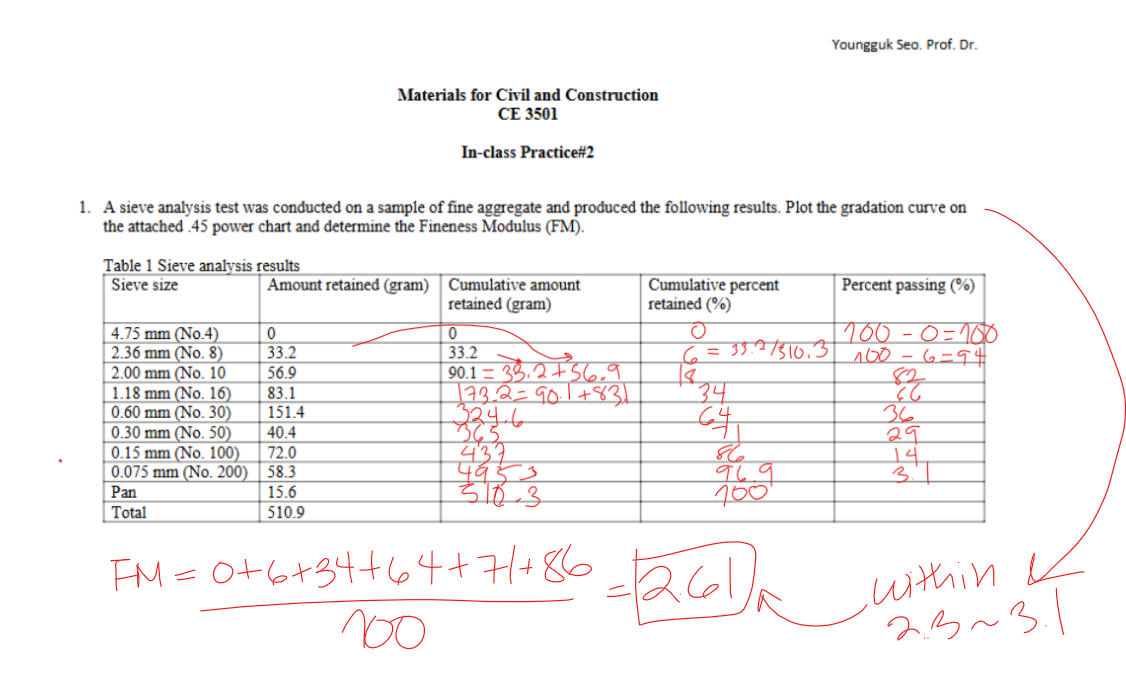
As part of mix design, a laboratory-compacted cylindrical asphalt specimen is weighed for determination of bulk specific gravity. The following numbers are obtained:
Dry Mass in grams: 1264.7 grams
Mass when submerged in water: 723.9 grams
Mass of Saturated Surface Dry: 1298.3 grams
What is the nearest air void content of this specimen in percent?
6.0%
Write the volumetric code names for the following quantities:
(Blank 1) Bulk specific gravity of mixture
(Blank 2) Maximum specific gravity of mixture
(Blank 3) Absorbed asphalt (binder) content
(Blank 4) Volume of air in asphalt concrete mixture
(Blank 5) Mass of total mixture or Bulk mass of mixture
(Blank 6) Mass of aggregate (solid)
Answer for blank # 1: | Gmb |
Answer for blank # 2: | Gmm |
Answer for blank # 3: | Pba |
Answer for blank # 4: | Va |
Answer for blank # 5: | Mmb |
Answer for blank # 6: | Ms |
An asphalt concrete specimen has a mass in air of 1353.9 g, mass in water of 792.4 g, and saturated surface-dry mass of 1342.2 g. Calculate the bulk specific gravity of the specimen.
2.463
A compacted asphalt concrete specimen contains 4% asphalt binder (Sp. Gr. 1.03) by weight of total mix, and aggregate with a specific gravity of 2.532. The bulk density of the specimen is 2.213 Mg/m3. Ignoring absorption, compute % Air Voids (%Va). Assume the total volume of asphalt mixture is 1 cubic-meter
7.5%
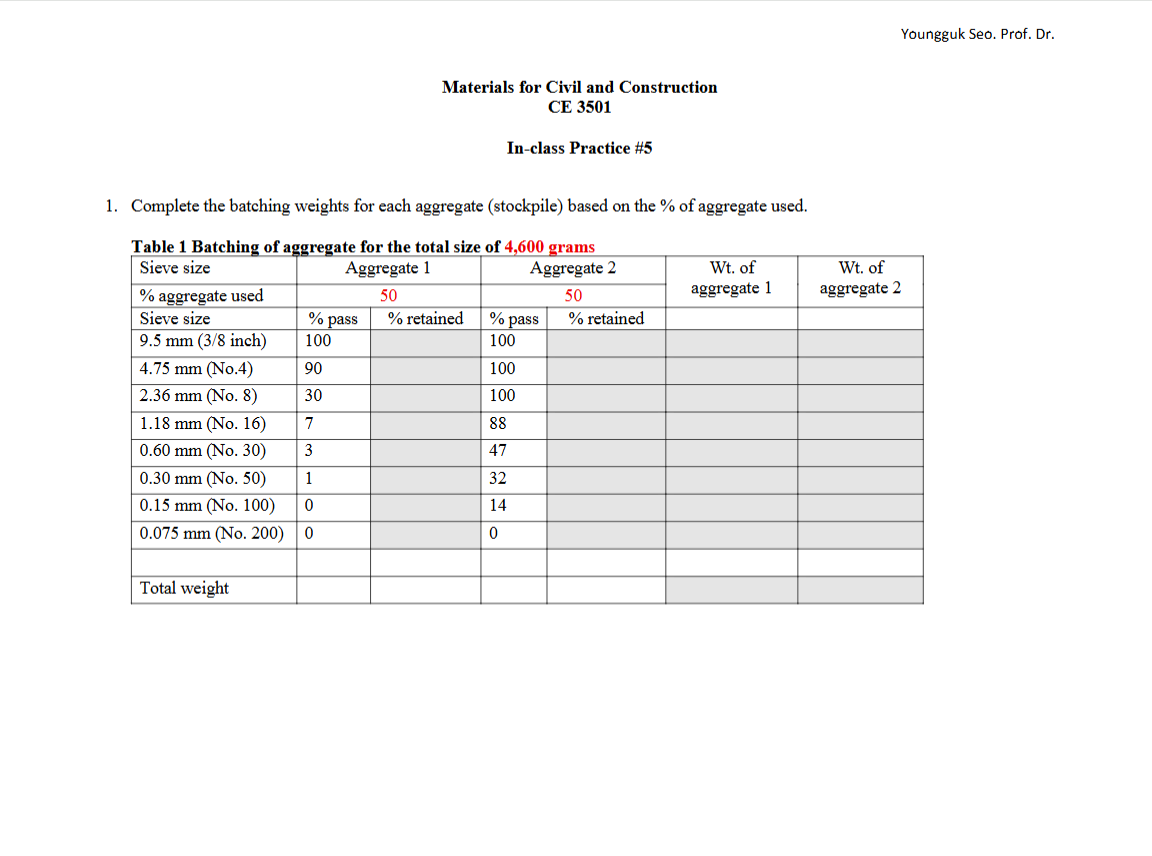
An aggregate blend is composed of 59% coarse aggregate by weight (Sp. Gr. 2.635), 36% fine aggregate (Sp. Gr. 2.710), and 5% filler (Sp. Gr. 2.748). The compacted specimen contains 6% asphalt binder (Sp. Gr. 1.088) by weight of total mix, and has a bulk density of 143.9 pcf. Ignoring absorption, compute the percent voids in total mix (%Va).
6.0%

Step-by-Step Solution
Select the concrete category: Air-Entrained Concrete (left half of the table).
Select the nominal maximum aggregate size row:
0.5 in.corresponds to12.5 (1/2).Read the Wet Coarse Aggregate factor: In the
12.5 (1/2)row under Air-Entrained Concrete -> Wet Coarse Aggregate, the relative weight fraction is0.399.Check footnote
**: Since the aggregate is non-crushed stone, no crushed-stone adjustment is applied.Multiply by total mix weight:
Weight of wet coarse aggregate=6,400×0.399=2553.6
Answer: 2553.6

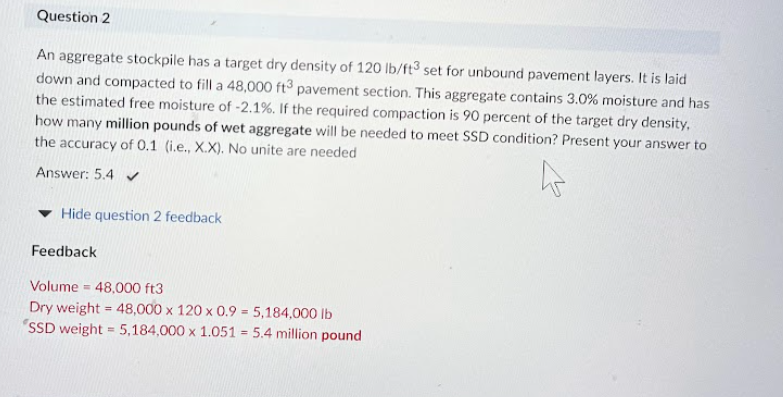
Find the total unmixed bulk volume needed: Since the final combined concrete volume (1.2 m3) is 32 of the original unmixed bulk volumes, divide by 32 (or multiply by 1.5):
Total unmixed bulk volume=2/31.2 m3=1.2×1.5=1.8 m3
Multiply by the Water factor for Air-Entrained Concrete:
Volume of water=1.8 m3×0.080=0.144 m3≈0.14 m3
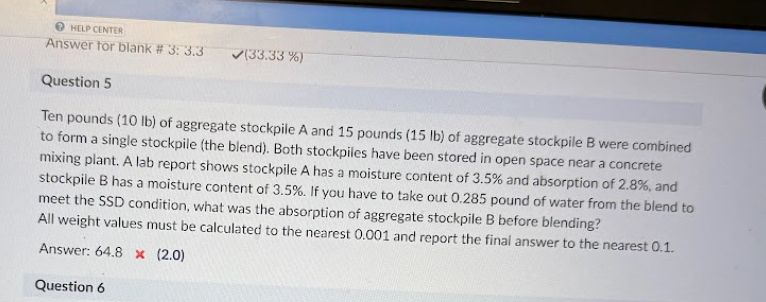
Portland Cement Concrete was mixed with the following ingredients:
Cement: 20.7 kg
Fine aggregate (sand): 39.2 kg – Moisture Content (MC) of 3.3% and Absorption (Abs) of 4.7%
Coarse aggregate: 60.9 kg – MC of 3.6% and Abs of 4.5%
Water: 14.6 kg
What is the water-to-cement ratio (W/C) of this PCC mix for the SSD conditions of aggregates (All the weight quantities must be calculated to the accuracy of 0.001 and report your value to the nearest 0.01)?
0.65
Recommend the maximum slump in inch allowable for concrete pavements.
3
Choose the concrete mix design case that requires the highest required compressive strength of concrete when the specified compressive strength is 4500 psi:
Case 1: The number of samples (N) tested for standard deviation (s) is 15; s = 520 psi
Case 2: The s is unknown; N is 5
Case 3: N = 35; s = 250 psi
Case 2
Which of the following design methods can be considered as the most accurate one for Portland cement concrete (PCC)?
Simple Volume Method |
Absolute Volume Method (a.k.a. the ACI design) |
Simple Weight Method |
Superpave Method |
Absolute Volume Method (a.k.a. the ACI design)
Select all required ingredients of Portland cement concrete.
Portland cement (PC) |
Water |
Coarse aggregates |
Fine aggregates |
All of the above
If the specified concrete strength (Fc') is 31 Mpa, determine the required average compressive strength for a plant with extensive history of producing (with many samples more than 30) concrete with s (standard deviation) of 3.8 Mpa.
Step-by-Step Calculation
First ACI 318M equation:
fcr′=fc′+1.34ss
fcr′=31+1.34(3.8)=31+5.092=36.09 MPa
Second ACI 318M equation:
fcr′=fc′+2.33ss−3.5
fcr′=31+2.33(3.8)−3.5=31+8.854−3.5=36.35 MPa
Select the governing (larger) value:
max(36.09 MPa, 36.35 MPa)=36.35 MPa
TRUE / FALSE
1.Hydration of C3S & C2S produces C-S-H (calcium-silicate-hydrate) which makes cement paste strong.
2.Under the normal design conditions (i.e., no amount changes in water and cement), air entrainer can increase strength by 20% and reduce the internal stress building up in Portland cement concrete subjected to freezing.
3.During hydration, there is a fierce competition between aluminates and silicates for water. Aluminates react with water faster then silicates do.
4.When water is added to PC (Portland cement), the main compounds in the cement undergo hydration, where C2S (Dicalcium Silicate) reacts with water faster than C3A (Tricalcium Aluminate).
Cement quantities are recommended to be specified and measured by volume.
By changing the proportions of major compounds of cement, we can produce different types of cement.
Water reducers can increase the workability of Portland cement mixes without compromising the strength of the hardened concrete.
Entrained air can be produced and controlled by admixtures (say, air entrainer) and can increase the durability of the Portland cement concrete.
Seawater can cause the loss of ultimate strength of concrete and is not recommended for steel reinforced concrete.
The finer the cement particles, the faster the strength gain in Portland cement concrete.
Capillary voids in cement can be caused by high w/c (water to cement ratio) and may induce a decreased strength.
If fresh water isn't available, we may allow some impurities as long as a reasonable concrete mix is obtained.
1.T
F
T
F
F
T
T
T
T
T
T
T