Biophysics minimal - 1st SCT
 Call Kai
 Learn
Learn Practice Test
 Spaced Repetition
 Match
Match Flashcards
 Knowt Play
1/16

There's no tags or description
Looks like no tags are added yet.
Name | Mastery | Learn | Test | Matching | Spaced | Call with Kai | Chat |
|---|
No analytics yet
Send a link to your students to track their progress
17 Terms
Define kinetic energy in words and with a formula, and give its unit.

Define electron volt (eV)
Electron volt is a unit of energy. It is equivalent to the amount of kinetic energy gained by a single electron when accelerated through a voltage difference of 1 V.
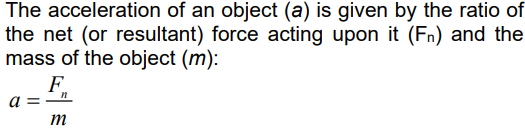
Define acceleration in words and with a formula.

Define Newton’s 2nd law in words and with a formula.
Define centripetal acceleration in words and with a formula

Define momentum in words and with a formula.

Define angular momentum!
Angular momentum is analogous to momentum, it serves the same purpose in circular motion as momentum does in linear motion. By definition, the product of the angular velocity and the moment of inertia of an object is its angular momentum.
Define the potential energy of an object in a homogenous gravitational field!

Define the potential energy of a charged object in an electrostatic field.

Define work in words and with a formula.

Define buoyant force in words and with a formula.

Define voltage and its unit of measurement.

State Ohm’s law verbally and in equation form

Give the energy and momentum of a photon with frequency f.

Align in ascending order the following components of the electromagnetic spectrum according to their energy: microwaves, gamma, ultraviolet, visible light, X-ray, infrared, radiowaves.
radiowaves < microwaves < infrared < visible light < ultraviolet < X-ray, gamma
State the definition of visible light and specify its wavelength range
The range of electromagnetic radiation observable by the human eye (approximately 400-750 nm).
Define the limiting frequency (fmax) of braking radiation at an accelerating voltage of U.
