Ecology: Climate, Populations, Communities & Ecosystems Exam Review 1
 Call Kai
 Learn
 Practice Test
 Spaced Repetition
 Match
 Flashcards
 Knowt Play
1/49

There's no tags or description
Looks like no tags are added yet.
50 Terms
How would the seasons most likely change if Earth’s axial tilt increased to 35 degrees instead of the usual 23.5 degrees?
Winters and summers would be more extreme.
Which of the following best exemplifies a study focused on microclimates?
exploring how variations in sunlight intensity influence plant distribution in the boundary between a forest and a meadow
If Earth’s rotation slowed from 24 to 48 hours per cycle, what would most likely happen to the climate in temperate regions?
Nighttime temperatures would drop significantly lower, while daytime highs would increase.
In mountainous regions of western North America, how would the environmental conditions of north-facing slopes most likely compare to those of south-facing slopes?
They would have plant and animal communities resembling those at higher elevations on south-facing slopes.
Deserts are typically found in regions where air masses are?
sinking toward the surface, creating dry conditions
What primarily drives global air circulation and precipitation patterns?
Solar heating causes moist air near the equator to rise, cool, and release precipitation before moving toward higher latitudes and descending as dry air.
Which of the following best describes a key characteristic of hot deserts?
Water availability is low, limiting plant abundance.
How do changes in biological communities with increasing elevation most closely compare to other natural transitions?
variations in ecosystems across different latitude

East of the Mississippi River in Hopkinsville, Kentucky, the mean annual precipitation is 130cm. The mean annual temperature is 14.3°C. In the winter, the mean temperature is 7.3°C, while in summer it is 20.6°C. Using the climograph shown here, the biome found in Hopkinsville is most likely a:
temperate broadleaf forest
Which of the following biomes has the lowest number of vertical strata?
tundra
Which aquatic biome listed here is one of the most productive on Earth, and why?
coral reef, diversity of organisms
Which of the following is responsible for the differences in summer and winter temperature stratification of deep temperate zone lakes?
Water is most dense at 4°C.
Which factor has the greatest influence on the types of organisms found in aquatic biomes?
levels of oxygen, nutrients, and salinity in the water

Data are from Strijbosch and Creemers, 1988.
The data in the table are most consistent with which of the following claims about the population of the Eurasian lizard, Lacerta vivipara?
the population is increasing
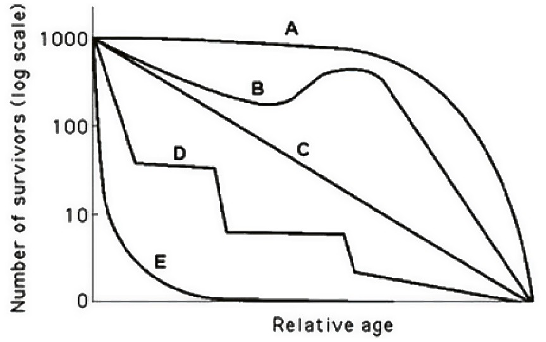
Which of the following curves best describes survivorship in a typical elephant population?
A
An ecologist conducting field research documented variations in the number of Cervus canadensis, elk per square kilometer across two distinct woodlots, revealing densities of 0.5 elk/km² in one area and 2.5 elk/km² in another. Based on these observations, which ecological question would be best addressed using these data?
What factors contribute to differences in population density between ecologically similar habitats?
In 2025, the United States Census Bureau reported the various components of population change as estimated below.
One birth every 9 seconds
One death every 9.4 seconds
One international migrant (net of immigrants versus emigrants) every 23 seconds
Net gain of one person every 21 seconds
Use the information to estimate the population change, if considering only the birth and death rates alone, in 2025.
+149,106 people
An undergraduate student is working in a research lab, and starting with a single bacterium, she cultures it in a flask of ideal nutrient broth at an optimum temperature over a two-hour period? Assume resources do not become limiting over this time frame.
The exponential model describes population growth in an idealized, unlimited environment
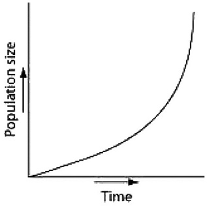
A marine biologist studying a population of loggerhead sea turtles (Caretta caretta) in a protected coastal habitat observes fluctuations in population size over several decades. Considering the concept of carrying capacity (K) in ecological systems, which statement best describes how K operates in this population?
K fluctuates over time and differs between populations due to environmental variability and resource availability

Based on the data graphed here, which size clutch would likely result in the highest estimated overall reproductive success (fecundity) after one year?
3
Two breeding female fish of the same species successfully reproduce, and one female lays 100 eggs, while the other female lays 1,000 eggs. Which one of the following outcomes is most likely, given the limits of fitness trade-offs?
The female laying 100 eggs lives longer than the female laying 1,000 eggs.

In the figure, one could depict a different scenario where the death rate per capita was dependent upon (and positively correlated with) the density of the population, and the birth rate was instead density independent. Which of the following would occur as the density of the population increased?
the death rate would increase and the birth rate would remain stable
A population of white-footed mice (Peromyscus leucopus) becomes severely overpopulated in a habitat that has been disturbed by human activity. Sometimes intrinsic factors cause the population to increase in mortality and cause lower reproduction rates to occur in reaction to the stress of overpopulation. Which of the following is an example of intrinsic population control?
Clumped dispersion of the population leads to increased spread of disease and parasites, resulting in a population crash.
Which of the following statements about human populations in industrialized countries is correct?
A) Life history is r-selected.
B) The population has undergone demographic transition and age distribution is relatively uniform.
C) Life history is r-selected, the population has undergone the demographic transition, and age distribution is relatively uniform.
D) The survivorship curve is a Type III
B) The population has undergone demographic transition and age distribution is relatively uniform.
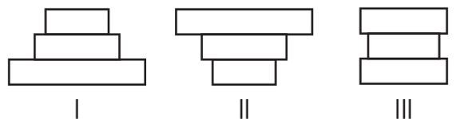
In the figure, populations of a plant species labeled I, II, and III are depicted using simplified age structures containing three age classes: young seedlings, middle-aged juveniles, and older adults. Which populations appear to have stable growth?
III

Based on the oil consumption data shown in the figure, which of the following conclusions best explains the variation in per capita oil use among different countries?
Countries with higher per capita oil consumption tend to have higher industrialization and reliance on private transportation.

Based on the experimental results shown in the figure, an ecologist studying Chthamalus stellatus and Balanus balanoides observes that when Balanus is removed, Chthamalus expands into the previously occupied zone. What does this indicate about the relationship between the fundamental and realized niches of these species?
Chthamalus has a fundamental niche larger than its realized niche, indicating that competition restricts its natural distribution.
A researcher studying two closely related finch species in the Caribbean, the Cuban bullfinch (Melopyrrha nigra) and the Greater Antillean bullfinch (Loxigilla violacea), observes that on separate islands, both species feed on medium-sized seeds using similarly sized beaks. However, on islands where their ranges overlap, the Cuban bullfinch evolves a smaller beak to specialize in small seeds, while the Greater Antillean bullfinch develops a larger, stronger beak to crack hard, large seeds. When the researcher raises lab-reared offspring from both species in isolation, their beak sizes remain intermediate, regardless of their island origin.
Based on these findings, which ecological process is most likely responsible for the observed shift in beak size where the species coexist?
character displacement, where evolutionary changes in physical traits reduce direct competition between similar species
Using the symbols +, −, and 0 to indicate interspecific species interactions, where the first symbol refers to the first organism mentioned, which interactions of the following would exist between a lion pride and African wild dogs, if the dogs are the lions’ prey and are found to typically avoid areas with lions?
+/−
Which of the following is an example of a commensalism?
cattle egrets eating insects stirred up by grazing bison

Which of the following is the best conclusion about the effect of a keystone species, based on the graphed data?
Removing a keystone species from the community drastically reduces species richness.
If there are 25 African elephants (primary consumer) living together in a given area, with an average weight of 4,000 kg each, approximately how much biomass of plant material would hypothetically be necessary as a harvestable food supply to support all of them on an ongoing basis? (Assume a 10% efficiency in energy transfer.)
1,000,000 kg
When certain species are introduced into new environments, they sometimes proliferate rapidly and outcompete native species, even though they do not dominate their original habitats. Which of the following provides the most scientifically supported explanation for this phenomenon?
Introduced species often escape natural predators, pathogens, or competitors that kept their populations in check in their native habitat.

The figure proposes a combination of a top-down and bottom-up model (a hypothesis) to describe the variable effects of biological control herbivores on the fitness of an invasive plant, spotted knapweed (Centaurea stoebe). Researchers transported and released several insect species from the plant’s native range in Europe in an attempt to reduce densities of this non-native weed in the United States. The y-axis shows C. stoebe plant fitness, and the x-axis represents the intensity of herbivory by the insects, from low to high. As the vertical shaded bar is moved along the x-axis, the ultimate effect of herbivory (now A, B, and C) and on plant fitness can change based on its intensity and the other factors. The horizontal dashed line represents no predicted change in fitness under the effects of varying intensity of herbivory, plant competition, and soil resources available to the plant (such as nitrogen or water), while the three solid lines represent other possible outcomes.
What portion of the model would be characterized as a bottom-up control?
the amount of resources available to the plant
In a particular case of secondary succession, three species of wild grass all invaded a field. By the second season, a single species dominated the field and the other two species had a lower relative abundance. A possible factor contributing to the abundances of these species in this example of secondary succession is:
inhibition
According to the island equilibrium model, species richness would be lowest on an island with which of the following characteristics?
small and remote
In recent years, two pathogens have exhibited notable differences in their rates of geographic spread:
Phytophthora ramorum, the causative agent of sudden oak death, has dispersed approximately 800 kilometers over a span of 15 years. Highly Pathogenic Avian Influenza (H5N1) has rapidly expanded since 2022, infecting poultry and wild bird populations across multiple continents within a few years. This has resulted in the mass culling of large numbers of poultry to prevent further spread, and egg shortages in the United States and elsewhere.
Which factor most plausibly accounts for the more rapid dissemination of H5N1 compared to Phytophthora ramorum?
the mobility patterns of their primary hosts, influencing the potential for widespread transmission
In a grassland ecosystem, various factors regulate species interactions and population dynamics. Which of the following best represents a top-down control, where higher trophic levels influence lower trophic levels in the community?
the regulation of plant diversity due to varying levels of grazing pressure from herbivores such as antelope
Which of the following best explains why food chains are sometimes short?
the transfer of energy from one trophic level to the next higher level is inefficient
A group of students walking through a coastal rainforest in Vietnam observe a large, beautiful tree towering above. The tree is full of orchids, mosses, birds, insects, arachnids, and millions of bacteria, all interacting with the abiotic environment, including the air, soil, and water of the forest. Which of the following terms best describes this in the entirety of what they are observing?
an ecosystem
A team of researchers was analyzing the movement of energy from its initial source through various trophic levels, in a forest ecosystem. They observe that while essential nutrients cycle or transfer repeatedly within the system, energy behaves differently. Why is a continuous supply of solar energy required to sustain life on Earth?
Energy from the sun flows through ecosystems, transferring from one organism to another but ultimately dissipates as heat, preventing its reuse.
A group of ecologists is studying energy transfer in a coastal wetland ecosystem of Alabama. They analyze how solar radiation is captured by plants, transferred through trophic levels, and eventually released. After repeated measurements, they conclude that energy follows predictable patterns within the system. Which of the following statements best describes the principles governing energy flow in this ecosystem?
The amount of energy stored in plant biomass equals the total solar energy absorbed minus the portions reflected and lost as heat.

The blue arrow exiting the left side of the “Primary consumers” box could best be described as which of the following examples of nutrient transfer?
feces excreted by the primary consumer
Which of the following best explains why an ecosystem that exhibits very low net primary production [NPP, measured as J/(m²× year)] could still represent one of the ecosystems that contributes the most to global net primary production?
Ecosystems with very low NPP may cover vast areas of the Earth’s surface.

After looking at the evidence from the experiment in the figure, which of the following is the most accurate conclusion about productivity in marine ecosystems?
Iron availability limits productivity.
Which one of the following correctly ranks these organisms in order from lowest to highest percent in production efficiency?
mammals, fish, insects
Which of the following is a reason that inefficient transfer of energy among trophic levels results in the typically high endangerment status of many top-level predators?
Top-level predators often have small populations that are sparsely distributed.
For most terrestrial ecosystems, pyramids composed of species abundances, biomass, and energy are similar in that they have a broad base and a narrow top. The primary reason for this pattern is that:
at each step, energy is lost from the system
As part of the carbon cycle, which of the following reservoirs of carbon is the largest?
the ocean
Which of the following is an example of biological augmentation?
adding nitrogen-fixing microorganisms to a degraded ecosystem to increase nitrogen availability