8.ESS.2 - Plate Tectonics
 Call Kai
 Learn
 Practice Test
 Spaced Repetition
 Match
 Flashcards
1/17

There's no tags or description
Looks like no tags are added yet.
18 Terms
Plate tectonics
The geological theory stating that Earth's lithosphere is divided into large sections that move slowly over the asthenosphere.

Volcano
An opening in Earth's crust through which molten rock, gases, and ash erupt onto the surface.

Magma
Molten or semi-molten rock material located beneath Earth's surface.
Lava
Molten rock that has reached and flows upon Earth's surface.
Continental drift
The hypothesis proposing that Earth's landmasses were once joined together and have gradually moved apart over geological time.
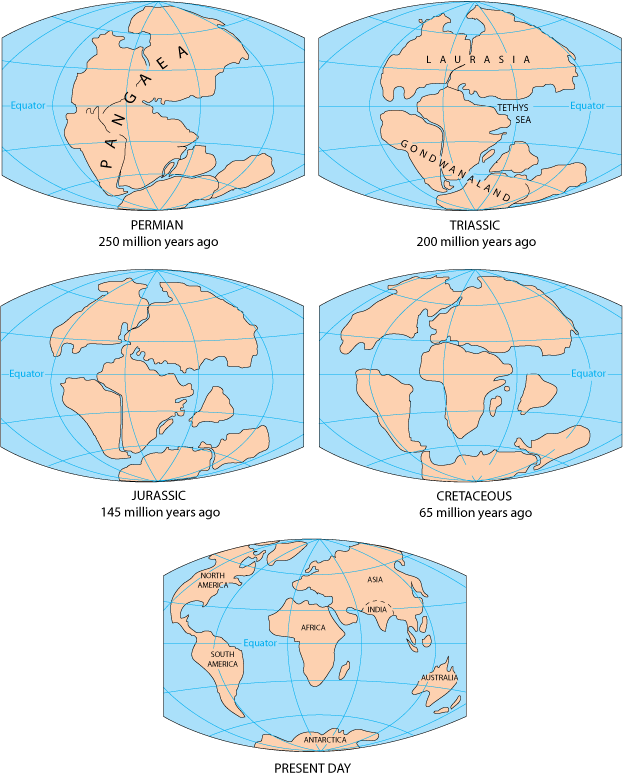
Pangea
The ancient supercontinent that existed during the late Paleozoic and early Mesozoic eras before breaking apart into modern continents.

Seafloor spreading
The process by which new oceanic crust forms at mid-ocean ridges as tectonic plates pull apart and magma rises to cool.

Mid-ocean ridge
An underwater mountain range formed where tectonic plates diverge and new oceanic crust is created.

Deep-ocean trench
A steep, narrow depression in the ocean floor formed where one tectonic plate is forced beneath another.

Subduction
The process where a denser tectonic plate slides beneath a less dense plate into the mantle at a convergent boundary.

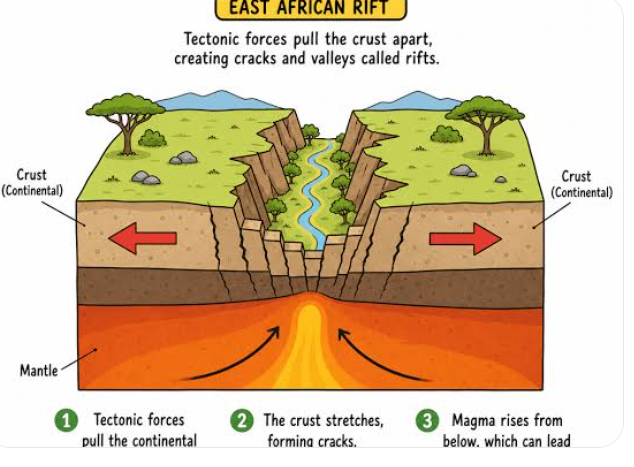
Divergent boundary
A tectonic region where two plates move away from each other, allowing magma to rise and form new crust.

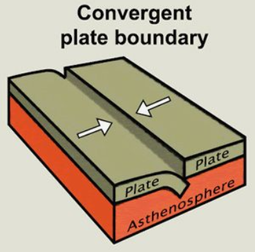
Convergent boundary
A tectonic region where two plates collide or move toward each other, resulting in mountain building or subduction.
Transform boundary
A tectonic region where two plates slide horizontally past one another, creating frequent seismic activity.

Fault
A fracture or zone of fractures in Earth's crust along which significant movement of rock masses has occurred.

Rift valley
A deep, linear lowland formed between parallel faults when Earth's crust stretches and diverges on land.
Volcanic arc islands
A curved chain of volcanic islands formed above a subduction zone where two oceanic plates collide.

Hot spot
An area where magma from deep within the mantle melts through the crust above it, forming volcanoes independently of plate boundaries.

Ring of Fire
A major region surrounding the Pacific Ocean characterized by frequent seismic activity and a high concentration of active volcanoes along tectonic plate boundaries.
