1: Consumer and Producer Theory + Applications
 Call Kai
 Learn
 Practice Test
 Spaced Repetition
 Match
 Flashcards
 Knowt Play
1/11

There's no tags or description
Looks like no tags are added yet.
12 Terms
d
d
CONSUMER THEORY
CONSUMER THEORY
What is rational consumer behaviour?
Rational behaviour = foundational idea that individuals (consumers) seek to maximise their overall utility from consumption choices
Choose their most preferred bundle of goods, from a set of available alternatives, that provides the greatest benefit
How are axioms and rational behaviour linked?
Axioms = assumptions (benchmark for consumer preferences)
Rational/Irrational behaviour = theoretical result

What are the 6 different axioms of consumer preferences?
Completeness
Reflexivity (consistency)
Transitivity
Monotonicity (well-behaved preference)
Convexity (well-behaved preference)
Continuity
Describe:
1 - Completeness
Foundational assumption - states that a rational consumer can always state a definitive preference ordering/ranking between any 2 distinct consumption bundles
E.g. comparing and ranking Bundle A and Bundle B, i.e. A > B
Strict or weak preferences permitted
Indecision NOT permitted

Describe:
2 - Reflexivity
Consistency - any bundle is always at least as good as itself
"If you gave me exactly the same shopping basket twice, I cannot say that one basket is better than the other"
Ability to recognise identical bundles & have stable preferences over identical bundles - a consumer must always consider a bundle to be at least as good as an identical bundle
Consumer shouldn’t confuse the outcome of choosing a bundle with the utility they get from their choice

Describe & state the violations for:
3 - Transitivity
Consumers are consistent in their preferences, e.g. if A > B and B > C then A > C
Crossing indifference curves = violating transitivity:
Ensuring indifference curves don’t intersect as if it did, it would NOT reflect a consistent ranking of preferences
Then would create a logical contradiction where the same bundle of goods would simultaneously belong to two different utility levels
Condorcet paradox:
When combining a group preference, though each individual preference may be transitive, the overall group preference may not be
As individually everyone has different preferences, when combined, group preferences can become circular, e.g. the group prefers A over B, B over C, but also C over A
Results in cyclical aggregate preferences/endless loop - no one group is ‘the best’
Describe:
4 - Monotonicity (non-satiation)
MORE IS BETTER
If one bundle of goods contains strictly more of everything than another bundle, the consumer will always prefer the larger bundle
E.g. if Bundle A = 1 biscuit & coke, Bundle B = 2 biscuits & coke > they would prefer Bundle B
PREFER HIGHER INDIFFERENCE CURVES > higher bundles
The further away from the origin, the higher the utility
Describe:
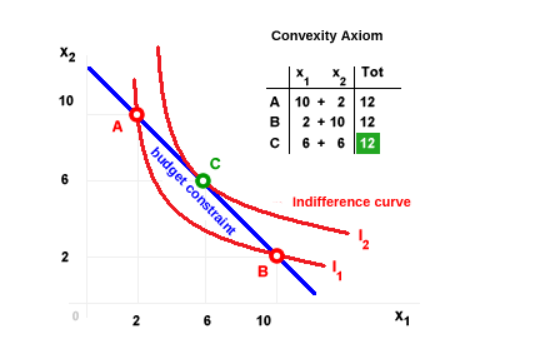
5 - Convexity
Mixed > extremes
If a consumer is indifferent between two distinct bundles of goods A and B, they will strictly prefer a balanced combination (a weighted average) of A and B (bundle C) which combines the 2, over either extreme bundle, as it yields a higher overall utility
The principle of diminishing marginal utility is used to explain convex preferences, as the additional satisfaction gained from consuming more of the same good declines as its quantity increases meaning consumers gain greater satisfaction from diversifying their consumption across different goods rather than consuming increasingly large quantities of just one good
Diminishing marginal utility helps explain why preferences may be convex; convexity is the actual assumption economists make about how consumers rank bundles
Graphical intuition:
Drawing a straight line connecting any two points on an indifference curve, all points on that line (representing mixed or averaged bundles) will lie on or above a higher/equal indifference curve
Describe & state the violation for:
6 - Continuity
Indifferent sets are continuous - continuity allows us to move smoothly along an indifference curve
Small changes in consumption bundles = small changes in preferences > no sudden jumps in consumer preferences
Continuity allows us to analyse marginal changes (how willing a consumer is to give up one good in order to gain another = MRS) which measures the trade off between goods
No continuity = no MRS
VIOLATION = discrete goods that aren’t indivisible (broken down):
Discrete goods can only be consumed in whole units not continuous quantities, e.g. cars - only have a unit (can’t have 0.5 units of a car)
However, many discrete units of goods can be approximated well with continuity in practice, e.g. burger (though buy 1 unit, can eat half a burger)
Describe an indifference curve
Everything along an indifference curve (e.g. I1) is equally preferred to x > statement of indifference
Everything above I1 represents increased amounts of x1 and x2 so is weakly preferred to x > statement of preference