Tectonics and volcanism quiz study
 Call Kai
 Learn
Learn Practice Test
 Spaced Repetition
 Match
Match Flashcards
 Knowt Play
1/27

There's no tags or description
Looks like no tags are added yet.
Name | Mastery | Learn | Test | Matching | Spaced | Call with Kai | Chat |
|---|
No analytics yet
Send a link to your students to track their progress
28 Terms
Two major controls on landformation
Endogenic (occurs inside the earth)
Exogenic (occurs on the surface of earth)
Whats a rock
Assemblage of minerals
Whats a mineral
Naturally occuring inorganic substance (building blocks)
Two types of silicate minerals
Alumino-silicate minerals and Ferro-magnesian minerals
Characteristics of Alumino-silicate minerals
High in aluminum (Al)
Labelled Felsic
light colour
light weight
Characteristics of Ferro-magnesian minerals
Rich in magnesium (Mg) and iron (Fe)
Labelled Mafic
Dark colour
Heavy weight
Three types of rocks
Igneous rocks
Sedimentary rocks
Metamorphic rocks
Formation of Igneous rocks
Formed through cooling and solidification of molton rock
Igneous rock classification
Extrusive igneous rock (rapid cooling on surface creating small crystals)
Intrusive igneous rock (slow cooling below surface creating large crystals)
In water (very fast cooling creating no crystals)
Formation of sedimentary rocks
Formed through accumulation of sediment or deposits produced by weathering
Sedimentary rocks classification
Clastic sedimentary rocks (formed through sediment accumulation)
Chemically precipitated rocks (formed through dissolved liquids)
Organically derived rocks (formed from organic dead material)
Formation of metamorphic rocks
Formed through alteration under high temperatures and high pressure
Classification of metamorphic rocks
Degree of alteration, either Low, Medium or High
What is lithification
the compaction, recrystalization or cementation of sediments creating clastic sedimentary rocks
“rock cycle”

main parts of earths structure
Crust
Mantle
Core
what is the crust
Outermost solid shell
what is the mantle
rock layer under crust
what is the Moho
Boundary between crust and mantle
what is the lithosphere
brittle outer shell of earth (crust plus upper mantle)
what are divergent or spreading boundaries
Oceanic plates undergo seperation casuing formation of new lithosphere
what are converging boundaries
between two colliding plates (lithosphere is consumed)
Continental + Oceanic = Subduction zone
Oceanic + Oceanic = Island arc
Continental + Continental = Surture zone
What are transform boundaries (faults)
Two lithosphere plates move past each other
What are fold belts
formed from compression of flat sedimentary strata by continental collision
Creates Anticlines (ridges) and Synclines (valleys)
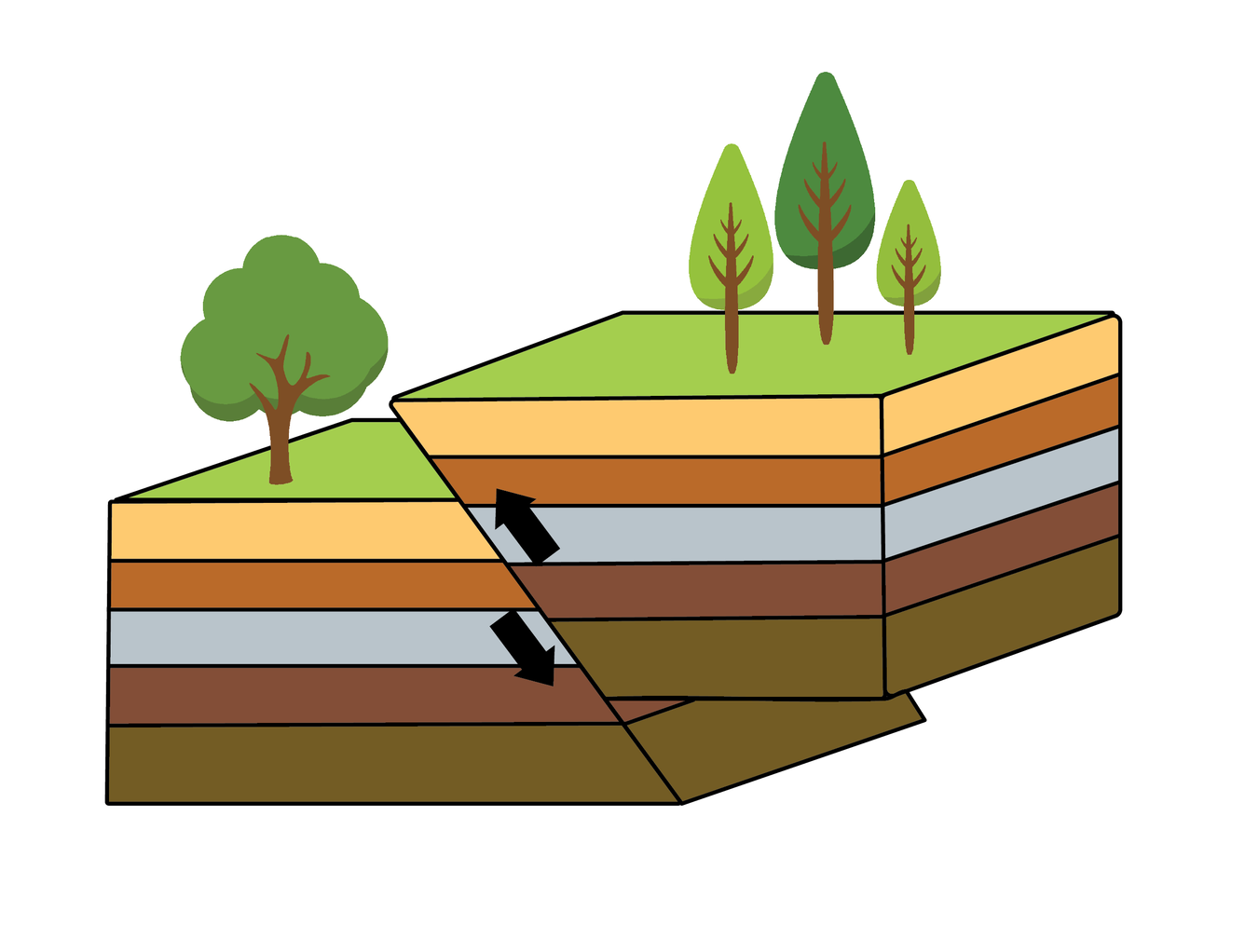
What are normal faults
Vertical movement of crustal blocks along a steep fault plane

What are reverse faults
One crustal block riding up over another
Produces overhaning scarps
What are overthrust faults
One crustal block riding over another at a low angle
low angle reverse fault

what are transform faults
horizontal movement of crustal blocks on a vertical fault plane
