Groups 1 Slides, Normative influence slides, Chapter 12 reading
 Call Kai
 Learn
 Practice Test
 Spaced Repetition
 Match
 Flashcards
 Knowt Play
1/85

There's no tags or description
Looks like no tags are added yet.
86 Terms
What are groups?
“A collection of individuals who have relations
to one another that make them interdependent
to some significant degree”

Which one is and is not a group? People in a movie theater and a Star Wars Fan group.
Movie theater = not a group; Star Wars Fans = group. Fans in a movie theater watching premiere of new Star Wars movie: Group-adjacent?
Groups Vary in ____. Individuals belong to many, ___________ groups of varying
importance. Ex:
Size; overlapping; Ex: Some may identify as a student at OWU, but also a Delaware native, but also an Ohioan, but also a part of the United States.
Tuckman’s (1965) Model of Group Formation:
• Forming – the group comes together
establishes roles and sets its sight on the task
• Storming – the group experiences (even
minor) conflict as it begins to work as a unit
• Norming – the group forms norms and
established patterns for working together
• Performing – Group roles become more
flexible as group excels at task
• Adjourning – The group dissipates
Groups enable social facilitation –
the presence of others helps us perform well
The presence of other helps on ____-_________
tasks, but hinders on _________ or novel tasks.
well-rehearsed; difficult
Dominant Response –
the thing we are most
likely to do in any situation
The presence of others causes arousal which
leads us towards the _________ response
dominant
Fill in the chart about mere presence

Evidence of Mere Exposure in Non - Humans example:
Had a cockroach go through either easy or hard mazes and had other cockroaches watch them and when they did the maze without anyone watching them, they got through it faster than when the cockroaches were watching them.
Social Loafing:
People exert less effort when in a group and
when their individual behavior cannot be
observed
Groupthink:
A process wherein a cohesive group fails to engage in careful scrutiny in order to reach a consensus quickly.
6 Antecedents to Groupthink are:
• High cohesiveness: Not going to speak up in high intense situations.
• Insulation of the group: Locked away.
• Lack of procedure for information search and appraisal: Not a lot of time.
• Directive leadership: Do now and will be good if you tell them what they want to hear.
• High stress with external threats: Adds to pressure.
• Recent failures: Adds to pressure.
Consensus seeking:
Pressured to come to an answer and likely will make a bad decision.
7 Symptoms of Groupthink:
• Illusion of invulnerability: Thinking you can’t fail.
• Collective rationalization: Justifying behaviors/warning signs (Ex: “During the space launch, this would be like if they said, the fuel won’t leak and make the rocket explode.”)
• Belief in morality of group: Thinking your group is anointed so much you can’t make mistakes you’ll make them.
• Stereotype of outgroups: Someone disagrees and this leads to the next step.
• Direct pressure on dissenters: Saying not to speak unless you agree.
• Self - censorship: If you disagree but say nothing.
• Illusion of unanimity: You don’t speak up/ say “oh we all agree” when really maybe most people were also self-silencing themselves.
7 Symptoms of Defective Decision Making:
• Incomplete examination of objectives
• Incomplete survey of alternatives
• Poor information search
• Failure to examine risks of preferred choice
• Selective bias in processing information at hand
• Failure to reappraise alternatives
• Failure to work out contingency plans
Kitty Genovese
attacked and killed near her apartment building in 1964
Neighbors could hear the attack, but help did not arrive until it was too late to save he
Diffusion of Responsibility:
A reduction in the urgency to help someone under a belief that the situation is not serious or that someone else will step up.
Notes on Kitty Genovese:
1. ____ neighbors did try to help
2. Number of neighbors who could have seen the
attack was ___________ in papers.
Many;
exaggerated
Diffusion of responsibility reduces the likelihood of:
bystander intervention (are you going to step up in a situation?)
Darley and Latane experiment:
One condition: Two people on the phone and one is a confederate and one is a participant. At some point one is going to yell help and in the case with two people 85% helped.
Another condition: Three people on the one, one is participant and two are confederates. At some point one is going to yell help and 62% helped this time which shows that the presence of others initiates us to feel like we have no obligation to help or that someone else will.
We are so _________ to the actions of others. In other words, people around us have a huge effect on our behavior.
susceptible
We help people less
when around ______/
have no obligation to
help
others
We might not help because we don’t feel “__ ___ ____” to do so. In a group, you can feel “____” in a crowd
on
the spot; lost
Summary:
• People form ______ easily
• The presence of others helps us ________ tasks
• As groups form they can create _________
patterns for resolving problems
• These problems include groupthink and have
been responsible for major (preventable)
__________
• Groups can also prevent us from stepping up
to ____ others.
groups
complete
unhealthy
catastrophes
help
People enjoy feeling “__ - ____” to others around
them
“in-sync”
3 Parts of Social Influence
• Obedience – The submission to a more
powerful person
• Compliance – Adhering to the wishes of
another person (regardless of their power)
• Conformity – Matching behavior to others due
to real or perceived pressure
According to the Milgram study, anyone can:
obey a horrible order
In the Miligram study, most people:
objected, but were pressured to
continue – ineffective disobedience
In the Milligram study, people did not start with supposedly lethal shocks:
they were brought there slowly
In the Miligram study Participants were made to not feel ___________
for their behavior
responsible
In the Miligram study Participant has a public choice –
resist the
authority and benefits of science, or follow
request of victim
Relationships between ______, gradual _________, etc also affects obedience.
others; obedience.
Reactance states that people do not like:
being told what to do.
It is easier to resist authority if you have
_________ doing so and if you have _____ and _______.
practiced doing so; allies; friends.
In the Asch Conformity Study 7 guys were shown the same line and asked to determine which line matched that one and it was obviously “B” but the confederates all said “A” which resulted in the person who didn’t know they were all in on it to:
also say “A” because that is what everyone else said.
Asch conformity:
People knowingly and willingly said what they
knew to be false because others did the same
If even one other person stated the truth, they
were far more likely to _______ from the group and this is early experimental evidence of ________ ____________ _________.
deviate; normative social influence.
Social Norms are:
societally held expectations
for the behavior of individuals
“Expectations” has multiple components:
descriptive and injunctive
Descriptive norms are:
Ex:
What people do / What is the
common behavior?
Ex: “I expect this to happen because it’s really common.”
Injunctive Norms are:
Ex:
The approved behavior of a group / “Norms of ought” / Expectation in the sense of your social obligations
Ex: “I expect you to behave/You better behave".”
We ______ our behavior to adhere to norms. We will follow whichever norm is more _______ in that moment
adjust; salient.
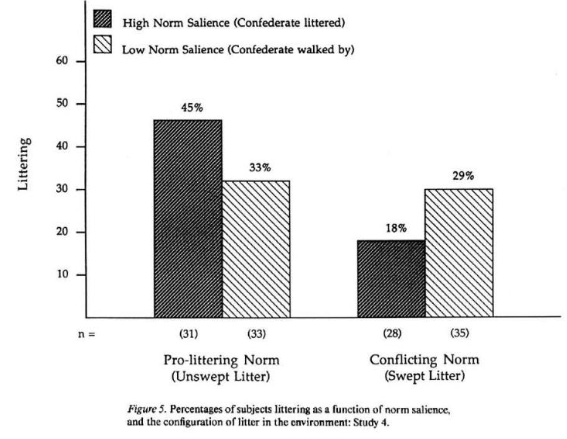
Effect of descriptive norms ex:
More people litter in an
environment that is already
littered.

Effect of injunctive norms ex:
More people litter in an
environment that signals
others do not care about
littering
Norms can be communicated through _____
messages
short
In norms messages short messages can
remind people of the desired behavior.

Social Norms Messages ___________ norms
communicate

Here is an
example of a
_________
norms message
descriptive
Norms are dynamic. Dynamic norms can be very effective at _________ _________.
changing behavior.

There is a debate as to whether _____ norms are truly “norms”.
moral
Social norms are enforced by ______ _________.
Include both ______ and ___ - ______ responses
to violations of social norms
social sanctions (Gossiping).
verbal; non - verbal
Who will sanction?:
• Those who are affected by the norm
transgression
• Extraverted individuals
• Those with a strong sense of responsibility
• Those in power
• Those who believe others can change their
behavior (think theory of planned behavior)
• Those in “tight cultures”
Tight culture:
Loose culture:
Neither is good or bad, just different ________ expectations for
behavior
Tight = strict norms with little room for deviation.
Loose = more permissive for deviating from norms.
cultural
However, Sanctioning can have a cost because people tend to _______ those who administer sanctions to others
dislike
_______ affect norms. Think of the example on the slide and describe it.
Leaders.

Pluralistic Ignorance:
A misperception between the perceived norm (our belief) and the actual norm (what is actually going on). Ex: We believe republicans don’t care as much as democrats about climate change but then it is proven that they both kind of care at the equal amount.
Mini- Summary
• People are highly motivated to ______ to
others
• People like being part of groups and will match
their behavior to their ____.
• People will administer sanctions to enforce
_____.
connect;
peers;
norms.
However, people have a desire for _______________.
distinctiveness
Optimal Distinctiveness Theory:
People want to maintain a balance between fitting in and standing out from a group
Foot in the Door :
Door in the Face :
Foot: commitment to consistency
Door: Norm of reciprocity
Everyone can influence norms, but influence occurs in ________. So in other words, everyone can influence norms but it is not always _____ (give example).
networks; equal; Ex: When the teacher tells everyone to raise their hand we do but if I were to just raise my hand to ask a question my peers probably aren’t going to follow this behavior.
Wrap- up
• Social Norms have a powerful effect on
________.
• They are critical to the formation of ______.
• Everything we do from here on out (and much
of what we have done) is affected by ______
_____.
behavior.
groups.
social norms.
Which of the following is necessary for a collection of individuals to be considered a group?
A. Any number of individuals greater than 10
B. The presence of a leader
C. Interdependence between the individuals
D. Individuals all in the same location
C. Interdependence between the individuals
Which of the following is correct about groups?
A. Living in groups can help ensure the reproduction of our genes.
B. Group living does not provide any evolutionary benefits to humans.
C. Only humans have the capacity to form and live in groups.
D. The advantages to group living are purely physical, not psychological.
A. Living in groups can help ensure the reproduction of our genes.
Which of the following correctly describes the elements of Zajonc’s theory of mere presence?
A. The mere presence of others can either facilitate or hinder performance.
B. The mere presence of others increases arousal for difficult tasks, while they decrease arousal for easy, simple tasks.
C. The mere presence of others increases arousal, which makes us less likely to make a dominant response.
D. The mere presence of others facilitates performance, but coacting with others hinders performance.
A. The mere presence of others can either facilitate or hinder performance.
Zadaesha recently started to learn Tae Kwon Do. After she successfully executed a spinning kick for the first time in her second class, she tried to demonstrate the kick in front of her siblings but failed. Based on Zajonc’s theory, which of the following best explains why Zadaesha was not able to perform the kick in front of her siblings?
A. Zadaesha needed an audience who would evaluate her kick objectively.
B. Zadaesha needed to attempt the kick alongside another person attempting the kick.
C. Zadaesha’s level of arousal was not high enough to perform the kick.
D. Zadaesha’s dominant response was to fail to execute the kick.
D. Zadaesha’s dominant response was to fail to execute the kick.
According to the evaluative apprehension hypothesis, which of the following correctly describes the effects of an evaluative versus a merely present audience?
A. An evaluative audience facilitates performance, while a merely present audience hinders performance.
B. An evaluative audience increases the likelihood of a dominant response, but a merely present audience does not.
C. An evaluative audience decreases arousal, while a merely present audience increases arousal.
D. An evaluative audience makes participants feel psychologically alone, while a merely present audience does not.
B. An evaluative audience increases the likelihood of a dominant response, but a merely present audience does not.
In one study (Markus, 1978), participants put on new lab clothes (novel task) while they waited for the experiment to begin, and then they changed back into their own clothes (well-learned task). Some participants completed these tasks while they were alone, some completed the tasks in the room with another person who had their back turned to them, and some completed the tasks in front of another person watching attentively. Which of the following hypotheses were tested with the condition with a person who had their back turned to the participant?
A. The evaluation apprehension hypothesis
B. The mere presence hypothesis
B. The mere presence hypothesis
Which of the following correctly describes social loafing?
A. Savitha devotes less time on the project when she is part of a group.
B. Weida, an Olympic athlete, attains her personal best record at the Olympics.
C. Xavier falls off his new bike when he sees several other kids watching him.
D. Dinh takes longer than usual to pack his backpack when he is alone.
A. Savitha devotes less time on the project when she is part of a group.
Which of the following conditions would most likely lead to groupthink?
A. Lack of a strong leader
B. Presence of a devil’s advocate
C. In-depth examination of information
D. High-stress situation
D. High-stress situation
Which of the following statements is true of groupthink?
A. Group members honestly share their opinions with the group.
B. Group members understand that each member may hold different opinions.
C. Group members consider themselves to be morally superior to other groups.
D. Group members acknowledge that they are vulnerable to making bad decisions.
C. Group members consider themselves to be morally superior to other groups.
Which of the following groups demonstrates group polarization?
A. Several socially liberal adults end up endorsing liberal attitudes more strongly after interacting in an online forum.
B. The leader of the senior prom committee doesn’t allow others to voice their true opinions about the prom venue.
C. A group of college students with differing opinions on which musician they should ask to perform at the spring concert tries to come to a consensus.
D. A parent-teacher community group votes for a leader who will make most of the decisions for the group.
A. Several socially liberal adults end up endorsing liberal attitudes more strongly after interacting in an online forum.
In one study, group members were exposed to everyone’s stances on an issue, but not the arguments underlying the reason for those stances. Results demonstrate that group polarization occurred even without group members understanding the reasoning behind people’s stances (Teger & Pruitt, 1967). Which of the interpretations for group polarization does this study support?
A. The persuasive arguments interpretation
B. The social comparison interpretation
C. The mere presence interpretation
D. The evaluation apprehension interpretation
B. The social comparison interpretation
Rae works as a part-time shift supervisor at the library while getting their degree. The process for students who wish to renew books is overly complicated, and the shift supervisors have collaborated on a plan to streamline it. They then put their names in a hat to decide who would present it to the head of the library. Rae’s name was selected. The head of the library and Rae meet to discuss the proposal.
Is Rae likely experiencing an inhibition or an approach response in this situation?
A. Approach
B. Inhibition
B. Inhibition
Rae works as a part-time shift supervisor at the library while getting their degree. The process for students who wish to renew books is overly complicated, and the shift supervisors have collaborated on a plan to streamline it. They then put their names in a hat to decide who would present it to the head of the library. Rae’s name was selected. The head of the library and Rae meet to discuss the proposal.
Based on the social power of the situation, which approach should Rae take to convince the head of the library to change the protocols?
A. Rae should frame the potential benefits of the new protocols to the school as a whole.
B. Rae should encourage the head of the library to consider how difficult the current process is for students.
A. Rae should frame the potential benefits of the new protocols to the school as a whole.
Kosta is a resident assistant (RA) in the same building as Janine, and the two are close friends. Though Janine is the head RA in the building, most of the students seek out Kosta in times of need, and he seems to have more sway with the program director.
Which of the two RAs would be more likely to act in a disinhibited way with the students?
A. Janine
B. Kosta
B. Kosta
Kosta is a resident assistant (RA) in the same building as Janine, and the two are close friends. Though Janine is the head RA in the building, most of the students seek out Kosta in times of need, and he seems to have more sway with the program director.
Which of the two RAs would be more likely to feel frustrated with work?
A. Janine
B. Kosta
A. Janine
Sakura, Claire, and Kim work at the local coffee shop. Sakura is the manager, and Claire and Kim are baristas. Over the last few weeks, both Sakura and Kim have become aware that Claire has been giving away free coffee to her friends.
Between Sakura and Kim, who is more likely to worry about being blamed if the coffee shop owner learns that an employee is giving away free coffee?
A. Sakura
B. Kim
B. Kim
Sakura, Claire, and Kim work at the local coffee shop. Sakura is the manager, and Claire and Kim are baristas. Over the last few weeks, both Sakura and Kim have become aware that Claire has been giving away free coffee to her friends.
Between Sakura and Kim, who would be most likely to confront Claire about giving away free coffee?
A. Sakura
B. Kim
A. Sakura
Which of the following is correct about power?
A. An individual’s level of power stays constant in every social context.
B. Power is specifically about influencing the outcomes of others, but not one’s own outcome.
C. Power is about one’s relative capacity to influence.
D. People rarely organize into social hierarchies based on power.
C. Power is about one’s relative capacity to influence.
Azra leads with kindness and care for her fellow group members. Which of the following best describes her approach to gaining power?
A. Machiavellianism
B. Justice
C. Psychopathy
D. Humanity
D. Humanity
Based on the approach/inhibition theory of power, which of the following describes someone with a high level of power?
A. A person who is less likely to stereotype another person
B. A person who fails to respond empathically to others
C. A person who underestimates the accuracy of their knowledge
D. A person who engages in increased ethical behavior
B. A person who fails to respond empathically to others
Which of the following correctly describes the state of deindividuation?
A. Heighted awareness of the self
B. Increased concern for evaluations of others
C. Decreased arousal
D. Reduced guilt and shame
D. Reduced guilt and shame
Pingwei is part of an excited crowd of trick or treaters on Halloween. Wearing a costume that includes a mask, Pingwei feels that he blends in with the crowd of trick-or-treaters and grabs a large handful of candy, rather than taking just one piece. Which of the following conditions of deindividuation does this best describe?
A. Anonymity
B. Diffusion of responsibility
C. Energizing effect of others
D. Stimulus overload
A. Anonymity
Deja is part of a crowd celebrating their college basketball team winning the national championship. The crowd starts to jeer and throw things at the opponent team, and Deja joins in the mayhem because she knows there are many people to share the blame. Which of the following conditions of deindividuation does this best describe?
A. Anonymity
B. Diffusion of responsibility
C. Energizing effect of others
D. Stimulus overload
B. Diffusion of responsibility