mammals 2
 Call Kai
 Learn
Learn Practice Test
 Spaced Repetition
 Match
Match Flashcards
 Knowt Play
1/353

There's no tags or description
Looks like no tags are added yet.
354 Terms
Laurasiatheria Phylogeny
Eulipotyphla & Artiodactyla

Order Eulipotyphla
Previously grouped with Afrosoricida in “Insectivora”
Shrews closely related to hedgehogs & gymnures
o North American origin in the Paleocene
Diversity of traits
Order Eulipotyphla: Previously grouped with Afrosoricida in “Insectivora”
• Wastebasket group for taxa with ancestral characters; but probably represent characteristics common to the earliest mammals
• Probably near the ancestral stocks of many orders of eutherians with advanced or more recently derived characteristics
Order Eulipotyphla:North American origin in the Paleocene
• Now worldwide except Australia and New Zealand
Order Eulipotyphla: Diversity of traits
• Dilambdodont and Zalambdodont dentition
• Eyes large (primitive character) or small (derived)
• Incisors same size (primitive character) or 1st pair canine-like (derived)
• Zygomatic arch complete (primitive characters) or absent or thread-like (derived)
• Many species small; unique modes of foraging; no hibernation
• Many species small; some heterothermic and hibernate
Order Eulipotyphla: Venom
Solenodon genome & convergent evolution of venom in Eulipotyphla
venomous shrew(short tailed shrew)
Order Eulipotyphla: Vertebrae
Unique backbone – lower vertebrae have multiple lateral processes that interlock with the processes of neighboring vertebrae.
This, plus extra musculature, makes for an exceptionally\ strong spine.
Named after Thor Holmes at Humboldt State

Order Chiroptera: Diversity
second in diversity to rodent
Order Chiroptera: Evolution
Greek “hand wing”
Order Chiroptera
Second most speciose group of mammals after rodents o
Large species diversity in terms of diet (body plan constrained for flight)
Order Chiroptera: evolutionary history
Poor fossil record of early bats
• Small organisms are preserved less frequently compared to large organisms
• Light bones for flight don’t fossilize well
• Found in tropical areas; fossils less likely to be found
• First fossils: Eocene in Wyoming and India (50 mya); Flight evolved before 50 mya, no echolocation? Divergence of major Chiroptera clades 60 mya
Order Chiroptera:Characteristics and Adaptations
o Only mammals capable of powered flight
o Most are nocturnal
o Major consumers of night-flying insects and pollinators of plants
o Large species diversity in terms of diet (body plan constrained for flight)
o Smallest bat 2-3 grams; largest 1200 grams
o Facial morphological diversity (nose leafs, bumps, etc.)
o Skulls very strong; Look a lot like insectivorans
o Heterothermy, unique reproductive patterns (delayed fertilization)
o Hardy; survive in periods of stress, can reduce metabolic rates
Order Chiroptera: Morphology
o Only mammals capable of powered flight
o Elongation of fingers – main body of wing between digits (4 fingers) of hand
• Birds, with wrist and 2 digits
o Bat flight membrane extends down the sides of the body; attaches to hind legs
o Uropatagium often present (membrane between hind legs that encloses the tail)
o Robust thoracic region to accommodate powerful flight muscles
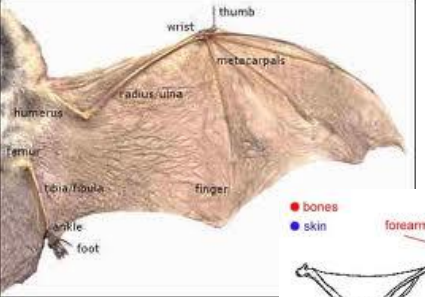
Order Chiroptera: Taxonomy & Evolution of Echolocation
o Previously subdivided into Microchiroptera and Megachiroptera
Recent phylogenetic finding support Yinpterochiroptera (Pteropodidae plus 5 echolocating families) and Yangochiroptera (all other echolocating bats)

Microchiroptera
• Supported by morphological and paleontological data everything else; most small; eat a diversity of food (fruit, insects, nectar, blood, pollen, frogs, fish, small mammals); all echolocate
At one point, Megachiroptera thought closely related to Primates
Megachiroptera
Eastern Hemisphere (Old World) fruit bats (1 family); possess a thumb claw on pollex; feed primarily on plant material; large eyes; large bats (wingspan 5.5 ft); no echolocation
Order Chiroptera: Phylogeny & Evolution of Echolocation
o Findings shed light on evolution of echolocation
• Acoustic orientation primary perception of environment (echolocation and vocalizations); Tragus and antitragus (ear projections) help with echolocation
o Evolved once & lost in Pteropodidae? Or independent evolution in Yin & Yang?
• Newest studies in 2009 point towards independent evolution of echolocation
o Flight and Echolocation were major keys to the success of bats (occupy same niches as birds, but at night; insects in flight novel resource)
o New, additional support convergent evolution in echolocation in bats AND cetaceans!
echolocation evolved twice in bats

Order Pholidota - Pangolins
o Fossils from the Oligocene/Miocene in Asia. Eocene records in Europe, Asia, and Africa; Oligocene records in North America
o Fossil from Java; specimen predicted to have been 7 ft long
o One family, nearly 10 species. Highly trafficked
o Occur in the tropics of Africa and SE Asia
o Some arboreal (prehensile tail), some not
o Convergence on ant-eating behavior; lack teeth
o Backs covered with large, overlapping (imbricate) scales – agglutinated hair (keratin)
o Ventrally, lack scales but have a sparse coat of fur
o Some can curl into ball when threatened
o Dentary lacks angular and coronoid processes
o Manus and pes with long recurved claws for digging
o Convergence on ant-eating behavior; lack teeth
Tongue extraordinarily long and muscular (arises from pelvis and last pair of ribs)
• Pyloric stomach thickened and muscular with keratinous spines projecting interiorly
Laurasiatheria Phylogeny
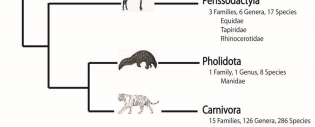
Pholidota & Carnivora
Order Carnivora: Evolutionary History
Derived from Creodonta
o All modern carnivorans have carnassial teeth or are derived from ancestor that did
o Stem group Creodonta were out-competed by daughter group, Carnivora
Derived from Creodonta
• Dominant late Cretaceous to the Miocene; Dinosaurs gone; large carnivores
• Possibly evolved in response to new food source (herbivores)
• Small brain cavity (know from skull casts)
• Earliest carnassial teeth in fossil record (multiple pairs)
o All modern carnivorans have carnassial teeth or are derived from ancestor that did
Carnassial pair 4th upper premolar, 1st lower molar. Shear and Slice
• By the Eocene, all carnivorans defined by presence of carnassial pair
• Radiation by late Eocene – reflected corresponding radiation of prey
• Phocidae (seals) secondarily evolved homodont teeth (fossil record w/ carnassial pair)
Order Carnivora: Taxonomy
Earliest Taxonomy (1800s): Carnivora (terrestrial) & Pinnipedia (aquatic)
o 1900s Taxonomy, merged to 1 order (Carnivora) with 2 subdivisions (suborders): Fissipedia (terrestrial) & Pinnipedia (aquatic)
o Monophyly of the Pinnipedia questioned 1960s, strongly supported now
o Newest Taxonomy: Feliformia (mongoose-like) & Caniformia (dog-like with a weasel-like ancestor)
o Pinnipeds monophyletic
o Not all carnivorans are carnivorous (some insectivores) and not all carnivorous mammals belong to the order Carnivora
o Distributed worldwide (Australian Carnivora probably introduced) and occupy a wide variety of terrestrial and aquatic habitats
Lots of recent systematic changes for Order Carnivora
New families (Nandiniidae and Eupleridae)
• Mephitidae recently elevated
• Ailuridae (red panda) controversial
Laurasiatheria Phylogeny
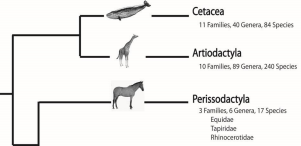
Perissodactyla & Artiodactyla
Order Perissodactyla: Characteristics
Do not ruminate (hindgut fermenters; expanded cecum); feed on fibrous vegetation of poor quality. Digestive efficiency of a horse about 70% that of a cow; eat more
o Evolutionary trend – decrease digits to 3 digits (2, 3, and 4) or 1 digit; Axis of symmetry of the foot passes though the large middle digit (Odd-toed or Mesaxonic); Most have 3 digits on hindfoot and 3-4 on forefoot
o Deep groove in the proximal surface of the astragalus (ankle bone) – creates a pulley-like surface that limits the limbs to forward-backward movement

Order Perissodactyla: evolutionary history
Evolved from Condylarthra-like mammals; earliest identifiable perissodactyl fossils from the Paleocene in Asia; Diversified and spread to Europe and North America by the Eocene (roughly 14 families recognized from this time). By the end of the Miocene, only 4 groups remained
Order Perissodactyla: Odd toed ungulates (Perissodactyla)
o Digits reduced to toes 2, 3, 4; extreme cases digit 3
o Axis of symmetry of the foot passes though the large middle digit (Odd-toed or Mesaxonic)
o Cannon bone (fusion 3rd & 4th metapodials)
1 hoove
Order Perissodactyla: Even-toed ungulates (Artiodactyla)
o Digits reduced to toes 2-5; extreme cases digits 3 &4
o Axis of symmetry between digits 3 &4 (even-toed or Paraxonic)
o Cannon bone (fusion 3rd & 4th metapodials)
Order Perissodactyla Odd-toed & Even-toed
Deep groove in the proximal surface of the astragalus (ankle bone) – creates a pulley-like surface that limits the limbs to forward-backward movement
Order Perissodactyla: Diversity
1) Family Tapiridae (Genus Tapirus) – Primitive with brachyodont cheek teeth. Like a large pig with a fleshy proboscis (uses proboscis to scoop up vegetation). Stands on 3 digits (little hooves on each digit). Three species in South America (tropic) and 1 species in SE Asia. Suggests tapirs were once widespread and current distributions are remnant populations (fossils in Texas, China, etc.). Fossils – evolved in North America in Eocene
2) Family Rhinocerotidae - Once very diverse and widespread (evolved in North America and Eurasia in Eocene). Extinct group Paraceratherium. Very large - one of the largest land mammals to ever live (5 m at shoulder). Probably browsers (based on teeth)
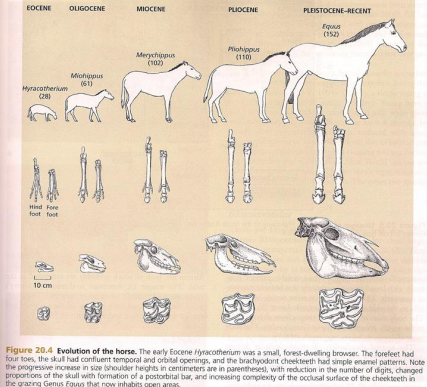
3) Family Equidae (horses, zebras, etc.) - First horses small and fox-like in the Eocene in North America. Simple, quadrate teeth and modestly enlarged third metacarpal
Order Perissodactyla Equidae Evolutionary History
Evolutionary history of Equus (Equidae) very clear. Lived in savannas and open areas (terrestrial) and had heavy bones. Equus thus conducive to fossilization (savannas and large size with heavy bones). Furthermore, often had herding habits; find one fossil, find more.

Order Perissodactyla Evolution & Trends
Majority of horse history in North America (occasional migrations to Asia and Europe, especially in the Pliocene).
General trends: increasing body size (too big for potential predators), lengthening of legs with an emphasis on the middle toe, widening of incisor, increase molarization (lophs and hypsodont)
North American plains mostly shrubs until the Miocene. Grasslands evolved: grasses made of silicon – abrasive to teeth. Sudden evolution of increased lophodonty and hypsodonty.
In the Miocene, horses very diverse. Pleistocene extinctions, every horse in North America extinct. Small group of horses (genus Equus) survived in Europe. This group evolved to all current species. Horses re-introduced to America from Spain in the 1500s.
Order Artiodactyla: Evolutionary History
Evolved from Condylarthra-like mammals. Fossil record goes back to the Eocene
o Terrestrial & Aquatic Forms
o Terrestrial dominance correlated with decline of perissodactyls
o Found worldwide (terrestrial forms not native Australia & Antarctica)
o Several suborders recognized: Suiformes, Tylopoda, Ruminantia, Cetacea
Unifying character: Astragalus in the ankle

Order Artiodactyla: Evolutionary History & Trends: Terrestrial
o Evolutionary trend: emphasize digits 3 and 4 (even-toed = split hoof)
o Extreme toe reduction in some groups (antelope and deer; cannon bone)
o Evolutionary trend: lengthened limbs and often digitigrade to increase speed
o When Perissodactyla radiating during the Eocene, Artiodactyla in the background, Not many species
o Now, terrestrial Artiodactyla much more diverse than Perissodactyla.
These two innovations may have allowed terrestrial Artiodactyla to go out to open areas, fill up with food, then go back to a safe area to chew up food (time exposure to predation reduced).
Perissodactyla had to chew right at moment of food intake.
(Artiodactyla) After evolution of grasslands (Miocene), more common & diverse via 2 innovations:
1) Evolution of double-pulley arrangement in lower leg (tendon extends across tip of leg bones creating a spring). Increases speed.
2) Ruminant/gastric digestion (Foregut). Digestion where animal chews food multiple times. Enabled early artiodactyls to chew, cough up, and chew (chew cud)
Advantage of chewing cud
eating low-energy food items. Multiple chewing gets all the energy out. Some with four-chambered stomachs and microorganisms are often present to decompose cellulose into digestible components
Order Artiodactyla Aquatic Forms: Cetacea
Aquatic Forms Evolutionary History
o Oldest fossils from coast of Pakistan in the mid-late Eocene (near Tethys Sea) o
Terrestrial ancestry and moved to an entirely, obligate aquatic life form (Sirenia also obligate)
Terrestrial ancestry and moved to an entirely, obligate aquatic life form (Sirenia also obligate) (Cetacea)
Rapid adaptation for aquatic life: vast increase in body size – life in water, even warm water, is very cold (water absorbs heat from a warm body about 27 times faster than air does); large size allows for heat retention (favorable surface area to volume ratio); blubber insulation; some problems in 0 C water with overheating
Increase in aquatic adaptations over time: decrease size and presence of hind limbs, evolution of flippers
Stream-lined bodies to reduce drag; telescoped skulls; echolocation
Order Artiodactyla Cetacea Evolutionary History
o Cetacean groups: 1 extinct (Archaeoceti) & 2 extant (Odontoceti and Mysticeti)
o Early Eocene, Archaeoceti in SE Asia/Northern Africa (stem cetaceans)
o Eocene/Oligocene – Evolution of toothed whales, Odontoceti (derived from Archaeoceti)
o Early Oligocene – Evolution of baleen whales, Mysticeti (derived from Archaeoceti)
o Daughter groups probably outcompete Archaeoceti
o Early Eocene, Archaeoceti in SE Asia/Northern Africa (stem cetaceans)
Primitive: No increase in number of teeth; heterodont dentition; external nares (opening to nostrils) located near tip of snout (rather than top of head); sacrum (pelvis region) somewhat vestigial (non-functional; hind limbs trailed behind).
• Earliest archaeocetes quadrupedal and terrestrial; Evolution of forelimbs as flippers
o Eocene/Oligocene – Evolution of toothed whales, Odontoceti (derived from Archaeoceti)
• First fossils in Australia, Europe, and New Zealand
• Carnivorous with large homodont dentition and increase in number of teeth
• Diverse (compared to Mysticeti)
o Early Oligocene – Evolution of baleen whales, Mysticeti (derived from Archaeoceti)
Earliest fossils from Australia
• Independent evolution from Odontoceti
• No teeth; baleen plates to filter food
Order Artiodactyla Cetacea Traits & Body Size

Order Artiodactyla Cetacea Traits.
Blue whale ear wax has rings, just like a tree. Can learn what is happening with a whale every 6 months using ear wax.
Can use the rings and the color of the wax to study:
•Biogeography
•Hormone levels (sexual maturity)
•Absorbed pollutants (certain ones)
Euarchontoglires Phylogeny
Euarchonta & Glires
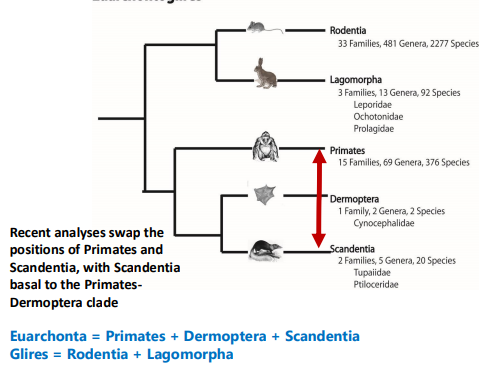
Euarchonta
Primates+Dermoptera+Scandentia
Glires
Rodentia+Lagomorpha
Order Dermoptera - Colugos
Fossils from the Eocene (Thailand)
o Indonesia, Philippines, etc. (SE Asia islands)
o “Flying Lemurs” commonly used common name
“Skin Wing”; 1-2 kg in size (very large squirrel)
o Family Cynocephalidae (“Cyno” Greek for dog)
o Furred Membrane neck, to digits of forelimbs, to tail
o Good gliders (even though large size)
Travel along branches to feed (upside down)
o Nocturnal and crepuscular (tree holes for refuge)
o Frugivorous and Folivorous
o Cryptic species on Sunda shelf
Colugos:Furred Membrane neck, to digits of forelimbs, to tail
Very extensive patagium
Use membrane as an air break (quadrupedal landings)
Colugos: o Good gliders (even though large size)
• Convergent on flying squirrels, sugar gliders
• Bad on the ground vs Flying squirrels
Colugos: o Frugivorous and Folivorous
• Lower incisors comblike (Pectinate)
• Intestinal tract 9x its head and body length
• Large cecum (microorganisms to cecal ferment)
Order Scandentia – Tree Shrews: Evolutionary history
o Origin obscure, only definitive fossils from Eocene in Asia
o Originally grouped with insectivores, but look primate-like
• Considered primitive living primates
o Two families, Tupaiidae and Ptilocercidae
o SE Asia distribution
Order Scandentia – Tree Shrews: Facts
Diurnal, Arboreal, Omnivorous (mostly fruits and invertebrates)
o Extensive scent-marking
o Superficially resemble squirrels, but with a more slender snout
o Upper incisors caniniform, Lower incisors procumbent for grooming
o Prominent hole in the zygomatic arch
o Primate-like characters include large braincase and presence of postorbital bar
o Tupaiidae – parental care minimal (absentee parental care)
Order Primates Evolutionary Trends
o Obscure origins – early radiation in Cretaceous when everything looked insectivoran (shrew)
Shared derived characters: locomotion, stereoscopic vision, brain characters, reproduction, dentition, auditory characters → leading towards arboreal lifestyle
o Major trend: terrestrial dwelling insectivores to arboreal omnivores. Arboreal ancestry explains adaptations of the visual system, skeletal system, etc.
o Minor trends: terrestrial again (open plains dwellers and forest ground; late transition)
o Most primates have a boney post-orbital bar with eyes generally directed forward
o More dependence on sight (larger brain areas associated with vision); less dependence on olfaction
o Molars largely bunodont and brachyodont
Primates were early shrews
May have originated in Asia (using distributions/fossils of Scandentia & Dermoptera)
• Early primate Purgatorius and Plesiadapis; Plesiadapiformes
• Earliest radiation in Europe and N. America Paleocene/Eocene
• Fossil remains of New World monkeys are rare (40-45 mya)*
Order Primates Phylogeny
Suborders
Haplorrhini
Strepsirrhini

Order Primates: Suborder Strepsirrhini
lemurs, lorises, galagos, aye-aye, and relatives (Daubentoniidae, Cheirogaleidae, Lemuridae, Indriidae, Lepilemuridae, Galagidae, Lorisidae)
o Concentrated in Madagascar, Africa, SE Asia; unclear origins
Presence of naked rhinarium (primitive characteristic), area of moist, hairless skin surrounding the nostrils & unfused nasal prominences and slitlike nostrils
o Presence of toothcomb (lower incisors and canine teeth) – used for grooming
Toothcomb secondarily lost in Daubentoniidae
o Grooming claw on the second digit of foot
o Bicornuate uterus and epitheliochorial placenta
Eye-eyes are weird
Wet nose
Order Primates Suborder Haplorrhini
monkeys, apes, tarsiers (Cercopithecidae, Hominidae, Hylobatidae, Aotidae, Atelidae, Cebidae, Pitheciidae, Tarsidae); used to be called Anthropoidea
Africa, Asia, Central and South America
o Post-orbital plate
o Spatulate incisors
o Nostrils ringed and dry hairy noses
o Distinctive differences in visual and olfactory systems vs Strepsirrhini
Invasive, hemochorial form of a placenta
o Breakdown Western Hemisphere (New World) and Eastern Hemisphere (Old World) families (within groups Platyrrhini vs. Catarrhini)
Dry nose (fur)
Order Primates Haplorrhini Groups
Platyrrhini
Catarrhini

Order Primates Haplorrhini Dichotomy
Western Hemisphere (New World) Haplorrhini = Platyrrhini
Eastern Hemisphere (Old World) Haplorrhini = Catarrhini
Western Hemisphere (New World) Haplorrhini = Platyrrhini
o Families Aotidae, Atelidae, Cebidae, Pitheciidae
o Nostrils point to the side
o Nearly all have 6 cheek teeth (3 premolars and 3 molars)
Eastern Hemisphere (Old World) Haplorrhini = Catarrhini
o Families Cercopithecidae, Hominidae, Hylobatidae
o Nostrils point down
o All have 5 cheek teeth
Order Primates Haplorrhini Evolutionary History
Primates evolve from Eastern Hemisphere (Old World) Primates? Eocene Split (~34-36 my)
o Too similar for South American and African primates to evolve independently
o But no suitable fossil in Africa for that time that is ancestral to South American primates; Could be gap in fossil record
o Arrived from Africa when continents were closer (1,000 km closer) & currents favorable, perhaps via rafting, island hopping at lower sea levels
• 1 kg (2.2 lb) primate could have survived 13 days on a raft of vegetation
Primate Color Vision
Hypothesis: ancestral haplorhines nocturnal
• Descendants invade diurnal niche, then comes three-color vision
• New data: stem haplorhines had three-color vision before becoming diurnal
• Examined opsin genes in tarsiers
• Data support ancestors of tarsiers had trichomatic vision, the same type found in living monkeys and apes
• Trichomatic vision usually associated diurnal lifestyle
• Indicates early tarsiers may have been adapted to dim light
Order Primates Big Lemurs
Most extinct lemurs were giants compared to living species. The largest living lemur today weighs about 20 pounds; the largest extinct lemurs clocked in at about 350 pounds, as big as a silverback male gorilla.
The largest extinct lemur, Archaeoindris, had similar anatomy to giant ground sloths that went extinct in North and South America.
Archaeoindris
was the largest of the sloth lemurs, and the largest known lemur. It weighed approximately 160 kg (350 lb).
Order Primates: New Species Part 1
Lesula & White-cheeked macaque
Cercopithecidae
Lesula: Cercopithecus lomamiensis
Central Democratic Republic of Congo (DRC)
Second primate species discovered in Africa in the last ~30 years
Initially found in 2007 (encountered as a pet)
Big for conservation in the Congo
General conservation issues for all primates: habitat loss, disease spread (Ebola, SIV/HIV
Order Primates: New Species Part 2
Gibbon and Orangutan
• Skywalker hoolock gibbon, Hoolock tianxing
• China; Published: 2017
• Named after Star Wars based on high treetop home and mysticism in Chinese history
• Geographically isolated from other species
• Genetic and morphometric analysis using museum specimens
o Eyebrow characteristics
o Shape of skulls and teeth
• IUCN: Endangered
Human evolutionary History
Were 4 species of the genus Homo as recently as 30,000 years ago
Sapiens
Neanderthalensis
Floresiensis
Heidelbergensis
Order Lagomorpha – Rabbits & Hares: Evolutionary History
Think derived from early placentals
o Earliest fossils from late Paleocene of Mongolia
Radiated in Asia during the Paleocene
o Leporidae: rabbits and hares; worldwide distribution except Australia (introduced!)
o Ochotonidae: pikas
o Lagomorphs and Rodents close relatives (Glires)
Coprophagous (enhances ability to survive on low-quality vegetation; hindgut fermenter)
o Fenestrated skull
o Lagomorphs and Rodents close relatives (Glires)
Both with a large diastema (gap between incisors and cheek teeth)
• Lagomorphs with 2 pairs of upper incisors (young with 3rd pair; drops out after birth)
• Males do not have a baculum & testes in scrotum positioned in front of penis
Order Rodentia: Evolutionary History
“Rodere” Latin for “to gnaw”
o Early group, dating back to the Paleocene of North America and Eurasia
o Oldest known rodents, Paramyidae, Alagomyidae, and Ischyromyidae
o Looked insectivorous; had beginnings of rodentlike incisors
o Large temporalis muscle, masseter muscles not highly specialized
o Early success – Highly abundant in the Eocene in North America and Eurasia
o Found in fossil deposits that did not contain members of Multituberculata. Rodents evolved in isolation from multituberculates; came in contact later; Eocene, adaptive radiation; out-compete Multituberculates
o Rapid radiation, difficult to determine higher-level relationships within Rodentia
Order Rodentia: Diversity & Characteristics
Most diverse order of living mammals (2nd most speciose = bats); cosmopolitan
o 5 Suborders. Different groupings based on jaw morphologies (sciuromorph, myomorph, and hystricomorph; sciurognathous and hystricognathous)
Many different occlusal cusp patterns and wide variety of diets
o Coprophagy common (in hindgut fermenters)
o Terrestrial; but also arboreal, gliding, aquatic, saltatorial, and fossorial forms
o Lots of variation in lifestyles and size (5 grams to 50 kgs)
o Economically important
o Distinguishing features of Rodents
1 pair blade-like upper and lower incisors, grossly enlarged – adaptation for gnawing
• Diastema between incisors and cheek teeth
• 3, sometimes 4, cheek teeth; No canines; rarely more than 2 pairs of premolars
Order Rodentia: Infraorbital Foramen

Order Rodentia: Jaw Morphology
A. C. Sciurognathi
B. D. Hystricognathi

A. C. Sciurognathi
alveolus in line with or medial to point of origin in angular process
B. D. Hystricognathi
alveolus lateral to point of origin in angular process
Order Rodentia: New Species
Paucidentomys vermidax
Lives in wet, mossy forests at high elevation in Indonesia
Unique among rodents:
▪No molars
▪Fang-like incisors
▪Sucks up earthworms by sticking nose into ground

Current Mammalian Taxonomy
Higher Level Taxonomy (extant groups)
Class: Mammalia
Subclasses: Prototheria, Theria
Theria Infraclasses: Metatheria, Eutheria
Theria Superorders: Marsupialia, Xenarthera, Afrotheria, Euarchontoglires, Laurasiatheria
Orders: 27
Why “Species”?
We are confronted with (a) a stupendous number of existing individuals, and with (b) their immense diversity. Hence, a coherent knowledge of the living world is possible only with the aid of a hierarchic classification.” -Dobzhansky (1935)
Impractical to describe individuals; have to organize diversity of individuals
Taxonomy
The practice of naming and classifying organisms. Science of naming groups. Taxo = Group; Nom = Name.
Classification is the ordering of species into groups and naming the groups
Systematics
Science of classifying organisms based on their evolutionary relationships
Binomial Nomenclature
A system for naming all organisms in which there are two names, one for the genus and one for the species
What is a Species? Easy to Define?
Very broad: populations on different evolutionary paths with no gene flow
o “The often dreamed of magic is a compelling definition of ‘species’ that fits our understanding of the causes of biological diversity and that leads us to identify species accurately and agreeably.” -Hey (2001)
• Sometimes easy
Most of time not easy
o What criteria can we apply to real populations?
“Species are groups of actually or potentially interbreeding populations, which are reproductively isolated from other such groups.” -Mayr (1942)
Mechanisms of Isolation
Prezygotic
o Postzygotic
o Postzygotic
Hybrid inviability: hybrid dies
• Hybrid sterility: hybrid unable to reproduce
Prezygotic
Habitat isolation: potential mates isolated in space
• Seasonal isolation: potential mates mating at different times, active different times of day
• Behavioral isolation: meet but won’t mate with each other
• Mechanical isolation: physical parts incompatible
• Gametic mortality: egg isn’t fertilized
Biological Species Concept Issues
Not applicable to asexual reproducers
o Not applicable to fossils
o “Potentially” interbreeding?

Phylogenetic Species Concept
“A phylogenetic species is an irreducible cluster of organisms, diagnosably distinct from other such clusters, and within which there is a parental pattern of ancestry and descent.” -Cracraft (1983)
Phylogenetic Species Concept Issues
o Need a phylogeny
o What do “irreducible cluster” and “diagnosably distinct” actually mean?
o Still need other evidence
Variation in Numbers Across Taxa
Variation in numbers of species across mammals
Lack of radiation vs rapid radiations
Why Does “Species” Matter?
basic and applied science
conservation
Peromyscus maniculatus Cryptic Species? Who Cares?
Disease Ecology:
Lyme disease
hantavirus
covid
Can better make vaccines at higher elevations

o Conservation—What are we trying to conserve?
• Conservation initiatives focused on species or populations within species
Hair
uniquely mammalian
nonliving structure
Epidermal cells surrounded by a sheath of keratin (alpha)
Keratin is a protein that protects epidermal cells; insoluable
Keratin
Fibrous structural protein found in hair, horns, claws, hooves; also protects epidermal cells from stress and damage.