Basic Dysrhythmia Course Exam
 Call Kai
 Learn
 Practice Test
 Spaced Repetition
 Match
 Flashcards
 Knowt Play
1/100

There's no tags or description
Looks like no tags are added yet.
101 Terms
SA node
the major pacemaker of the heart
60-100
inherent rate of the SA node
40-60
inherent rate of the AV node
20-40
inherent rate of the ventricles (purkinjie fibers)
systole
phase of contraction
diastole
phase of relaxation
p wave
what does atrial depolarization show on the ECG?
QRS complex
what does ventricle depolarization show on the ECG?
T wave
what does repolarization show on the ECG?
increase
what does sympathetic stimulation do to the heart rate?
decrease
what does parasympathetic stimulation do to the heart rate?
absolute refractory period
the period immediately following the firing of a nerve fiber when it cannot be stimulated no matter how great a stimulus is applied
relative refractory period
during the ventricular cardiac cycle when all cardiac cells are not fully repolarized and a strong enough stimulus can excite cardiac tissue and initiate arrhythmias
last half of t wave
When is the relative refractory period of the ventricles?
.20 secs
how much time is one large box in an ecg strip?
.04 secs
how much time is one small box in an ecg strip?
0.12-0.20
normal range of PR interval
0.04-0.12
normal range of QRS complex
less than 1/2 the preceding R-R interval
what is the normal time of the QT?
p to p
how do you measure the atrial rate?
R to R
how do you measure the ventricular rate?
sinus rhythm

sinus bradycardia

assess pt
atropine
pacing
IV, O2
tx for sinus bradycardia
sinus tachycardia

treat underlying cause (Fever, pain, hypoxia)
tx for sinus tachycardia
sinus arrhythmia
irregular rhythm that varies with respiration; rate increases with inspiration and decreases with expiration
Premature Atrial Contraction
rhythm with an early P wave, but the next P wave comes on time
Premature Atrial Contraction (PAC)

continue to monitor
check electrolytes and oxygen
possible betablocker/calcium channel blocker
tx for PAC
Atrial Tachycardia
atrial Rate: 160-250 beats per minute, reglular rhythm/QRS/
betablockers/calcium channel blocker
cardioversion
adenosine**
vagal manuever
tx for atrial tachycardia
atrial flutter

atrial flutter
atrial rate of 250-350
"saw tooth pattern"
atrial flutter
complete heart block
which rhythms do you HAVE to use the exact rate measurement card?
betablockers/calcium channel blockers
cardioversion
anticoagulants
amiodarone
**call HCP if new onset
tx for atrial flutter
atrial fibrillation

betablockers/calcium channel blockers
cardioversion
anticoagulants
amiodarone
**call HCP if new onset
tx for atrial fibrillation
atrial fibrillation
irregular rhythm, atrial rate of 350-400, no P waves,
RVR (Rapid Ventricular Response)
A. Fib with ventricular rate > 100
SVT

adenosine
cardioversion
vagal maneuver
tx for SVT
SVT
rate >100 originating above the ventricles; No P waves seen
paroxysmal atrial tachycardia
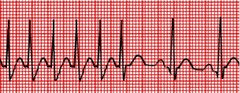
paroxysmal atrial tachycardia (PAT)
Atrial tachycardia that starts and stops suddenly
betablockers/calcium channel blocker
cardioversion
adenosine**
vagal manuever
tx for PAT
Junctional Dysrhythmias
dysrhythmias that originate in the AV junction around the AV node or Bundle-of-His, when the SA node fails
Junctional Rhythm

junctional rhythm
rate 40-60, inverted/absent P waves
assess pt
withhold digoxin
potassium replacement
atropine
pacing
tx for junctional rhythm
Accelerated Junctional Rhythm

Accelerated Junctional Rhythm
rate 60-100, p waves inverted/absent
Junctional Tachycardia
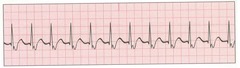
junctional tachycardia
rate >100, p waves absent/inverted
withhold digoxin
potassium replacement
pacing
tx for accelerated junctional rhythm
hold digoxin
beta blocker/calcium channel blocker
amiodarone
cardioversion
O2/IV
tx for junctional tachycardia
Ventricular dysrhythmias
originate in the ventricles below the Bundle of His usually associated with wide bizarre QRS-complexes
premature ventricular contraction (PVC)
wide QRS > 0.12, inverted T wave,
premature ventricular contraction (PVC)

check electrolytes/oxygen/meds
amiodarone
lidocaine
tx for PVC
ventricular tachycardia
rate 100-250, regular r-r rhythm, wide QRS >0.12
ventricular tachycardia

R on T - can cause v. tach!
what can happen if a PVC occurs in the relative refractory period?
code
CPR
defib
Epi
amiodarone
tx for v. tach
ventricular fibrillation

ventricular fibrillation
chaotic irregular rhythm, unmeasurable rate, no QRS/P/T
code
CPR
defib
Epi
amiodarone
tx for V.Fib
Torsades de pointes

code
CPR
defib
magnesium
**NO AMIODARONE**
tx for torsades de pointes
magnesium
which electrolyte is often associated with torsades de points?
Idioventricular Rhythm

Idioventricular Rhythm
rate 20-40, absent p wave, wide QRS>0.12
pacing
atropine
correct underlying cause (hypoxia, drugs)
tx for idioventricular
Accelerated Idioventricular Rhythm

asystole

Accelerated Idioventricular Rhythm
rate 40-100, wide QRS>0.12
code
CPR
epi
fix cause (hypoxia, hypovolemia, hypokalemia, hypothermia)
tx for asystole
atropine if slow
pacing
treat underlying cause (hypoxia, drugs)
tx for accelerated idioventricular
in two lead!!!
how do you confirm asystole?
prolonged PR interval
prominent U waves
ECG signs of hypokalemia
tall peaked T waves
widened QRS
ECG signs of hyperkalemia
Short QT interval
ECG signs of hypercalcemia
prolonged QT interval
ECG signs of hypocalcemia
chamber paced
what is the first letter of the pacing code?
chamber sensed
what is the second letter of the pacing code?
mode of operation
what is the third letter of the pacing code?
atropine
vagolytic stimulator that increases HR
epinephrine
vasopressor used during cardiac arrest
First degree heart block
PR greater than 0.20 consistently, normal QRS,
second degree heart block type 1 (wenckebach)
Atrial rate is greater than ventricular rate, P-P is regular, *PR progressively lengthens until QRS is dropped*
second degree heart block type 2
P waves come on time and PR interval is constant, but a QRS is dropped,
third degree heart block
R-R is constant and p-p is constant, but they aren't talking to each other (coming whenever they want)
milliamps or volts
what is output measured in for pacemakers?
millivolts
what is output measured in for pacemakers?
failure to capture

failure to sense

failure to sense
failure or pacemaker to appropriately sense the patients own intrinsic electrical signal - spikes where you don't need them to be
atropine
pacing
hold causative meds (dig, ca channel blockers, beta blockers)
epi drip
tx for complete heart block
atropine
pacing
hold causative meds (dig, ca channel blockers, beta blockers)
tx for second deg heart block
reposition leads
increase output
tx for failure to capture