gtc micro lab final ALL EXERCISES 15-20
 Call Kai
 Learn
 Practice Test
 Spaced Repetition
 Match
 Flashcards
 Knowt Play
1/150

There's no tags or description
Looks like no tags are added yet.
151 Terms
how are zones of inhibition measured?
in millimeters
at what temperature are bacteria and tubes incubated at?
37 degrees C
what type of bacteria does our antibiotic sensitivity exercise test? (gram + or -)
both gram + and gram -
what range of microorganisms do broad spectrum antibiotics target?
a wide range; used when cause of infection is unknown
what range of microorganisms do narrow spectrum antibiotics target?
target one particular agent when cause of infection is known
define bacteriostatic antibiotics
antibiotics that inhibit/stop the GROWTH of bacteria
define bactericidal antibiotics
antibiotics that kill the bacteria
name 5 antibiotic modes of action
-inhibit cell wall
-interfere with 70s ribosome
-damage prokaryotic cell membrane
-interfere with nucleic acid synthesis
-block prokaryotic metabolism
why is it optimal to use a spread plate to test antibiotic sensitivity?
an even lawn of bacteria allows an accurate and measurable zone of inhibition to evaluate antibiotic sensitivity
which inoculating tool/transfer instrument do we use for antibiotic sensitivity testing to push the disc into the agar?
alcohol-flamed forceps
what is the purpose of the oxygen requirements experiment?
to classify bacteria based on their requirements for oxygen
name the 4 classifications for bacteria based on their oxygen requirements?
obligate aerobes, obligate anaerobes, facultative anaerobes, microaerophilic anaerobes
what type of bacteria require the prescence of oxygen to grow?
obligate aerobes
what type of bacteria cannot grow in the prescence of oxygen?
obligate anaerobes
what type of bacteria can only tolerate small amounts of oxygen?
microaerophilic anaerobes
what type of bacteria grow well in aerobic and anaerobic conditions?
facultative anaerobes
what type of inoculating tool/transfer tool will we use for the oxygen requirements experiment?
inoculating loop

these bacteria were placed into an aerobic environment. what can we conclude about the oxygen requirements of bacteria #1?
it is an obligate anaerobe

these bacteria were placed into an aerobic environment. what can we conclude about the oxygen requirements of bacteria #5?
it is a facultative anaerobe

these bacteria were placed into an aerobic environment. what can we conclude about the oxygen requirements of bacteria #9?
it is an obligate aerobe

these bacteria were placed into an anaerobic environment. what can we conclude about the oxygen requirements of bacteria #1?
it is an obligate anaerobe

these bacteria were placed into an anaerobic environment. what can we conclude about the oxygen requirements of bacteria #5?
it is a facultative anaerobe

these bacteria were placed into an anaerobic environment. what can we conclude about the oxygen requirements of bacteria #9?
it is an obligate aerobe
what is the purpose of selective media?
inhibits the growth of a specific group of microbes while allowing the growth of another specific group of microbes
what is the purpose of differential media?
differentiates between closely related organisms using differences in growth patterns/biochemical changes
what kind of test is a hemolysis test?
a differential test
what is the purpose of the hemolysis test?
determine what bacteria have the ability to breakdown Red Blood Cells
what species of bacteria is the hemolysis test used to differenciate?
Streptococcus species
what type of inoculating tool/transfer tool is used to perform the hemolysis test?
an inoculating loop
what will a blood agar plate look like if a bacteria incubated on it was beta hemolytic, and why?
a clear ring would be observed around the colonies, because beta hemolysis is the most aggressive
what will a blood agar plate look like if a bacteria incubated on it was alpha hemolytic, and why?
a green hue would be observed around the colonies, because these bacteria result in the discoloration of red blood cells to a green color instead of hemolysis
what will a blood agar plate look like if a bacteria incubated on it was gamma hemolytic?
no change on the blood agar
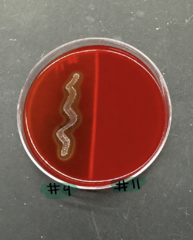
this bacteria was plated and incubated on a sheep blood agar. what type of hemolysis does #4 exhibit?
beta hemolysis
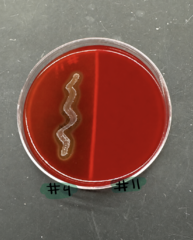
this bacteria was plated and incubated on a sheep blood agar. what type of hemolysis does #11 exhibit?
gamma hemolysis
what type of test is the MSA (mannitol/salt agar) test?
a selective AND differential test
how can the mannitol/salt agar test be selective and differential at the same time?
it allows gram POSITIVE salt-loving (halophiles) staphylococci to grow, but differentiates them based on their ability to ferment the sugar mannitol
what inoculating tool/transfer tool is used for the mannitol/salt agar test?
an inoculating loop
what is the PH indicator used for the mannitol/salt agar test?
phenol red
how will the mannitol/salt agar appear if the bacteria has positive mannitol fermentation?
it will appear yellow
how will the mannitol/salt agar appear if the bacteria has negative mannitol fermentation, but doesn't die?
reddish/pink color
what types of bacteria can grow on a mannitol/salt agar?
gram positive cocci
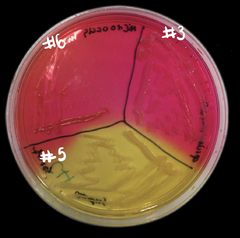
these bacteria were placed in a mannitol/salt agar. what can we conclude about #5?
it is positive for mannitol fermentation

these bacteria were placed in a mannitol/salt agar. what can we conclude about #3?
it is negative for mannitol fermentation
(since it grew, it must be a staphylococcus species)

these bacteria were placed in a mannitol/salt agar. what can we conclude about #6?
it is negative for mannitol fermentation
(since it did not grow, probably not a staph species)
what is the purpose of the Eosin Methylene Blue (EMB) test?
to differentiate between gram negative lactose/nonlactose fermenters
what type of bacteria does the Eosin Methylene Blue (EMB) Agar allow for the growth of?
gram negative lactose/nonlactose fermenters
how is the Eosin Methylene Blue Agar (EMB) selective and differential at the same time?
it inhibits the growth of gram positive bacteria and allows the growth of gram negative bacteria
what might an Eosin Methylene Blue (EMB) agar plate look like when it has a positive lactose fermenter result?
trail of colonies that are dark purple/pink and sometimes a green metallic color on top
what might an Eosin Methylene Blue (EMB) agar plate look like when it has a gram negative bacteria but no lactose fermenting properties
clear bacterial growth
which bacteria is most commonly known for producing dark purple/pink colonies and a green metallic color?
Escherichia Coli (E.Coli)

these bacteria have been plated and incubated on an EMB agar plate. what can we assume about #6?
it is a lactose fermenting gram-negative bacteria
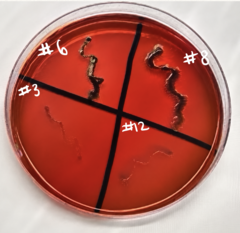
these bacteria have been plated and incubated on an EMB agar plate. what can we assume about #12?
it is a non-lactose fermenting gram-negative bacteria

these bacteria have been plated and incubated on an EMB agar plate. what can we assume about #3?
it is not a gram negative bacteria
what inoculating tool/transfer tool is used to perform the Eosin Methylene Blue Agar (EMB) test?
an inoculating loop
the presence of what molecule allows the EMB agar to be a differential medium?
lactose
what type of bacteria posess the cytochrome c OXIDASE enzyme
only obligate aerobes (not even facultative anaerobes)
what is the purpose of the oxidase test?
to classify a bacteria's tolerance to air
what is the function of the cytochrome oxidase?
acts as an electron carrier in a set of electron carriers called cytochromes
what bacteria is the oxidase test generally used to differenciate?
pseudomonadaceae or enterobacteriaceae
what inoculating tool/transfer tool is used for the oxidase test?
the wooden end of a cotton swab

what can be assumed about the bacteria on side A?
they contain the cytochrome C oxidase enzyme, meaning they are obligate aerobes

what can be assumed about the bacteria on side B?
they do not contain the cytochrome C oxidase enzyme, meaning they are anaerobic
what is the purpose of the catalase test?
identify bacteria that carry the enzyme catalase & are obligate aerobes
what term describes bacteria that produce oxygen + bubbles in the presence of hydrogen peroxide?
catalase positive
what does a positive catalase test indicate about a bacteria?
it is an obligate aerobe
what inoculating tool/transfer tool is used for the catalase test?
the wooden end of a cotton swab
what is the formula that describes the breakdown of hydrogen peroxide with catalase?
2H2O2 -> 2H2O + O2

how would you describe bacterium A?
catalase negative
what is the purpose of the amylase test?
determine wether a bacterium produces amylase, an enzyme that breaks down starch
after incubation, which solution will be added into a starch agar plate to determine the prescence of amylase?
Lugol's Iodine
what would a starch agar plate look like in the presence of amylase?
it would produce a clearing under the bacteria, meaning its amylase broke down the starch
what would a starch agar plate look like in the absence of amylase?
it will turn dark brown/black (iodine solution will cause the color change)

these bacteria were inoculated on a starch agar plate. what can be assumed about the enzyme bacteria A produced?
it produced amylase and broke down the starch in the agar plate

which bacteria is amylase positive?
bacteria A

which bacteria is amylase negative?
bacteria B
what is the purpose of the urease agar test?
determine if a bacteria can break down urea and survive acidic environments
what is the name of the PH indicator that is present in the urease agar test?
Phenol Red
what inoculating tool/transfer tool is used for the urease agar test?
inoculating needle for stab and streak technique
what color does the PH indicator phenol red turn at alkaline PHs?
red/pink
what color does the PH indicator phenol red turn at acidic PHs?
yellow
what color would a urea broth turn in the presence of urease activity, and why?
a red/pink color, indicating the breakdown of Urea into ammonia (a base)
what color would a urea broth turn in the absence of urease activity, and why?
it would remain yellow orange, indicating a negative urease test

these bacteria were placed in a urea agar tube. what can be concluded about tube A?
it is urease positive, meaning it broke urea down into ammonia

these bacteria were placed in a urea agar tube. what can be concluded about tube B?
it is urease negative, meaning it did not break urea down into ammonia
what type of test is the lethicinase test?
a differential test
how is the lethicinase test differential?
it differentiates between two gram positive bacillus-shaped bacteria that can be difficult to tell apart
what inoculating tool/transfer tool is used for the lethicinase test?
an inoculating loop
what type of agar is used to determine wether or not a bacteria has lethicinase, and why?
mannitol egg yolk polymyxin (MYP) agar
Egg yolk: detects lecithinase
Polymyxin: inhibits many other bacteria, separating gram positive bacilli
Mannitol: tests carbohydrate source of the media
what would an MYP agar look like in the presence of lethicinase?
white/pink precipitate around colonies
what would an MYP agar look like in the absence of lethicinase, and why?
yellow precipitate around colonies due to the fermentation of the mannitol present in the agar

these bacteria were inoculated onto a Mannitol egg yolk polymyxin (MYP) agar. what can be concluded about bacteria A?
they are lethicinase positive and broke down the egg yolk component of the agar

these bacteria were inoculated onto a Mannitol egg yolk polymyxin (MYP) agar. what can be concluded about bacteria B?
they are lethicinase negative, but fermented the agar's mannitol, producing a yellow precipitate
what is the purpose of the triple sugar iron (TSI) test?
to identify bacteria that can ferment carbohydrates and produce hydrogen sulfide
what is the PH indicator involved in the TSI agar test?
phenol red
what inoculating tool/transfer tool is used for the TSI agar test?
an inoculating needle to use the stab and streak technique
what type of bacteria is TSI agar used to differentiate?
gram-negative rod shaped bacteria based on sugar fermentation and hydrogen sulfide production
what color would a TSI agar test look like if the bacteria fermented one or more of the carbohydrates, but does not combine with iron to produce hydrogen sulfide?
the media would turn yellow
what color would a TSI agar test look like if the bacteria fermented one or more of the carbohydrates and produces hydrogen sulfide?
the media would turn yellow and black
what color would a TSI agar test look like if the bacteria did not ferment any of the carbohydrates, and did not produce hydrogen sulfide?
the media would stay red
what color would a TSI agar test look like if the bacteria did not ferment any of the carbohydrates, but combined with iron to produce hydrogen sulfide?
the media would turn black